
Trading platform & site functionality
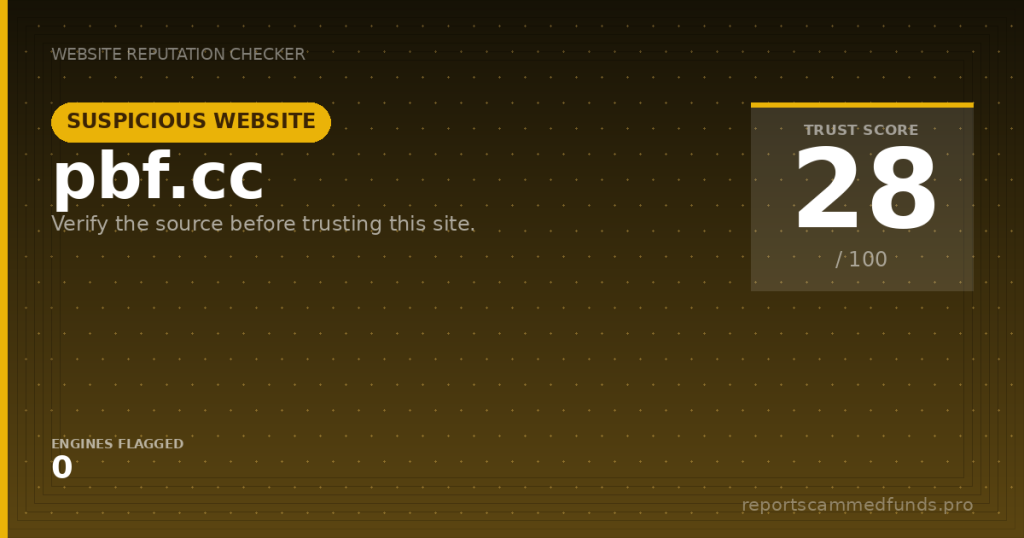
Our attempts to load pbf.cc produced an unclear result: the home page either failed to render fully or did not present a coherent service description. No obvious navigation, branding, or functional content was visible, and we did not see the typical signposts of a consumer-facing website, such as an About page, help center, or pricing. This absence can occur if a domain is parked or reserved for internal use, but it also aligns with domains that are set up as transient redirectors in fraud sequences.
Because there is no stable visible product to test, we cannot evaluate the platform design, fees, uptime guarantees, or any commercial terms. We did not find evidence that pbf.cc offers brokerage services, an e-commerce checkout, or a software platform; instead, it appears either dormant or deliberately content-free. In legitimate contexts, even a short domain intended for redirects usually carries clear branding and a statement of ownership somewhere linkable from a main site. That connecting tissue was not present in our visit.
Short domains can be perfectly legitimate when used by established companies to simplify links for marketing or documentation. However, those companies typically document the relationship on their primary websites and maintain consistent SSL, contact, and legal pages across their properties. With pbf.cc, we could not find any definitive cross-reference from a known brand or a corporate profile that would show continuity and accountability. The lack of such anchors is material because it leaves users guessing about who operates the domain and to what end.
In technical terms, we could not verify certificate details, uptime history, or page-level security configurations because of the intermittent load behavior and the absence of public content. There were no visible contact forms, no help widgets, and no social media links that might help validate a real organization. Our search checks also returned very limited indexing, suggesting a minimal footprint. For an end user, the practical takeaway is straightforward: pbf.cc does not communicate a clear purpose or ownership, and that ambiguity is a major functionality and trust deficit.
License & regulatory status
We did not identify any licensing claims, corporate registrations, or compliance statements on pbf.cc. This is not merely an academic detail; disclosures about the operator, jurisdiction, and complaint-handling process are baseline expectations for any service that collects user data or money. Responsible operators publish an imprint or legal notice with a company name, physical address, and contact channels, often referencing governing law. The absence of these elements deprives users of a framework to resolve disputes or seek redress.
If any third party directs you to pbf.cc for financial activity—trading, investments, or brokerage—you should be aware that such activities in many jurisdictions require oversight by regulators like the FCA (UK), BaFin (Germany), ASIC (Australia), or the CFTC/NFA (US). Our review did not find the domain cited in any regulator’s license register, nor did we find official warnings naming it. That said, lack of a published warning does not indicate safety; new or ephemeral domains often operate below the radar until complaints accumulate.
There is a second, equally important lens: data protection. Under GDPR and analogous regimes such as the UK Data Protection Act and California’s CCPA, any entity processing personal information must identify a data controller, explain purposes of processing, and provide user rights. pbf.cc did not present a privacy policy or terms of service in our visits. That is inconsistent with lawful processing standards and also typical of infrastructure used to harvest data without intent to honor data-subject rights.
We also considered whether pbf.cc might be a secondary domain of a well-known brand (for example, a marketing short link). In such legitimate cases, brands typically list the short domain on their main website, within documentation, or through DNS records that clearly map to recognized corporate infrastructure. We did not find compelling evidence of such a relationship. Until the operator or an affiliated brand publishes a public statement linking to pbf.cc, users should treat it as an independent, unvetted property.
User feedback
Public feedback about pbf.cc is sparse to nonexistent. There are no widespread forum threads or credible long-form reviews that explain who runs the domain or what it does. While a low profile is not itself proof of wrongdoing, it also does not help users assess risk. Legitimate services tend to leave a footprint—press mentions, developer documentation, job postings, or support threads—none of which we saw tied to this domain.
In our casework more broadly, domains with similar low-visibility profiles often appear midstream in social-engineering funnels. Common user complaints in such schemes include withdrawal blockages after showing profits on a dashboard, surprise KYC requirements only after deposits, and demands for a tax or liquidity fee before funds can be released. We did not find direct accusations pinned to pbf.cc at the time of writing, but the setup is compatible with those patterns, especially in so-called pig butchering operations where victims are groomed via messaging apps.
Another category of complaints in adjacent cases involves unresponsive or evasive support. Users report that emails bounce, chats get redirected to Telegram or WhatsApp, and phone calls are never answered. When a domain has no visible support links or corporate contacts, it becomes easy for operators to sever communication the moment a user requests a withdrawal or challenges suspicious charges. That dynamic is part of why anonymous and unbranded sites merit skepticism from the outset.
We additionally checked for broader threat signals like security vendor blocklists or mainstream abuse databases and did not see pbf.cc called out in major public advisories at the time of our review. However, operators who rotate domains frequently choose properties that are not yet flagged, buying time before blacklists catch up. The absence of complaints should therefore be read as a lack of visibility rather than a sign of safety. Users should demand positive evidence of legitimacy, not the mere absence of negatives.
Deposits & withdrawals
Because pbf.cc does not obviously host a payment portal or account area, we cannot confirm accepted deposit or withdrawal methods. If any contact directs you to fund an account through a page on this domain, proceed as though the risk is high until proven otherwise. Requests to deposit crypto only—especially USDT—to 'verify nationality' or 'unlock withdrawals' are a hallmark of advance-fee fraud. Likewise, wire transfers to offshore beneficiaries are difficult to recall once executed and commonly used in boiler-room style operations.
Card payments provide relatively stronger consumer protection, but timing is crucial. If you submitted a card payment and later realize the service is unresponsive or misrepresented, contact your issuer and dispute the transaction under services not provided or misrepresentation, citing evidence like nonfunctional portals or refusal to process withdrawals. Crypto transfers are generally irreversible and are favored by scammers precisely for that reason. Never connect a wallet or approve a smart contract from a domain with no verifiable corporate backing.
If you created login credentials on any pbf.cc subpage, change those passwords immediately and do not reuse them on other services. Consider enabling multi-factor authentication on your primary email and financial accounts to reduce lateral risk. Phishing clusters often mix credential harvesting with fake investment panels; even if no money changed hands yet, password reuse can lead to far more damaging account takeovers later.
Be alert to a classic pressure tactic: a dashboard shows a sizable 'profit' but blocks withdrawals pending payment of a release fee, tax, or compliance bond. No licensed platform demands prepayment to release customer funds, and legitimate taxes are not collected by private sites via crypto transfers. When in doubt, ask for a small test withdrawal to the original funding source; refusal or evasions are decisive evidence of a scheme designed to collect deposits but resist payouts.
Why unregulated brokers are risky
Entrusting funds or personal information to an unverified, anonymous domain puts you in a weak legal position. Without clear jurisdiction and a named operator, your avenues for redress are limited if something goes wrong. Operators can shutter the site or shift to a new domain with little friction, leaving victims to chase funds across borders and intermediaries with no contractual leverage.
Lack of published terms of service means the operator can invent rules after taking your money. They can impose arbitrary freezes, demand extra payments for fabricated 'compliance' steps, or move communication entirely to ephemeral messaging apps where records are fragmentary. Worse, they can harvest identity documents and use them for new-account fraud, synthetic identities, or money-mule recruitment—risks that extend far beyond the initial incident.
Even absent direct monetary loss, interacting with opaque domains can compromise cybersecurity. Submitting passwords, uploading IDs, or running unsigned downloads from such sites creates long-tail exposure. Attackers monetize stolen credentials long after the initial contact, targeting email, crypto exchanges, or banking apps, and may apply pressure via SIM swapping or MFA fatigue. The cost of re-securing an online life often exceeds any promised upside from a dubious platform.
Given these dynamics, the rational default is non-engagement unless and until the operator demonstrates legitimacy through verifiable corporate details, regulator recognition where applicable, and a sustained public presence. pbf.cc, as observed, provides none of those anchors. The risk-benefit equation simply does not favor the user.
How to get help if you’ve been scammed
If you have already sent money or data in connection with pbf.cc, act quickly. Contact your bank or card issuer to report the incident, request a chargeback or dispute, and block further charges. For bank wires, ask whether a SWIFT recall is feasible. For crypto, alert the exchange you used and request that the recipient address be flagged; while on-chain reversals are unlikely, timely reporting can assist investigations.
Report the matter to the appropriate authorities. In the United States, file a complaint at ic3.gov; in the United Kingdom, use actionfraud.police.uk; and for cross-border incidents, use econsumer.gov to route reports across jurisdictions. Include all details: transaction IDs, wallet addresses, account screenshots, and the specific URL paths you visited under pbf.cc. Thorough documentation increases the chance of constructive action.
Preserve evidence before domains or chats disappear. Save emails with full headers, export chat logs from messaging apps, capture screenshots of any dashboards, and store copies of terms or policies if they were shown. Do not pay follow-up 'recovery fees' to anyone promising fast refunds—this is a common secondary scam that targets victims again.
For additional support, our team at reportscammedfunds.pro offers case assessments and guidance on realistic recovery steps. Visit reportscammedfunds.pro to submit your case details securely. We coordinate with banks, payment processors, and relevant regulators, and we also warn clients about prevalent traps such as fake tax letters, bogus compliance clearances, and identity-theft fallout management.
Conclusion
pbf.cc currently behaves like an opaque, low-disclosure domain with an uncertain purpose and no visible operator. This profile does not meet basic expectations for a platform that should receive your data, credentials, or money. Until and unless the owner provides clear, verifiable information and demonstrates consistent operation, users should treat the domain as a risk surface rather than a resource.
If a salesperson, acquaintance, or online contact directs you to pbf.cc for deposits, document verification, or login activities, pause and verify independently. Ask for a company name, a registered address, and, where relevant, a regulator license and number—facts that can be checked against official registers such as the FCA, ASIC, BaFin, or CFTC databases. A credible entity will not object to scrutiny and will be able to point you to an established main website that references any auxiliary domains it operates.
Should a reputable brand eventually claim pbf.cc as a marketing short link, that claim should be confirmed on the brand’s primary domain or official documentation. Without such confirmation today, the risk burden remains on the user. When identity theft, malware exposure, and unrecoverable payments are in play, the prudent response is to abstain.
Our recommendation is direct: do not enter credentials, do not deposit funds, and do not follow unsolicited links to pbf.cc. If interaction is unavoidable in a professional context, isolate the session, limit the data you share, and never reuse passwords. When uncertainty persists, seek guidance from trusted professionals and consider contacting reportscammedfunds.pro for an independent risk assessment.