
Trading platform & site functionality
Shiftdoge.cc’s name strongly positions it in the Dogecoin niche, a well-known token with a volatile retail following. Platforms that adopt single-asset branding often promise simplified experiences—deposit your DOGE or other crypto and watch it grow—without the complexity of order books or spreads. In legitimate outfits, that model would typically be accompanied by visible custodianship details, audited smart contracts, or a clear explanation of how yields are generated. Here, we did not find verifiable materials explaining business mechanics, governance, or the counterparties involved in custody and execution. Lack of operational transparency makes it impossible to evaluate whether any purported service is an exchange, a staking pool, a mining contract, or simply a holding page for deposits.
While some crypto sites act as full brokers—quoting spreads, supporting leverage, and offering multi-asset coverage—this brand appears pitched around a single cryptocurrency theme rather than a regulated multi-asset platform. We found no documentation indicating supported instruments beyond the Dogecoin inference in the name. Notably, mature exchanges publish fee schedules and reliability statistics (uptime, incident reports, API status pages), whereas thin sites show little more than a sign-up form and deposit address. In our assessment, shiftdoge.cc offers none of the hallmarks of a robust trading venue. The contrast is stark when compared with recognized exchanges that publicly document security audits, insurance, and regulatory registrations.
Even when a platform uses a simple web dashboard rather than downloadable software, legitimate providers tend to offer a demo or read-only preview to demonstrate interface quality and risk controls. We did not observe any verifiable demo environment, nor did we see credible references to peer-reviewed smart contracts or open-source code repositories that would allow independent scrutiny. Without a testable environment, prospective users cannot assess execution quality, slippage, or the stability of any wallet infrastructure. This opacity is common among entities designed to collect deposits first and manage expectations later. For a financial platform, the absence of tangible, verifiable functionality is a material warning sign.
Platform reliability also encompasses how consistent the site remains accessible over time. Reputable services prioritize uptime and communicate outages with transparency through status pages and social channels, typically maintaining historical incident logs. In this case, periods of unreachability and a lack of official communications leave users uncertain about whether downtime stems from technical maintenance, deliberate blocking, or a broader operational failure. Such uncertainty directly affects users’ ability to monitor balances or request withdrawals in a timely manner. That practical constraint alone, regardless of any other claims, should weigh heavily in risk assessment.
License & regulatory status
Because shiftdoge.cc appears to solicit or at least invite retail participation in crypto-related activity, the first step in any due diligence is verifying regulatory standing. We searched for the brand or plausible corporate aliases in public registries maintained by the UK’s FCA, Germany’s BaFin, Italy’s CONSOB, Switzerland’s FINMA, Australia’s ASIC, and US bodies like the CFTC/NFA. No entry for ShiftDoge or shiftdoge.cc was located in these databases at the time of review. Absence from these registries does not automatically prove illegality, but it does mean the operator has not subjected itself to baseline oversight for consumer protection or anti-money-laundering supervision.
If shiftdoge.cc is operating as a crypto exchange or custodian in the UK or EU, it would normally require registration for AML supervision (for example, as a cryptoasset business with the FCA or with national competent authorities under EU AML regimes). If it offers interest-bearing accounts, mining contracts, or profit guarantees to the public, additional financial promotions rules would likely apply, imposing strict disclosure controls. None of those disclosures were identified alongside the brand. Users should be wary when a financial-facing website makes retail promises without listing the legal entity authorized to provide them in their jurisdiction.
Should the site offer leveraged products or contracts referencing cryptocurrencies, a further layer of regulation would come into play. In several jurisdictions, crypto derivatives or contracts for difference (CFDs) trigger supervision or outright restrictions for retail investors, enforced by the FCA, ESMA-guided regulators like CySEC, or the CFTC/NFA in the United States. In such cases, legitimate providers display regulator names, reference numbers, and jurisdictional disclaimers prominently and consistently. With shiftdoge.cc, we found no independently verifiable license numbers, no regulator-issued warnings or approvals, and no clear jurisdictional carve-outs that would indicate compliant operation.
We also caution readers about false-affiliation claims, a frequent tactic in crypto marketing. The presence of Dogecoin in the site’s name does not imply any endorsement or association with the Dogecoin Foundation, core developers, or known public figures. We have seen similar schemes borrow the logos of exchanges, wallets, or media outlets without permission to project credibility. Users should verify all affiliation claims and look for direct confirmations on official channels of any named partners. In the case of shiftdoge.cc, we found no legitimate brand partnerships acknowledged by the alleged counterparties.
User feedback
A trustworthy platform typically accrues reviews and discussions in reputable crypto communities, industry forums, and independent review sites over time. Our searches surfaced minimal credible third-party feedback tied specifically to shiftdoge.cc. In particular, we did not encounter substantive, time-tested user narratives demonstrating successful deposits and withdrawals over months or years. The absence of consistent, verifiable user histories limits our ability to credit the platform with a public performance track record. Additionally, low-quality comments or mention spam—common around high-yield crypto pitches—do little to establish legitimacy.
Where retail users do lodge complaints against high-yield crypto programs, certain themes recur: withdrawal blockages after reporting profits, promises of expedited release for an extra “unlock” fee, and sudden demands for taxes or compliance payments before funds can be withdrawn. These tactics fall under classic advance-fee fraud patterns: once victims comply with one payment, the perpetrator introduces another pretext. We cannot confirm that shiftdoge.cc has engaged in these behaviors, but the risk profile is similar to other sites that present sparse corporate details and solicit crypto deposits. Prospective users should consider these patterns as part of their risk calculus.
Another frequent complaint pattern involves surprise KYC requirements invoked only after users attempt withdrawals. In many legitimate services, identity verification is upfront, standardized, and clearly documented in the onboarding flow. By contrast, questionable sites may apply opaque KYC demands selectively at the point of withdrawal, sometimes requesting additional deposits to “activate” verification tiers. This combination of moving goalposts and pressure to add new funds is a hallmark of boiler-room style operations. We recommend treating any post-deposit KYC or VIP upgrade pitches with extreme skepticism unless they are backed by transparent, regulator-aligned policies.
For balance, not every negative comment online is accurate, and competitor astroturfing exists. However, in the absence of strong, verifiable positive histories from a diverse set of real users, risk-averse readers should not grant the benefit of the doubt. A legitimate crypto service will typically be referenced by analysts, compared against peers in media pieces, and discussed constructively by long-standing community members. Shiftdoge.cc does not appear to enjoy that type of organic validation. In consumer finance, silence can be as telling as controversy.
Deposits & withdrawals
Transparent platforms are explicit about accepted funding methods, processing times, and fees. Established exchanges usually support bank transfers, card payments via regulated gateways, and on-chain crypto deposits, with full fee schedules and withdrawal limits disclosed. With shiftdoge.cc, we did not find verifiable documentation outlining deposit options or withdrawal mechanics. If the platform is crypto-only, that configuration severely restricts your ability to recover funds through traditional chargebacks or disputes. If it uses third-party card processors without naming them, you lose the ability to verify the safety of the payment rail.
Users should be alert to friction-laden withdrawal experiences that introduce unexpected costs. Common red flags include demands for a “release” or “liquidity” fee, requests to pay taxes directly to the platform, or claims that wallet upgrades are required before funds can move. None of these practices align with normal exchange operations, where fees are either deducted from the proceeds or paid to network validators, not wired to a private operator before anything is released. If a site requests upfront payments to unlock your own balance, consider it a major warning sign. Advance-fee conditions are widely reported in crypto fraud cases.
A prudent approach when testing any unfamiliar platform is to start with the minimum possible funding and immediately trial a small withdrawal. Note how quickly the funds arrive on-chain, whether transaction IDs are provided, and if support is responsive without asking for additional money. Keep a secure record of every transaction and correspondence. If a platform cannot return even a nominal test withdrawal cleanly and promptly, escalate no further deposits and disengage.
Finally, be careful with identity documents. Some sites solicit KYC information only after funds are deposited, then stall indefinitely, exposing you to the double risk of monetary loss and potential identity misuse. Unless you have validated a platform’s legitimacy and data-handling policies, avoid sharing sensitive documents like passports or utility bills. Identity theft frequently follows the same pathways as financial fraud, amplifying harm.
Why unregulated brokers are risky
Using an unregulated or anonymously operated financial website transfers nearly all risk to the customer. Without oversight, there is no mandated segregation of client funds, no minimum capital requirements, and no independent audits. If the operator mishandles deposits or simply disappears, you have no statutory compensation scheme to invoke—no FSCS in the UK, no SIPC in the US, no equivalent safety net elsewhere. Litigation across borders is costly and often futile against unknown or shell entities. In crypto, the finality of on-chain transfers compounds this exposure.
Jurisdictional ambiguity is another concern. Entities that choose opaque domains and undisclosed addresses often do so to avoid scrutiny and obligations like AML/KYC alignment. If a dispute arises, you may not even know which country’s courts claim jurisdiction, let alone whether service of process is feasible. Reputable providers publish legal entities, geographic footprints, and dispute resolution mechanisms precisely to reduce uncertainty. The lack of these details at shiftdoge.cc leaves users exposed to legal and operational grey zones.
Operational continuity also matters in this market. Reliable services invest heavily in uptime, redundancy, and incident response, knowing that delays can cost customers real money. When a site is intermittently unavailable or offers no status transparency, your exposure to timing risks—missed exits, frozen balances, and stale pricing—rises dramatically. In darker scenarios, downtime can herald an exit event where the operator shutters access while continuing to accept deposits from those who can still reach a mirror. That possibility cannot be ignored here.
Lastly, remember that marketing language in this sector can be designed to trigger urgency and FOMO. Unregulated platforms often dangle high, consistent returns with low or no risk—an economic impossibility in volatile crypto markets. Whether labeled as staking, mining, doubling, or arbitrage, these offers typically collapse when withdrawals outpace new deposits, leaving latecomers stranded. Without audited performance data and regulatory guardrails, treat any fixed-return claims as presumptively unsafe.
How to get help if you’ve been scammed
If you have already sent money to shiftdoge.cc or a related address, act quickly. For card payments, contact your bank or issuer immediately to request a chargeback, citing suspected fraud and any misleading representations. For bank wires, ask the sending institution to submit a recall or fraud report; speed matters. If you transferred cryptocurrency, gather transaction hashes, wallet addresses, and all correspondence—these details are essential for any tracing effort and for filing reports with exchanges’ compliance teams.
Report the incident to your national authority. In the United States, file at ic3.gov and reportfraud.ftc.gov; in the United Kingdom, submit to actionfraud.police.uk; in the EU, check your national police cybercrime unit and consumer protection agency; for cross-border cases, use econsumer.gov. Provide screenshots, transaction IDs, email headers, and the website domain shiftdoge.cc. The earlier your complaint is logged, the better the chances of correlating with other reports and prompting platform-level actions by exchanges or regulators.
Be extremely cautious with unsolicited recovery offers that appear after you complain publicly. “Recovery scams” typically ask for an upfront retainer, taxes, or a blockchain “unlock” fee, then disappear. Thorough recovery work, when possible, focuses on transaction tracing, engaging compliant exchanges where funds may transit, and supporting law enforcement documentation—not paying private keys or random wallet operators. If anyone guarantees a full crypto recovery for a fee, treat that claim as a red flag.
For case-specific guidance, contact our team at reportscammedfunds.pro. We can help you organize evidence, evaluate viable chargeback or recall paths, prepare regulator-ready dossiers, and coordinate outreach to exchanges’ risk teams. While no outcome is guaranteed—especially with crypto transfers—swift, structured action improves your odds. Use the contact options at reportscammedfunds.pro to request an assessment and next-step plan tailored to your situation.
Conclusion
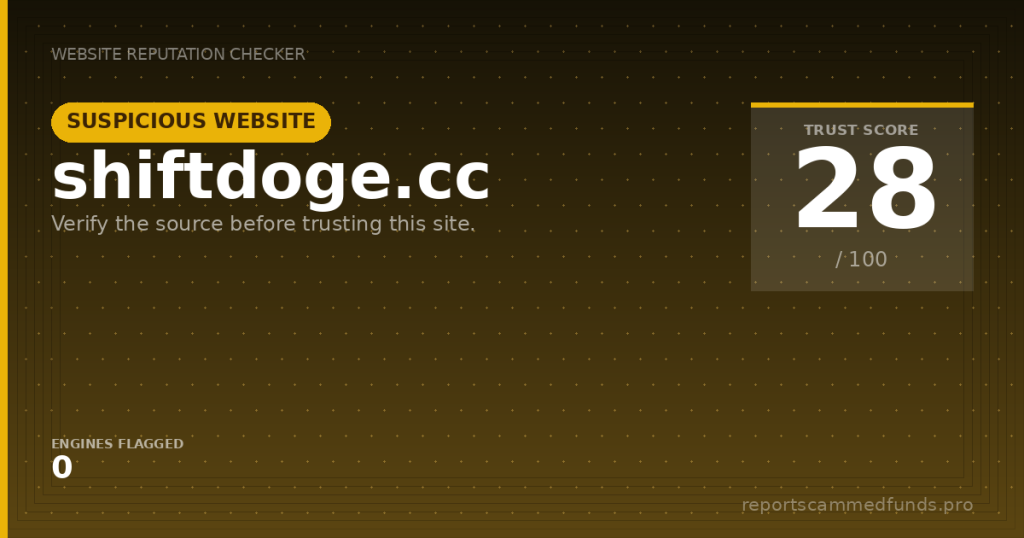
Shiftdoge.cc exhibits multiple high-risk characteristics: intermittent site availability, no verifiable regulation, no proven corporate identity, and no durable user track record. These factors, taken together, push our assessment firmly into the suspicious category. Responsible consumers should not entrust funds to an operator that cannot demonstrate who it is, where it is regulated, or how it safeguards customer assets.
If you still consider experimenting with the platform, approach it as money you can afford to lose and conduct hard-nosed due diligence first. Demand a legal entity name and verify it in a government company registry; search major regulators (FCA, ASIC, BaFin, CONSOB, FINMA, CFTC/NFA) for registrations; request a written fee schedule; trial only the smallest deposit and instant withdrawal; and insist on transparent, written policies for KYC, data protection, and dispute resolution. Any refusal or evasion is itself an answer—walk away.
Our recommendation is to avoid funding accounts at shiftdoge.cc until and unless the operator provides verifiable regulatory status, corporate identity, and a consistent record of successful withdrawals corroborated by independent sources. In the fast-moving crypto sector, skepticism is not cynicism; it is self-defense. Choose platforms that earn trust through transparency, oversight, and time-tested performance.