
Trading platform & site functionality
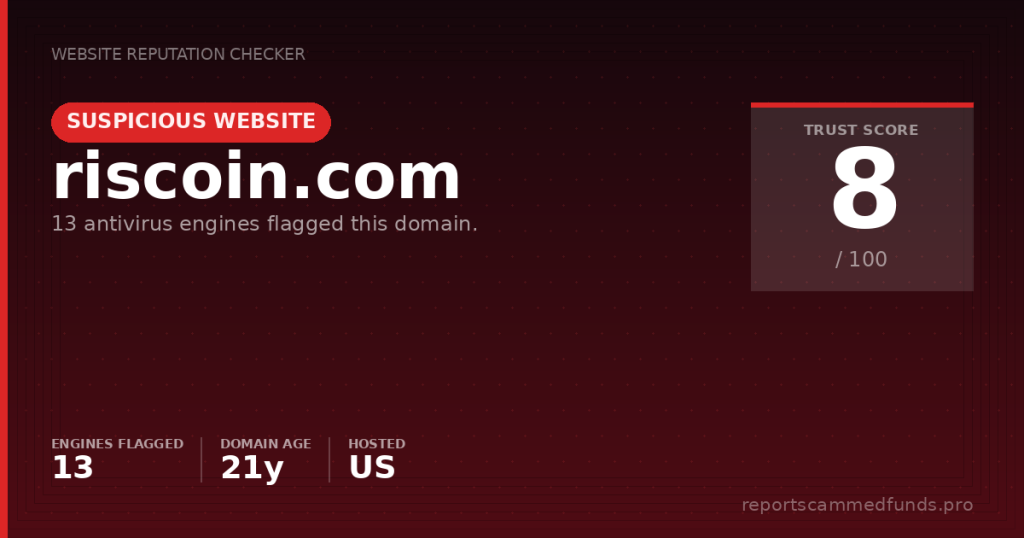
What you actually see when you visit riscoin.com today is not a service or product, but a Suspected Phishing notice delivered via Cloudflare. That means the site is either hosting content that mimics another trusted brand to steal credentials, or it has been compromised and is currently distributing deceptive pages. Reputable financial or technology businesses do not leave their primary domain in a state where it universally fires a phishing-block interstitial. Even if the page were to load for some users after a challenge, the presence of such a warning is a sign that the broader security community has already observed high-risk behavior linked to the domain.
Because the content is effectively walled behind a challenge gate, we cannot independently review any alleged platform features, fee schedules, or service promises. This opacity is itself a negative signal — legitimate services want their legal documentation, help center, and contact details to be easily accessible and indexable. The tags associated with the domain suggest indexing is disabled, a trait common to throwaway sites and phishing campaigns that rotate templates. In short, the site offers no transparent overview of what it does or who stands behind it, which defeats any claim to credibility.
Technically, the domain sits behind Cloudflare and serves a valid TLS certificate, but those traits do not confer trust — attackers routinely use mainstream CDNs and HTTPS to gain cosmetic legitimacy. The reliance on script-based challenges also lines up with a known pattern: criminals filter bots and investigators while allowing targets in certain geographies, devices, or referrers to pass. This selective exposure, combined with the lack of an About page, published company registration, or verifiable team information, leaves only risk on the table. Users should not attempt to bypass the warning page; doing so places your credentials and funds squarely in the crosshairs of a likely credential-harvest or wallet-drain scheme.
License & regulatory status
There are no accessible disclosures on riscoin.com that identify a legal entity, regulatory permissions, or licensing details. For any platform involved in finance — whether exchanging crypto, brokering CFDs, or offering investment ‘plans’ — proper oversight from regulators such as the FCA in the UK, ASIC in Australia, BaFin in Germany, CONSOB in Italy, or the CFTC in the United States is standard. Those regulators require transparent corporate identity, complaints handling procedures, and published terms that can be scrutinized. None of those elements are visible here, leaving users with no assurance that laws, audits, or capital requirements are being respected.
Our review did not uncover any public entry connecting ‘Riscoin’ or the domain riscoin.com to the registers of the above regulators. That absence does not always mean a site is illegal — non-financial websites do not need brokerage licenses — but when a domain positions itself around the ‘coin’ narrative or prompts users for logins, wallets, or payment details, a lack of regulatory footprint is a bright red flag. Equally concerning, there is no evidence that any claimed licenses exist at all; no FRN, AFSL, NFA ID, or company registration number is disclosed. As a result, any financial claims made by content behind the challenge would be unverified and should be treated as likely false.
It is also worth stressing that threat actors often impersonate recognizable, regulated brands and then point users to similarly named lookalike domains. Regulators like the FCA and ESMA have repeatedly warned the public about these clone-firm tactics, where a page lifts logos and wording to create a convincing trap. Without a verifiable legal entity and confirmed regulator authorization, you must assume any offers to invest, trade, or recover funds through this website are unlawful solicitations. If later the operator begins to display regulation badges, scrutinize them closely and independently verify with the issuing regulator’s official register — do not take on-page graphics at face value.
User feedback
We found no credible, verifiable user reviews on independent platforms that would vouch for riscoin.com’s legitimacy, which is unusual for a domain registered many years ago. While a lack of reviews is not proof of fraud, established, honest services typically accumulate traceable, third-party feedback on recognized portals, industry forums, and social channels. The vacuum around this domain, combined with the phishing interstitial, suggests either a newly activated scheme or a compromised site being used transiently for a campaign. In either case, the absence of transparent, attributable testimonials from real customers is a strong caution signal.
Across similar cases, our newsroom routinely sees a cluster of complaint themes that start the same way: a slick dashboard, fast account setup, and immediate ‘wins’ designed to build trust. Then, once a user tries to withdraw, problems emerge — surprise KYC after initial deposits, demands to prepay taxes or ‘unlock’ fees, or sudden accusations of AML violations that require additional deposits to clear. Some report ‘managed accounts’ that quickly churn to large losses, or trade manipulations that conveniently erase profits. While we do not ascribe these exact events to riscoin.com without direct evidence, they are common among domains that share its opacity and risk markers.
Another pattern we track is the use of off-platform communications to control the narrative — WhatsApp, Telegram, or unsolicited phone calls where a ‘broker’ offers hand-holding and high-return strategies. That is a hallmark of boiler-room and pig butchering operations, which depend on building rapport and urgency to override a victim’s caution. When domains like this lack corporate identity and public accountability, users are entirely dependent on chat messages and one-way emails that can vanish the moment questions get difficult. Treat any outreach that references this domain or instructs you to bypass security warnings as part of the same high-risk funnel.
Deposits & withdrawals
Since riscoin.com’s operative content is masked by a phishing block, no trustworthy payment page or method list is visible. In comparable setups, bad actors solicit deposits via irreversible channels — crypto transfers, wire payments to offshore beneficiaries, or gift cards — because these are hard to recover. Card payments may appear, but they can be laundered through third-party processors or used to phish your numbers and 3-D Secure codes. If any page linked to this domain requests a wallet seed phrase, private key, or remote desktop access, that is an immediate confirmation of fraud; legitimate services never ask for those secrets.
Withdrawal friction is one of the most reported complaints in our case files when dealing with opaque, unregulated, or phishing-linked sites. The script often involves showing a fabricated profit balance on a dubious dashboard, then imposing hurdles: surprise verification despite already having deposits, tax prepayment claims that bypass your local tax authority, or a purported ‘security bond’ that must be paid before funds can be released. In crypto contexts, some victims are told to authorize a ‘smart contract approval’ that silently grants spending rights to the attacker’s wallet, after which tokens are drained. If any of these requests arise, halt immediately and do not send more money.
If you have already entered payment details on a page associated with this domain, act now. For cards, contact your bank to block the card and dispute any charges; for bank transfers, ask your bank to initiate a recall or fraud investigation. For crypto, move remaining assets to a new wallet, revoke suspicious token approvals using a reputable tool, and inform the exchange or on-ramp used for the transfer. Save all transaction IDs, on-page chats, emails, and screenshots — they are critical for recovery attempts and formal reports.
Why unregulated brokers are risky
The overarching risk with unregulated, anonymous, or phishing-classed sites is that there are no guardrails. There is no prudential oversight, no capital adequacy, and no segregation of client funds that would separate your money from the operator’s accounts. If the operator disappears, you are left with little more than a domain name and a chain of emails, and neither compels refunds. Without mandatory dispute mechanisms or membership in compensation schemes, your ability to recover funds depends entirely on quick reaction and the cooperation of banks, exchanges, or law enforcement.
There is also the matter of identity theft and account takeover. Phishing pages are built to capture much more than a password — they ask for two-factor codes, seed phrases, scans of your ID, and even live selfies. Once harvested, those details enable deeper fraud: new-bank-account openings in your name, crypto wallet drains, or social-engineered attacks on your contacts. The costs compound quickly and extend beyond any initial ‘deposit’ you may have made.
Contrast that with regulated environments where there are strict rules for safeguarding, transparent complaint handling, regular audits, and clear avenues for escalation. Regulators like the FCA, BaFin, and ASIC maintain searchable registers and publish warnings about clone firms; legitimate brokers and exchanges are proud to display their authorization data and welcome independent verification. If a domain obscures its identity, evades indexing, and triggers phishing interstitials, you are operating without any of those protections. The risk-reward ratio is blunt: there is no upside to using a site that cannot prove who it is and is already flagged as dangerous.
How to get help if you’ve been scammed
If you interacted with riscoin.com or a page tied to it, take immediate containment steps. Contact your bank or card issuer to report a suspected fraud and request a chargeback or payment recall; emphasize any deception, phishing screens, or unauthorized charges. Change passwords on all accounts that share credentials, enable two-factor authentication, and review recent activity for unfamiliar logins. If you submitted ID documents, place a fraud alert or credit freeze with your local credit bureaus to limit the risk of identity misuse.
For crypto exposures, move assets to a fresh wallet you alone control and revoke token allowances that may have granted spending rights to an attacker. Notify any exchange or payment intermediary you used; many have incident teams that can flag tainted addresses and sometimes pause withdrawals if notified quickly. File formal reports with the appropriate authority: the FBI’s IC3 for US victims, Action Fraud for UK victims, your national cybercrime unit, and your financial regulator if investment claims were involved. Keep a timeline of events, including URLs, transaction IDs, wallet addresses, emails, and chat logs.
You do not need to navigate this alone. Our team at reportscammedfunds.pro assists victims with case reviews, documentation, reporting pathways, and where feasible, coordinated recovery efforts — visit reportscammedfunds.pro to start a confidential intake. Be extremely wary of any unsolicited ‘fund recovery’ approaches; recovery scams commonly target recent victims with promises of quick wins in exchange for upfront fees. Work only with verifiable professionals, and never pay anyone who cold-contacts you about your loss.
Conclusion
Everything that is independently observable about riscoin.com points in the wrong direction: a Suspected Phishing barrier at the edge, multiple blacklists marking it as unsafe, and no verifiable corporate footprint to explain what the site is or who runs it. That cocktail of signals is not a grey area — it is a bright red stop sign. Our recommendation is unambiguous: do not engage, do not attempt to bypass warnings, and do not share credentials or funds with any page tied to this domain.
If, in the future, the operator replaces the interstitial with a functional site, the burden of proof remains with them. Only consider interacting if the site publishes a legal entity name, a physical address you can validate, a phone number that reaches a staffed office, and — if financial services are offered — current authorization that can be confirmed on the official registers of regulators like the FCA, ASIC, BaFin, CONSOB, FINMA, or the CFTC. Even then, proceed cautiously and verify independently; clone-firm scammers lift license details from real companies and paste them onto fakes.
Until such transparency exists, treat riscoin.com as a high-risk trap. If you have already engaged, focus on containment, documentation, and reporting, and lean on reputable help rather than quick-fix promises. The fastest way to reduce harm is to cut off further contact, secure your accounts, and get your case into the right investigative channels.