
Trading platform & site functionality
ACCCAT’s web presence suggests an online investment or earnings platform that leans on technology buzzwords and a minimalist interface. The public-facing pages emphasize sign-up and login rather than plain-English disclosures about the product, counterparties, or the company standing behind the site. From the outside, it looks like a web application rather than a standard content-heavy corporate portal, which is common for dashboards that show purported balances and returns. That structure is not inherently bad, but the absence of up-front detail forces prospective users to hand over personal information before learning the basics.
Technically, the site appears to use a Bootstrap-style frontend and a modern content delivery setup behind Cloudflare, which can help availability and loading speed under normal conditions. Those choices reflect routine web engineering, not credibility on the financial side. There is no visible, detailed breakdown of an asset universe, fee tables, or risk control methods that one would expect from a broker or asset manager. Instead, the core proposition seems to be 'earn with tech'—a framing we regularly see in high-risk projects that do not present verifiable strategy documents, audited results, or a named investment committee.
The operational flow implied by the interface is familiar: register, deposit, watch a dashboard increment, then request withdrawals. Many high-yield sites simulate this experience to create the impression of profit without demonstrating underlying trading or lending activity. We did not see disclosures of spreads, commissions, or market counterparties, because acccat.com does not present itself as a broker with order execution; it is closer to a promised-returns portal. Combined with the gating of essential information behind registration, these elements set a cautious tone for anyone considering engagement.
License & regulatory status
Our review did not find a license number, regulator logo linked to a verifiable entry, or a clear statement of jurisdiction on acccat.com. For any platform claiming to invest client money or manage assets, authorizations from bodies such as the FCA in the UK, ASIC in Australia, BaFin in Germany, CONSOB in Italy, the CFTC/NFA in the US, or FINMA in Switzerland are critical. Legitimate operators typically publish a full legal name, registration number, and a direct reference to their entry on the regulator’s register. The absence of those details is a significant departure from best practice.
We searched public registers for a match on the names 'ACCCAT' and 'acccat.com' and did not locate a clearly corresponding authorized entity in the databases of fca.org.uk, asic.gov.au, bafin.de, consob.it, cftc.gov, or finma.ch. This does not preclude the possibility that the operator uses a different legal name or is registered in an offshore jurisdiction, but reputable firms publicize their corporate identity to allow verification. Without a regulator’s entry and a matching corporate name, prospective users are left to trust claims that cannot be independently confirmed.
We did not observe formal regulator warnings specifically naming acccat.com at the time of this review. However, the lack of an active warning does not equate to safety or authorization; it may simply mean the site is below the radar or not yet the subject of an official notice. Equally concerning is the common practice among dubious platforms of displaying regulator logos or generic compliance statements in footers that do not correspond to a genuine license. If acccat.com makes any such claims behind the login wall, insist on verifying them yourself on the regulator’s official website.
User feedback
Independent, attributable user feedback is limited. Where the domain appears on public review portals and forums, ratings and comments skew negative, citing issues like non-responsiveness and difficulty withdrawing. We cannot independently verify the identity of each commenter or the completeness of each account, and anonymous postings should never be treated as conclusive. Even so, the consistency of complaints about access to funds is notable, especially when placed alongside the lack of transparent licensing and ownership information.
Themes we see repeatedly across reports about similar 'earnings' sites include withdrawal blockages after the account shows profit, surprise KYC demands that only appear post-deposit, and requests for additional money to unlock funds or pay invented 'taxes' or 'compliance fees'. These are classic hallmarks of advance-fee fraud in the investment context. If a platform requires you to pay an extra fee to release your own balance, or insists that tax must be paid directly to them before you can withdraw, consider it a red flag that merits immediate disengagement.
We also see social media posts and blog comments that present glowing testimonials with screenshots of dashboards and rapidly compounding profits. The language is often repetitive and generic, posted within tight time windows, and sometimes linked to referral codes—patterns commonly associated with affiliate marketing or astroturfing. While such content is not definitive proof of wrongdoing, it is not a substitute for audited performance and regulated status. Authentic investor protection comes from transparent governance, verified licensing, and independently verifiable financial statements, none of which we could locate for acccat.com.
Deposits & withdrawals
Funding and payout mechanics are crucial in assessing risk. On acccat.com, those details are not clearly presented on public pages; they appear to be accessible only after creating an account. This withholding of basic information, such as accepted deposit methods (cards, bank transfer, e-wallets, or crypto), fee schedules, and withdrawal timelines, undermines informed consent. Legitimate investment providers usually publish at least a high-level summary of how clients can fund and redeem without requiring registration.
In the unregulated sphere, we frequently see a heavy reliance on cryptocurrency deposits on the grounds of 'speed' or 'global access'. Crypto transfers are fine for legitimate services, but they are nearly irreversible and hostile to consumer remediation when something goes wrong. Another common pattern is the introduction of hurdles at the withdrawal stage—requests for additional deposits, unsolicited 'tax' bills, or sudden 'compliance checks' used as a pretext to delay or block payouts. Users should insist on seeing a full, written schedule of fees and withdrawal conditions before sending any money and should test a very small withdrawal early.
Well-run, licensed providers segregate client funds, state redemption rights in clear, audited terms, and return money through the same channel it came in whenever possible. If a site pressures you to use a method that leaves you with no chargeback rights, or refuses to honor a withdrawal unless you pay an extra sum, those are serious red flags. We recommend avoiding any deposit until acccat.com provides transparent, pre-registration disclosure of funding channels, named banking partners or payment processors, and a verifiable record of timely withdrawals.
Why unregulated brokers are risky
Operating outside recognized regulatory frameworks removes critical protections for consumers. There is no compensation scheme like the UK’s FSCS, no oversight akin to the SEC or CFTC for US investors, and no binding client money rules to prevent commingling of funds. If a platform like acccat.com were to freeze accounts or disappear altogether, customers would have no statutory safety net and very limited legal leverage to recover funds across borders.
The marketing posture of 'AI-powered returns' that is not supported by audited results or verifiable methodology is particularly risky. Sophisticated technology can add value in investing, but without third-party assurance, those claims are little more than slogans. Many high-yield scams imitate the surface features of legitimate fintech—sleek dashboards, jargon-heavy descriptions, and graphs that always rise—yet do not tie any of it to real trading, hedging, or credit risk management. Treat on-screen numbers as marketing unless an independent audit proves otherwise.
Jurisdictional opacity adds another layer of exposure. Without a disclosed company address, corporate officers, or legal name, you may be sending funds to an entity that is effectively anonymous. That obscurity also affects your personal data: handing over identification documents to an unregulated, unidentified operator creates lasting privacy risk. Combining financial exposure with identity exposure is the worst of both worlds, and readers should demand clear, verifiable corporate information before sharing either.
How to get help if you’ve been scammed
If you have already deposited money with acccat.com and are encountering delays or refusals to withdraw, act quickly. For card payments, contact your issuing bank immediately and request a chargeback on the basis of misrepresentation or non-receipt of services; provide screenshots, emails, and the site address to support your claim. For bank transfers, call your bank’s fraud team and ask about recalling the transfer or flagging the receiving account. Document every interaction with the platform, including timestamps of withdrawal attempts and any unexpected fee requests.
For cryptocurrency transfers, compile the transaction hashes, wallet addresses, and any correspondence that references them. Notify your local cybercrime unit and file a report with ic3.gov if you are in the United States or actionfraud.police.uk in the UK. Also report the platform to your national financial regulator—fca.org.uk, sec.gov, asic.gov.au, bafin.de, consob.it, finma.ch, and cftc.gov are starting points depending on your jurisdiction. If you purchased crypto through a centralized exchange, inform the exchange’s compliance team and request a freeze or flag on the recipient address if possible.
For tailored support, contact our team at reportscammedfunds.pro. We can help you structure your evidence, draft effective chargeback submissions, prepare preservation letters to banks and exchanges, and route your complaint to the right authorities. Be wary of unsolicited 'recovery agents' who demand upfront fees—these are often recovery scams piggybacking on the original loss. A methodical approach, grounded in documentation and timely reporting, offers the best chance of containment and, in some cases, recovery.
Conclusion
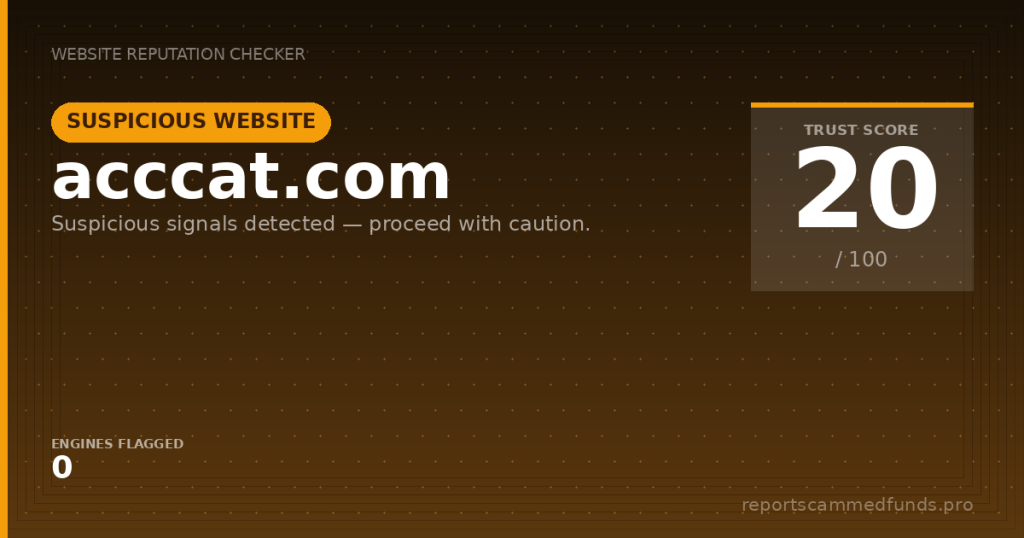
ACCCAT shows a blend of modern web infrastructure and conspicuous gaps in the fundamentals that confer trust: no visible licensing, no verifiable corporate identity, and a proposition framed around opaque 'technology-driven' earnings. Those weaknesses overshadow neutral technical positives like HTTPS and CDN use, which protect data in transit but say nothing about business integrity. The presence of external reputation flags and the absence of independently audited results tilt the balance toward caution.
Our recommendation is straightforward: do not deposit money or provide identity documents to acccat.com unless and until the operator discloses a real, verifiable company name, an address, responsible officers, and an authentic regulatory authorization you can confirm on an official register. If any representative pressures you to act urgently, asks for crypto 'for speed', or proposes paying extra fees to unlock your funds, disengage immediately. These are the exact dynamics that show up in boiler-room and advance-fee variants of investment fraud.
If you choose to explore further despite the risks, limit exposure to funds you can afford to lose, test withdrawals early and often, and insist on written, pre-registration disclosures covering fees, funding channels, and withdrawal timelines. Better still, favor providers that are duly authorized by your home regulator and have a public track record with named executives, audited financials, and clear dispute procedures. Your capital and identity deserve safeguards that anonymous, unlicensed platforms do not provide.