
Trading platform & site functionality
Coderbyte positions itself as a comprehensive technical hiring suite: employers can create coding assessments, schedule live interviews with integrated code editors or whiteboards, and analyze candidate performance. The help center and documentation linked from the site outline features such as project‑based challenges, plagiarism detection, AI‑assisted analysis, and integrations with popular applicant tracking systems. During our visit, the homepage and product pages were delivered via a modern front end with numerous media assets and dynamic modules; this indicates a content system capable of fast iteration, but also shows reliance on multiple third‑party libraries. The experience felt polished and consistent, without obvious broken links or load errors in our checks.
Under the hood, Coderbyte uses a heavy client‑side stack that includes a consent banner provider, analytics tags, a session recording script, and marketing automation. That is typical for a growth‑stage SaaS product and is not inherently a security issue, but it does mean your usage data is being extensively measured and could be shared with service providers; buyers with strict compliance requirements should confirm the vendor’s data sharing and sub‑processor list. The platform also links to its security and privacy documentation, including a Data Processing Addendum (DPA) and a Data Protection Impact Assessment (DPIA) document. While the presence of such documents is positive, the assurances they provide depend on the specifics of your contract and any master service agreement you negotiate.
For end users, day‑to‑day functionality is straightforward: create or import questions, configure scoring rules, invite candidates, and track outcomes. Interviewers can switch between code editors and whiteboards, and some guides reference using VS Code‑style environments during interviews, which may improve realism. The site also exposes scheduling flows (for example via Calendly links) and public review references (like G2), suggesting a mature go‑to‑market motion. As usual with vendor‑hosted testing environments, teams should validate editor stability, language support, and network requirements in their own environment, so there are no surprises when high‑stakes interviews begin.
License & regulatory status
Because Coderbyte is not a broker, exchange, or payments institution, it is not subject to financial services regulation by the FCA, BaFin, ASIC, CONSOB, CFTC, or similar authorities. Our review did not find the site claiming any such licenses, which is appropriate for a developer‑assessment SaaS. Instead, the relevant oversight areas are privacy, data protection, and contractual compliance—especially GDPR for EU data subjects, and standard US privacy considerations. Those are governed by private agreements (DPA, terms of service, and sub‑processor disclosures) rather than a public regulator’s license number.
The site links to policy materials and a trust/status presence (including trust or status subpages and a DPIA document) that outline how data is handled and how uptime is monitored. We were not able to independently verify the completeness or currency of those documents, and we did not conduct a penetration test or vendor audit. If you are processing candidate PII, biometric data (webcam proctoring), or sensitive personal details, you should review the DPA, confirm sub‑processors, and ensure your internal legal and security teams sign off on the vendor. For organizations with strict data locality or retention mandates, ask for documented answers on where data is stored, for how long, and how deletion requests are fulfilled.
Importantly, our checks surfaced no warnings from prominent financial or telecom regulators directed at this domain. That does not guarantee zero risk; it simply means we did not find any regulator alerts that would be applicable to a non‑financial SaaS tool like this. As a best practice, buyers should request an up‑to‑date security whitepaper, evidence of third‑party security assessments (if available), and service‑level commitments in writing. This kind of due diligence is routine for HR tech procurements and helps ensure that your compliance obligations are met.
User feedback
Public commentary on software review platforms linked from the site suggests Coderbyte has a sizable customer base across recruiting and engineering organizations. Reviewers often praise breadth of assessment content, ease of setting up coding challenges, and improved speed to screen large candidate pools. We also saw references to positive experiences with interview features that simulate real coding scenarios, which some hiring teams perceive as a better signal than generic quizzes.
At the same time, feedback across the web is not monolithic. As with many proctoring and challenge platforms, some candidates report frustration with false positives in plagiarism checks, overly strict timer settings, or friction with webcam and identity verification flows. A few employer‑side comments on third‑party forums note occasional UI quirks or learning curves for less technical recruiters, and sporadic mentions of delayed support responses during peak periods. These themes are common in the assessment‑tool market; the key is to pilot with your own roles and workflows so you understand how the platform behaves under your conditions.
We did not see credible, pattern‑based allegations of withdrawal blockages, advance‑fee requests, or managed‑account losses—complaint types that typically accompany financial scams. Instead, the complaint categories here are those you would expect for an HR SaaS: content validity debates, candidate experience concerns, and integration hitches. None of these automatically disqualify the product, but they do argue for a controlled trial, careful rubric design, and support SLAs aligned to your hiring calendar. If your program will run global, high‑volume screens, ask the vendor to simulate load and share reference architectures.
Deposits & withdrawals
Coderbyte is not a trading venue and does not take user deposits in the brokerage sense; instead, organizations purchase subscriptions or licenses. We saw public checkout pages referenced on the domain, but the site’s marketing pages do not display a global price list during casual browsing, and accepted payment methods were not enumerated in the pages we scanned. If you are in procurement, request a written quote that specifies seat counts, feature tiers, overage rules, and billing cadence. Clarify refund terms, upgrade/downgrade pathways, and whether you can export all assessment data upon termination without additional fees.
For individual developers who subscribe to practice materials, the same guidance applies: verify exactly what you are buying, for how long, and how to cancel. Use payment methods that provide dispute and chargeback protections (for example, major credit cards) in case of billing misunderstandings. Retain invoices and cancellation confirmations in your records; if you later need to contest a renewal, those documents become essential.
Because this is a data‑handling platform, an equally important ‘withdrawal’ is your right to remove or delete data. Press the vendor on how to close accounts, purge candidate PII, and obtain exports in standardized formats. Ask whether deletion is automatic upon contract end, how long backups persist, and how to document completion of a deletion request for compliance audits. These questions are standard for HR tech and help you avoid surprises after sunsetting a tool.
Why unregulated brokers are risky
With unregulated SaaS platforms—meaning no sector‑specific regulator like the FCA or CFTC—the material risks are contractual and operational rather than licensure‑related. You do not have the fallbacks of investor‑protection schemes or guaranteed mediation pathways you might find with a financial product; instead, your safety net is the service agreement, vendor reputation, and your payment provider’s consumer protections. If a vendor were to cease operations or materially change terms, your recourse is typically through the contract, your jurisdiction’s consumer laws, and the data portability rights available to you under privacy regimes like GDPR or CCPA.
Data risk deserves special emphasis. Assessment platforms collect candidate code, video, and behavioral signals; mishandling any of that could have reputational and legal consequences. Review sub‑processors, ensure encryption in transit and at rest is standard, and confirm that audit logs are available to your security team. If you plan to use webcam proctoring or identity verification, check that informed consent language is clear and that you can disable these features for candidates in regions with heightened restrictions.
Operational risk also includes the vendor’s uptime and support capacity during your busiest recruiting seasons. While the site links to status pages, only a historical view and guaranteed SLAs in your contract will tell you what to expect if disruptions occur. Ask for metrics and a named escalation path, including response times for critical incidents. Conduct a small pilot under real conditions before you commit to a multi‑year agreement.
How to get help if you’ve been scammed
If you already paid for access and believe you were billed incorrectly or the service materially differs from what was promised, act quickly. Start by contacting Coderbyte’s support channels in writing and keep a record of all correspondence, screenshots, and invoices. If the issue is a billing error and you paid by card, ask your issuing bank about a chargeback within the time window allowed by your network (for example, Visa or Mastercard). Payment platforms often have strict deadlines, so do not wait.
If your concern involves misuse of personal data—such as an inability to delete candidate information—you may also have rights under GDPR, CCPA, or other privacy frameworks. File a request directly with the vendor and, if unsatisfied, consider reporting to your national data protection authority or consumer regulator. For the United States, you can report unfair or deceptive practices to the FTC; in the UK, Action Fraud is the reporting channel for cybercrime and fraud; and for cross‑border incidents, IC3 (FBI Internet Crime Complaint Center) is a central intake.
For tailored guidance on recovering funds or resolving a vendor dispute, our team is available. Visit reportscammedfunds.pro to share your case details securely; we can help you triage next steps, prepare documentation for your bank or card network, and point you to the correct regulator for your jurisdiction. Even with a legitimate SaaS provider, structured escalation often makes the difference in obtaining a refund, a service credit, or a timely remediation.
Conclusion
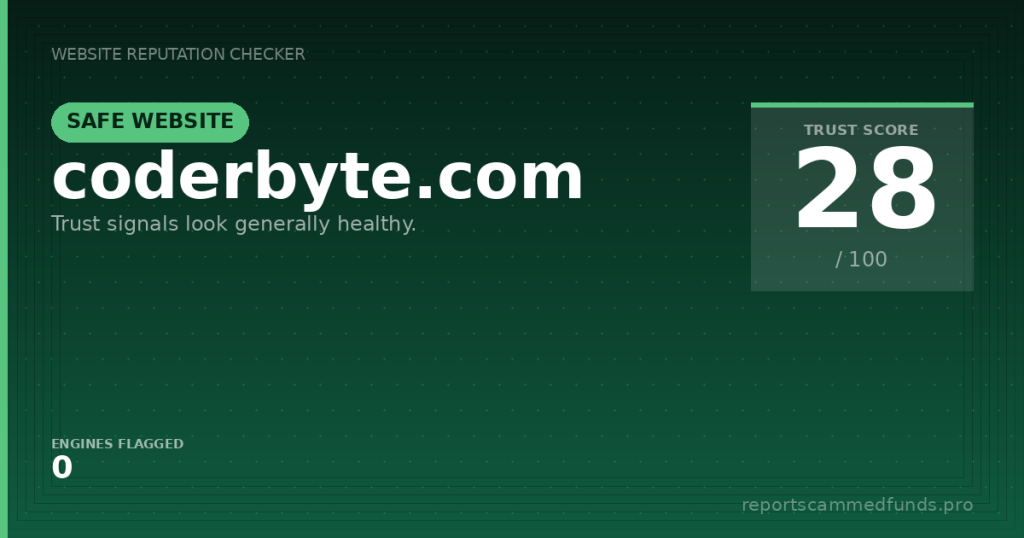
Overall, coderbyte.com presents as a legitimate technical‑assessment SaaS with established adoption and a professional online footprint. We did not observe hallmarks of a financial or investment scam, and the domain’s infrastructure and documentation suggest an operational company with live support and customers. That said, its site is tracking‑heavy and does not openly list universal pricing or payment terms, which means buyers must do the usual enterprise diligence before commitments—particularly if you will process candidate PII at scale.
If you are a hiring team, run a pilot with a small cohort and confirm that proctoring, plagiarism checks, and integrations behave as expected in your environment. Lock down a DPA, verify sub‑processors, and negotiate SLAs that reflect your volume and seasonality. Confirm that account closure and data deletion are practical and verifiable.
With those safeguards in place, Coderbyte can be considered a viable option in its category. As with any vendor that will touch candidate data and influence hiring outcomes, independent verification remains essential. Proceed, but proceed thoughtfully—and document everything.