
Trading platform & site functionality
At first load, i3w9k2h.com resembles a mobile‑first landing page that funnels visitors toward a casino experience associated with the name JDBJILI. The headline offer is the seductive promise of a free sign‑up bonus that can be withdrawn after a single round of betting — an incentive designed to lower initial skepticism and prompt rapid registration. Technically, the page uses a modern front‑end bundle, fonts from Google, and bot‑mitigation scripts, yet the domain’s identity is detached from the promoted brand. That mismatch will matter to anyone who needs to understand who is truly behind the offer and where their funds and personal data will end up.
Beyond surface polish, the site loads a service worker, registers a push‑notification SDK, and references both Cloudflare Turnstile and an Aliyun captcha. It also loads Telegram’s WebApp JavaScript, which suggests it may attempt to integrate chats or in‑app flows via Telegram environments. The presence of a /download route is notable because it encourages users to move beyond the browser into an app‑like experience, where permissions and data collection are harder to monitor. The asset path reveals a tenant‑style structure and remote file hosting through an external subdomain, further distributing functionality across multiple hosts.
We observed calls to an external endpoint named api2.h-f-a-4.com for a domainInfo query, passing headers such as a tenant ID and client version. This is consistent with white‑label, multi‑tenant casino stacks that spin up numerous branded shells on frequently cycled domains. In parallel, image assets are served via upload.w-0-x-j.com, not directly from i3w9k2h.com. While such architectures can be legitimate for scalability, they also make it easy for operators to close one shell and reopen under a new hostname, frustrating chargebacks, complaints, and investigative continuity.
Crucially, the site’s promise — that a bonus can be withdrawn after one betting round — is both atypical and operationally imprecise. Reputable casinos usually impose minimum wagering requirements well above one round and make those terms highly visible. Here, we could not find transparent, exhaustive bonus terms on the landing page to clarify conditions, limits, or geographic restrictions. This kind of vagueness is exactly how disputes occur later: a user deposits to unlock the offer, is told they need to complete additional steps, and ultimately finds out withdrawals are gated by surprise conditions.
License & regulatory status
Licensing transparency is arguably the single most important indicator for online casinos. Well‑regulated operators declare their licence number, regulator, and jurisdiction clearly in the footer and the terms of service — for instance, UKGC in the United Kingdom, MGA in Malta, or state‑level bodies in certain countries. On i3w9k2h.com, no such disclosure was visible during our review. There was no reference to a supervisory authority, no licence registry hyperlink, and no independent testing seals for fairness auditing (such as eCOGRA), making it impossible to verify oversight.
The absence of licence data is particularly concerning given the site’s language and locale hints, including en_PH bundles, which suggests that the Philippines could be a target market. Legitimate Philippine‑facing operators typically reference PAGCOR or relevant offshore licensing tied to the Cagayan Economic Zone. Here, nothing comparable is present, and the use of a short‑lived domain dramatically raises the bar for proof of legitimacy. Without a regulator named, there is no clear path for player recourse if funds are frozen.
We did not find public warnings from major European regulators (FCA, BaFin, CONSOB), market‑wide notices from ESMA, or commodity regulator alerts such as those from the CFTC — but those bodies focus primarily on financial instruments, not casinos. In the gambling sphere, warnings usually come from UKGC, MGA, local gaming boards, or national consumer agencies. The lack of a formal warning therefore should not be interpreted as a positive; more often, it reflects how quickly disposable casino landing pages appear and disappear before an authority can act.
Equally vital is the problem of brand representation. The page markets JDBJILI, yet operates under i3w9k2h.com with no corporate imprint, company number, or registered office disclosed. Reputable operators have detailed legal pages listing the company entity, registered address, and jurisdictional restrictions, including self‑exclusion and safer‑gambling resources. When all of that is missing, users are left to rely entirely on marketing copy and a bonus hook — not the sort of foundation on which to risk deposits.
User feedback
Because the domain is so new, there is little independent user feedback that we could locate through our usual tracked sources. That vacuum itself is informative: long‑standing, above‑board casinos tend to accumulate a trail of app‑store reviews, forum threads, watchdog analyses, and regulator‑related disclosures. When a site moves on a fresh domain that lacks any broader reputation history, the user has to assume more of the risk, because there is no proven track record to lean on.
Although we cannot cite verified, case‑specific complaints for this exact host, our newsroom has seen strong patterns among similarly structured, bonus‑led casino funnels. Common themes include withdrawal blockages after profit, sudden demands for enhanced KYC only after a payout request, and shifting goalposts around bonus wagering requirements that were not apparent at the time of deposit. We also observe frequent reliance on messaging platforms like Telegram for support, which reduces paper trails compared to ticketing systems and can make escalations harder.
In the most severe instances across this pattern, users report being steered into higher tiers of deposit “to unlock” bigger cash‑out limits, effectively an advance‑fee dynamic masquerading as VIP upgrades. When the user finally refuses to deposit more, accounts can be frozen for alleged “risk checks,” and communication dwindles to canned responses. We are not saying i3w9k2h.com has done this — we have no verifiable evidence either way — but the site’s architecture and marketing resembles the anatomy of these cases closely enough to warrant maximum skepticism from potential players.
Deposits & withdrawals
The landing flow and loaded scripts hint at payment integrations via a module named biz‑pay, but the site itself does not disclose a clear schedule of accepted methods, fees, or payout timelines. Reputable casinos list cards, bank transfer, and e‑wallets alongside processing times and KYC requirements, with precise policies around chargebacks and responsible gambling. Here, we do not see those disclosures front‑and‑center, nor do we see clear country restrictions for payment options — details that matter a great deal to avoid surprises.
The headline claim that users can withdraw a bonus after a single round invites pointed questions about wagering requirements and maximum cash‑out limits. Standard practice in regulated markets is to state the wagering multiple (for example, 20x bonus), contribution percentages, game weightings, expiry windows, and any maximum withdrawable amount from bonus funds. Without that specificity, the operator retains wide discretion to reinterpret a user’s eligibility at the withdrawal stage, often coupled with a request for additional deposits to “clear” the account or speed up verification — a classic stall tactic we have tracked in past cases.
Another operational risk is the reliance on external asset and API hosts, because payments that occur inside iframes or embedded flows may not be easily attributable when a user later disputes a transaction. If an offshore processor or crypto address is used, your ability to reverse an error diminishes dramatically. The lack of visible corporate details exacerbates this: without a corporate entity displayed, you don’t know whom you are contracting with, which jurisdiction’s consumer laws apply, or how to escalate a payment dispute beyond a generic chat handle.
Why unregulated brokers are risky
When a casino operates without a disclosed licence, players lose the structural protections that licensed environments enforce. Regulated operators must segregate player funds, submit to technical audits, publish transparent terms, and maintain accessible complaints channels. An unregulated or undisclosed‑regulated operator faces no such scrutiny, which means that, in a dispute, the player has little leverage beyond their card issuer or bank.
Unregulated platforms also have no binding obligation to honor cash‑out timeframes, wagering representations, or self‑exclusion requests. Random number generators (RNGs) are not independently tested, and game fairness claims cannot be substantiated without third‑party certifications. In practice, that means a player could spend weeks chasing documents that are suddenly demanded post‑withdrawal, only to be told that a different rule applies because of an obscure clause that was never highlighted during sign‑up.
Further, disposable domains can be cycled rapidly to escape negative reviews and regulator attention. The combination of an ephemeral hostname, opaque WHOIS, and off‑platform messaging channels makes it difficult for victims to coordinate or even find the same website later. That transience is not how legitimate, long‑term casino brands build customer trust — it is how high‑risk funnels keep moving.
How to get help if you’ve been scammed
If you have already deposited money with i3w9k2h.com and are facing delays, blocks, or new demands to release your withdrawal, act quickly. First, contact your bank or card issuer and request a chargeback or dispute on the basis of misrepresentation or services not provided; provide screenshots of the bonus claim and any contradictory withdrawal messages. If you paid by bank transfer or instant account‑to‑account methods, notify your bank’s fraud team immediately and ask about recall options.
Next, file a report with the relevant authority in your country. In the United States, submit a complaint to the FBI’s Internet Crime Complaint Center (IC3). In the United Kingdom, report to Action Fraud. In the EU, contact your national consumer protection authority; if gambling laws are involved, also notify your local gaming regulator (e.g., UKGC, MGA, or PAGCOR if you are in the Philippines). Even if the operator is offshore, your report helps establish a paper trail and supports broader enforcement actions.
Finally, you do not need to go through this alone. Our team can review your documentation, help structure your chargeback, and identify the payment processors involved. Visit reportscammedfunds.pro to request case assistance — include transaction records, chat logs, and any KYC or terms you were shown. The sooner you involve your bank and a specialist recovery service, the higher your odds of interruption or recovery.
Conclusion
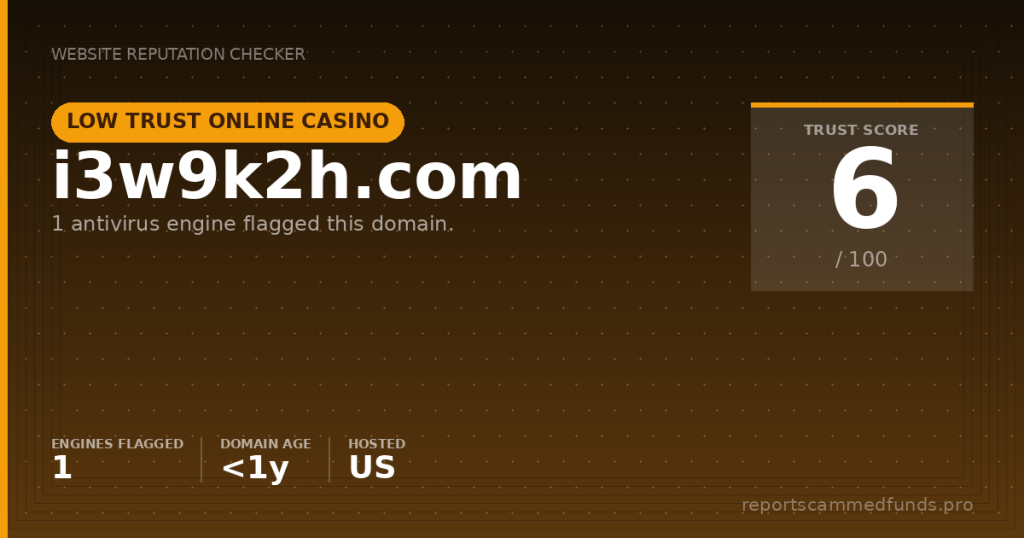
i3w9k2h.com has all the hallmarks of a disposable, bonus‑led casino funnel: a brand/domain mismatch, a very new and opaque registration, no visible licence, and an app‑style flow that shunts users toward push‑notification engagement and ambiguous payment modules. None of these characteristics alone prove fraud, but together they present a risk picture that is hard to justify for anyone considering a deposit. When the offer centers on withdrawing a bonus after just one round, the absence of clear wagering terms should be a deal‑breaker.
If you are determined to explore casino play online, we strongly recommend restricting yourself to operators that publish regulator names and licence numbers you can check on the regulator’s official register. Look for UKGC, MGA, or your local authority, confirm self‑exclusion and safer‑gambling tools, and read independent reviews with a multi‑year history. Avoid domains that have just appeared, hide their corporate identity, or lean on messaging apps for customer service.
Our recommendation is to avoid transacting on i3w9k2h.com. If you nonetheless choose to interact, do not deposit meaningful sums, do not share identity documents until you have verified licensing, and document everything. Your safest option remains to walk away and pick a well‑established, regulated operator instead.