
Trading platform & site functionality
Fatecas presents as a Web3 casino for crypto gamblers, emphasizing “on‑chain logic” and “provable trust.” The landing experience appears to be built with a modern JavaScript framework, and asset paths suggest a crash‑style game is featured (“game_crash.webp” is referenced). That particular format—where a multiplier increases until it crashes—is a staple in crypto casinos, and it can be fair if implemented with transparent seeds and verifiable hashes. However, the presence of a familiar game style does not substitute for disclosures about the operator, jurisdiction, or legal compliance. Users evaluating any crypto casino should always be able to find licencing and audit pages from the first click.
From a technical standpoint, the site loads chunked JavaScript bundles typical of a Next.js build alongside Cloudflare’s performance/analytics beacon. It also fires Facebook Pixel and X/Twitter Ads scripts, which indicates a marketing pipeline focused on re‑targeting and audience measurement. The page requested Google Fonts and Google’s tag script, but we observed a parameter that looked like a site‑verification token appended to a gtag URL—a minor but telling sign of potentially rushed integration. None of these elements are inherently malicious, yet they point to a site designed quickly to scale traffic, not to provide extensive transparency.
We could not readily locate independent “provably fair” documentation or an RNG audit link on the accessible pages. Responsible platforms typically publish seed generation details, verification workflows, and third‑party assessments (sometimes by a recognised testing house). Fatecas’ copy references trust, but trust is earned through verifiable specifics: demonstrable smart‑contract addresses, reproducible hash proofs per game, and an auditable trail that users can validate on their own. Without these, “provably fair” remains a marketing phrase rather than a user‑verifiable feature. For a platform that asks for crypto deposits, the onus is on the operator to provide those proofs up front.
License & regulatory status
Casinos that accept players in regulated markets usually publish clear licence details—examples include the UK Gambling Commission (UKGC), Malta Gaming Authority (MGA), or Curaçao eGaming. Our review did not find any licence number, regulator seal, or clickable validation link on fatecas.com. That absence does not automatically prove illegality, but it does mean users have no immediate way to verify the site’s authority to operate or to check disciplinary history. For a platform handling wagers and withdrawals, the absence of licensing disclosures is material risk.
The site’s pitch focuses on “decentralized Web3” gambling, yet decentralization does not exempt an operator from compliance. Jurisdictions like the UK, most of the EU, and several U.S. states have strict rules about remote gambling, player identity verification, anti‑money laundering procedures, and dispute handling. We saw no conspicuous references to jurisdictional restrictions, KYC policy placement, or responsible gambling frameworks on the paths we loaded. Even if the platform intends to serve only permissive jurisdictions, it should say so unequivocally and demonstrate controls to block restricted markets.
We checked for public regulator warnings against the brand name and domain and found no formal notices at the time of review. That said, the domain is new and has not had enough time to surface in official alert lists, so the absence of warnings is not an endorsement. For readers who want to verify independently, consult databases from regulators such as the FCA, BaFin, ASIC, CONSOB, and your national gambling authority, and search for the operator’s legal entity name rather than only the domain. In this case, a legal entity name was not disclosed on the pages we inspected, which itself is a caution signal.
User feedback
Because the domain was only registered in June 2026, there is very little third‑party commentary to analyse. We did not find a credible footprint of verified user reviews tied to an identifiable operator, and there is no long‑lived Trust or FAQ footprint that might help users evaluate reputation over time. In our experience, a brand‑new gambling site without transparent company details and without measurable community history should be treated skeptically until it builds a proven track record.
In the broader crypto‑casino niche, common complaint themes include withdrawal blockages right after a player becomes profitable, surprise KYC demands after accepting deposits, and disputes about “bonus terms” being used to nullify winnings. We are not asserting that Fatecas has already engaged in these tactics; rather, we are highlighting what tends to happen when an unlicensed, crypto‑only operator controls the payout lever without oversight. The best defense is to test with tiny sums, request a withdrawal early, and scrutinize terms before wagering.
Another recurring issue in Web3 contexts is the misuse of “provably fair.” A legitimate implementation should publish server/client seeds, roll hashes, and a verification method that a non‑expert can follow. When sites mention fairness but fail to publish reproducible proofs or an independent audit, users are left to trust the operator’s word. That is the opposite of verifiability. With Fatecas, we did not find a formal, user‑executable fairness guide linked from the landing routes we crawled, which is a notable gap given the claims.
Deposits & withdrawals
The site positions itself as crypto‑first, and we did not encounter card or bank logos during our crawl. In similar casinos, deposits typically involve sending funds to a generated wallet address or connecting a Web3 wallet. Because transfers on‑chain are final, the key questions become how quickly withdrawals are processed, what identity checks apply, and whether payout rules change after a player wins. None of these answers were clearly documented in the materials we reviewed.
If a platform demands multiple completed wagers before allowing a withdrawal, or introduces new KYC checks only after a big win, these can be warning signs of adversarial terms. Legitimate operators disclose payout timelines, fees, and verification steps clearly before any money is deposited. With Fatecas, the absence of a visible, detailed withdrawals page and a comprehensive terms document on public routes increases counterparty risk for users considering a deposit.
As a matter of prudence, anyone intent on testing the site should start with a negligible amount and immediately attempt a withdrawal to gauge responsiveness. Save transaction hashes and any on‑site confirmations, take timestamped screenshots, and keep all correspondence. If you meet friction, do not escalate your exposure; instead, pause and consider formal complaints and recovery options as outlined below. The best protection is to avoid large initial deposits and to require the platform to prove it will pay out promptly.
Why unregulated brokers are risky
Unregulated platforms can freeze or refuse withdrawals without recourse. There is no financial ombudsman, no statutory compensation scheme, and no regulator to arbitrate. If the operator cites internal terms to justify withholding funds, your options are limited to voluntary support channels or legal action that may be impractical across borders. This structural asymmetry is why visible, verifiable licensing matters in online gambling.
Web3 adds additional complexity: blockchain transactions are irreversible, and pseudonymous wallet flows can disappear behind mixers and chains of addresses. While blockchains are traceable at a technical level, retail users often lack the leverage to compel a payout or to force an exchange to intervene. Properly licensed casinos mitigate this through clear KYC, AML controls, and dispute processes overseen by a regulator; without those, your bargaining position weakens dramatically.
Finally, rapid‑launch sites—with brand‑new domains, aggressive pixel tracking, and minimal corporate identity—have a higher failure rate. Even if the operator is not malicious, poor QA, misconfigured analytics, and unclear terms lead to avoidable disputes. The burden of proof is on the operator to show longevity, audits, and compliance. Until Fatecas publishes its licensing details and verifiable fairness documentation, users carry disproportionate risk.
How to get help if you’ve been scammed
If you already sent money and are facing payout issues, act quickly. For card or bank deposits, contact your issuing bank immediately and request a chargeback or dispute, citing an unregulated online gambling merchant and misrepresentation if applicable. Document everything—transaction IDs, emails, chat logs, and screenshots—and do not send additional funds under any pretext (including supposed “tax” or “unlock” fees), which is a classic advance‑fee tactic.
For crypto transfers, reach out to your exchange or wallet provider with the transaction hashes and destination addresses. Ask whether they can flag the receiving wallet for suspected fraud and whether an internal report can be filed with their compliance team. Report the incident to your national authority: in the UK to Action Fraud, in the EU to your local police/cybercrime unit, and in the U.S. to the FBI’s IC3. Include the domain (fatecas.com), the amounts, and any identifying details you captured.
You can also request case assistance from our team at reportscammedfunds.pro. We triage web‑fraud cases, help you structure evidence for banks, exchanges, and law enforcement, and advise on practical next steps based on jurisdiction. Contact us via reportscammedfunds.pro, and we will review the facts, warn you about common “recovery scam” pitfalls, and point you to the most effective escalation channels for your situation.
Conclusion
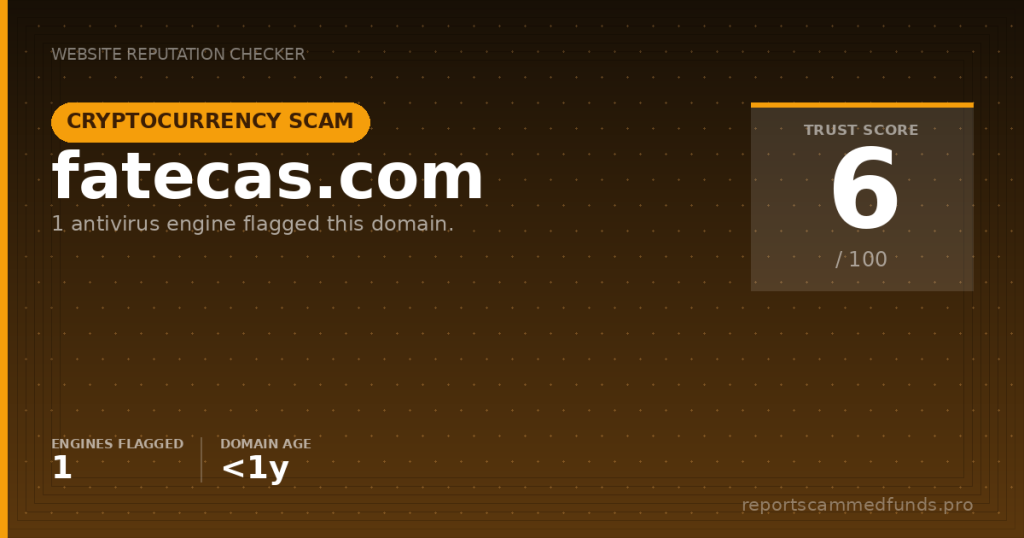
Fatecas asks you to believe in decentralization and provable fairness, yet it offers no visible licence, no clear corporate identity, and no independently verifiable fairness audit on the public routes we inspected. The domain is brand‑new (June 2026) despite promotional copy implying years of history, and at least one reputation engine has already flagged the site as malicious while others categorise it as high‑risk crypto gambling. These are not technicalities; they are core trust indicators, and they are missing or negative.
There may be a legitimate team behind the site working to finalize compliance and disclosures, but until those materials are published—and can be independently verified—players shoulder all the risk. If you still proceed, limit exposure to trivial sums and attempt an immediate withdrawal to test responsiveness. Avoid sending identification documents unless you have reason to trust the operator’s data handling and legal standing in your jurisdiction.
Our recommendation today is to avoid depositing funds into fatecas.com. Wait for transparent licensing, a verifiable operator entity, third‑party fairness/audit reports, and a stable history of timely withdrawals documented by independent users. Caution is not cynicism; it is the cheapest insurance you have in a high‑risk corner of the internet.