Trading platform & site functionality
At the time of review, ledgerholm.trade does not present a working homepage, feature list, or legal pages. Instead, visitors are met with an 'Attention Required! | Cloudflare' screen that blocks access to any real content. Legitimate financial platforms, especially brokers handling client funds, typically maintain transparent, publicly accessible pages outlining their products, fees, corporate identity, and licensing basis. The absence of even a basic overview is a glaring operational risk: if a service cannot clearly state who it is and what protections it offers, there is no reason to trust it with deposits.
The site loads Cloudflare Browser Insights scripts and assets but offers no visible trading terminal, no account signup accessible from the public side, and no download links for commonly used platforms like MT4 or MT5. Reputable providers make platform availability obvious because traders need to assess spreads, execution speed, instruments, and platform reliability before onboarding. Here, none of those essentials are available. This sort of 'empty shell' presentation is consistent with throwaway domains used to harvest deposits and then vanish or recycle under a different name.
We also note the lack of standard transparency markers: no published fee schedule, no statements about spreads or commissions, no swap policies, and no materials about slippage or execution. These omissions matter because they prevent prospective customers from evaluating true trading costs and operational risk. By contrast, regulated brokers display product disclosure statements and detailed T&Cs, including margin requirements and leverage caps dictated by the local regulator. When a site skips all of that, it either does not operate a legitimate brokerage or is deliberately hiding the economics of the offer.
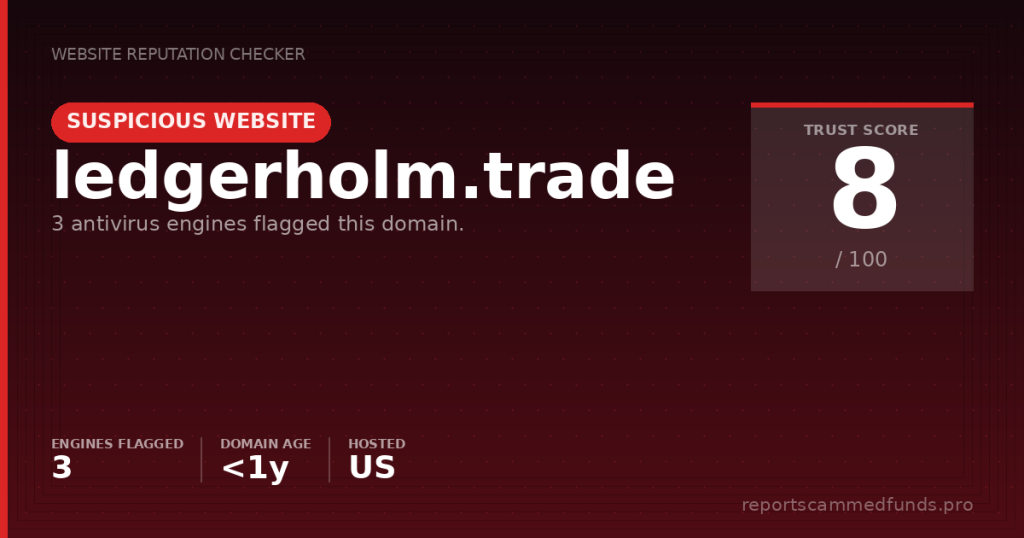
There are further quality concerns that compound the risk. The domain has tagging consistent with 'Index Disabled' and 'Blacklisted' reputational attributes, and it is very young. Taken together with a Cloudflare gate in place of a functioning homepage, the most likely explanation is an operation that is either not fully built but already soliciting contacts, or a storefront designed to funnel victims to off-site payment requests. Either way, this is not how trustworthy financial services present themselves.
License & regulatory status
No licensing or authorization claims are visible on ledgerholm.trade, nor is there a company number, legal entity name, or registered address on the public-facing entry point. In the regulated world, this is unacceptable. Entities that handle client funds for trading are expected to disclose their supervising regulator prominently and provide reference numbers that can be independently verified. Without those disclosures, the default position is that the operator is unregulated—an immediate disqualifier for anyone considering depositing funds.
Prospective clients in the UK, EU, Australia, and the US should be aware of jurisdictional requirements. In the UK, a firm offering investment services to the public must be authorized by the Financial Conduct Authority (FCA). In the EU, authorization flows through a national authority under MiFID II, with cross-border passporting overseen by ESMA; Italy’s CONSOB and Germany’s BaFin are prominent examples. In Australia, brokers require an Australian Financial Services Licence (AFSL) from ASIC. In the US, derivatives and leveraged forex for retail are overseen by the CFTC with mandatory NFA membership. Any platform serving those markets without proper licensing is operating unlawfully.
Our review could not independently verify any listing for 'Ledgerholm' or a plausible corporate parent in public registers commonly consulted by investors (e.g., FCA, BaFin, ASIC, CONSOB, CFTC/NFA). Absence from those databases does not prove a negative in every case, but when it is paired with a faceless website and no documentary trail, the risk profile is not just high—it is unacceptable. Fraudulent brokers frequently rely on vague claims like 'regulated under EU law' without an actual license number, or they misuse logos from bona fide regulators to simulate legitimacy. Nothing on ledgerholm.trade suggests even that attempt; it presents no compliance posture at all.
It is also worth noting that unlicensed operators often add disclaimers after the fact or bury references in PDFs only visible to logged-in users—another tactic intended to avoid scrutiny by the general public and web archives. We see no evidence of even these shadow disclosures here. Given the stakes—client money handling, personal data processing, and cross-border solicitation—the only safe conclusion is that this domain should be treated as unregulated and unsafe. If the operator had genuine authorization, it would have every incentive to display it upfront.
User feedback
Because ledgerholm.trade is a very new and largely inaccessible domain, there is no credible, independently verifiable set of user reviews or community discussion about real trading experience. That lack of a public footprint is itself a warning sign for a purported brokerage, where reputation and word-of-mouth typically accumulate quickly. When a platform keeps its details behind a gate and shows no verifiable client testimony, the prudent inference is that the operators either do not want scrutiny or are preparing to cycle the brand after a brief run.
While we cannot cite direct complaints specific to this domain, patterns from comparable unregulated sites are depressingly consistent. Users frequently report withdrawal blockages after initial profits, often accompanied by sudden 'verification' demands that were never disclosed before the deposit. Others describe time-limited pressure from 'account managers' who promise to unlock higher-tier features or recover losses if the client wires more funds. When customers push back, communication turns sporadic and then ceases entirely, with the platform citing vague 'compliance reviews' or 'tax holds' as stalling tactics.
Another recurring pattern is the 'managed account' pitch where the platform or its agents place trades on behalf of the client, quickly generating unrealistically high 'profits' on the dashboard. These paper gains are used to justify upsells and 'maintenance margin' top-ups, but they mysteriously evaporate if the client resists further deposits. Ultimately, the cycle culminates in either a complete account freeze or a demand for additional pre-withdrawal fees, such as 'clearance taxes' or 'liquidity provider' charges—none of which credible, regulated firms ever require upfront.
In addition, victims of such operations sometimes encounter a second wave of fraud known as a recovery scam. After complaining publicly, they are contacted by supposed investigators or refund agencies who claim they can retrieve the funds for a fee. In reality, these are the same perpetrators or their affiliates, harvesting more money from already targeted individuals. The safest approach is to avoid initial entanglement entirely and to treat vague promises, pressure tactics, and nonstandard withdrawal conditions as immediate deal-breakers.
Deposits & withdrawals
Ledgerholm provides no transparent information on accepted funding methods, minimum deposit, or withdrawal processes. Legitimate brokers typically disclose whether they accept cards, bank wires, and e-wallets, and they publish clear timelines for withdrawals as well as any fees. The silence here is notable. When a platform refuses to outline how money moves in and out, it eliminates the ability for a prospective client to assess operational risk or plan an exit.
Unregulated operators frequently lean on crypto deposits because they are hard to reverse and easy to launder through exchange networks. Card payments can sometimes be chargebacked, and bank wires can occasionally be recalled swiftly if a victim acts immediately, but neither remedy is guaranteed. By keeping the funding channels opaque until after onboarding, bad actors can steer victims toward irreversible methods under the guise of 'expediting verification' or 'qualifying for a promotion.' If you cannot see acceptable funding and withdrawal options upfront, do not proceed.
Withdrawal friction is a hallmark complaint in this niche. Tactics include surprise KYC hurdles introduced only after profits appear on the dashboard, the imposition of arbitrary turnover requirements linked to 'bonuses' that were never properly consented to, and invented pre-withdrawal fees or 'taxes' that must be paid out of pocket. Reputable firms simply deduct any lawful fees from the withdrawal itself; they do not demand additional payments to release your money. Any request to send more funds to access your balance is a bright red stop sign.
If you have already deposited, do not send any further payments, even if labeled as 'unlocking', 'compliance clearance', or 'anti-money-laundering checks.' Keep meticulous records of all communications, screenshots of the dashboard, and transaction receipts. These documents will matter if you pursue a chargeback, wire recall, or a complaint with authorities. Time is critical—act immediately with your bank or card issuer rather than attempting to negotiate with the site’s 'support' team.
Why unregulated brokers are risky
Trusting an unregulated platform with your capital introduces systemic risks that cannot be mitigated by personal caution alone. Without a recognized supervisor like the FCA, BaFin, ASIC, or the CFTC/NFA, there is no mandated segregation of client funds, no enforceable complaints mechanism, and no capital adequacy standard. If the operator decides to close shop, freeze accounts, or refuse withdrawals, there is no prudential safety net or investor compensation scheme to bridge the loss.
Moreover, unregulated operators can manipulate pricing, spreads, and execution internally without fear of audit. They can display fabricated balances and trade histories on a private dashboard that are never reconciled to any market venue. In a regulated environment, there are reporting obligations and surveillance expectations that deter this behavior. Absent oversight, you are trading inside a black box controlled entirely by the counterparty whose incentives are misaligned with yours.
Data security is another overlooked hazard. A faceless site that hides its ownership and offers no privacy policy can mishandle or sell your personal data. Copies of your ID and proof-of-address—often demanded as part of a 'surprise KYC'—are valuable commodities for identity theft rings. Handing those documents to an unknown, unregulated operation can amplify your exposure far beyond the initial financial loss.
Finally, cross-border enforcement is limited. Even if you identify the individuals involved, pursuing them across jurisdictions is complex and expensive, and recovery odds diminish rapidly once funds are converted into crypto or sent through high-risk payment processors. This is why regulators repeatedly urge investors to verify authorization status before sending a single dollar. If a platform cannot pass that first check, the only safe move is to walk away.
How to get help if you’ve been scammed
If you have already deposited funds with ledgerholm.trade, act immediately. Contact your bank or card issuer, explain that you suspect fraud, and request a chargeback or wire recall. Provide evidence of misrepresentation, lack of disclosure, and any refusal to process withdrawals. If you paid by bank transfer, ask your bank to initiate a recall or trace and to place a fraud marker on the beneficiary account where possible.
If you sent cryptocurrency, gather wallet addresses, transaction hashes, timestamps, and any correspondence that shows the request for crypto payment. Reach out to the exchange you used to purchase or send the funds and submit an urgent support ticket to their compliance or fraud team; while crypto transactions are final, exchanges sometimes can flag suspect wallets to prevent further cash-outs. Do not send any additional 'release' or 'verification' fees—those are almost certainly part of the same scheme.
File reports with the appropriate authorities in your jurisdiction. In the United States, submit a complaint to the FBI’s Internet Crime Complaint Center (IC3). In the United Kingdom, report the matter to Action Fraud. In the European Union, use your national financial regulator’s complaint channel and consider submitting to econsumer.gov for cross-border assistance. In Australia, report via ReportCyber or ASIC, and in Canada, contact the Canadian Anti-Fraud Centre. A formal record helps in banking disputes and can aid broader enforcement.
For expert support putting together a recovery plan and documenting your case, you can reach our team directly at reportscammedfunds.pro. We specialize in triaging brokerage and investment fraud cases, preparing evidence for banks and exchanges, and helping victims avoid secondary 'recovery scams'. Visit reportscammedfunds.pro to begin a confidential case review. We will help you prioritize actions that preserve your best chance of recovery while reducing ongoing exposure.
Conclusion
Everything about ledgerholm.trade points to a high-risk, likely fraudulent operation: a new and disposable domain, no accessible content, no corporate identity, and no regulatory footprint. Legitimate financial services do not hide behind a generic Cloudflare gate and leave prospective clients guessing about who they are and how they operate. They publish license details, provide transparent fee and product disclosures, and make their platforms accessible for scrutiny.
In the absence of such fundamentals, the correct response is simple—do not deposit, do not share personal documents, and do not engage. If someone claiming to represent 'Ledgerholm' contacts you by phone, email, text, or social messaging, treat it as a boiler-room solicitation and disengage. Any promise of guaranteed returns, time-limited 'VIP' promotions, or requests to pay a fee to withdraw funds are classic hallmarks of investment fraud.
If you have already interacted with this site, move quickly to contain the damage: contact your bank, document everything, and report to the appropriate authority. For structured, case-specific guidance, contact reportscammedfunds.pro. Until a transparent, verifiable company with recognized regulatory authorization stands behind ledgerholm.trade, it should be considered unsafe.