
Trading platform & site functionality
At a glance, manuinvestments.com markets retail trading in forex, indices, spot metals, cryptocurrencies, and selected equities via CFDs. The site’s front end is built with common web components (Bootstrap, jQuery, Font Awesome), and it is accelerated and protected by Cloudflare. A row of language badges (including EN, ES, AR, FA, HI, ID, and CN assets) implies a global audience, and promotional sections highlight tight spreads and a quick sign‑up process. Visuals also push the MetaTrader 4 brand and a striking “partnership with Tradeland” banner, which reads well in marketing but is not substantiated with documentary detail.
In terms of usability, the platform loads quickly and renders coherently in our spot checks, suggesting competent implementation of front‑end assets and caching. However, the materials emphasize outcomes and ease without giving equal prominence to risk, costs, and controls. For example, while we noticed graphics referencing spreads and platforms, we could not locate a granular spread table, margin schedule, or a PDF of Terms with a named legal entity and fee annex. Traders deserve clear, upfront fee transparency before committing funds, and its absence here is not ideal.
The site’s design evokes a full‑service CFD broker, but operational depth is harder to assess. The presence of a registration form and the brand badges of multiple payment rails can create a sense of completeness, yet these do not confirm whether all listed methods actually function at checkout or how refunds and chargebacks are handled in practice. We did not observe a plainly labeled Client Agreement, Order Execution Policy, or Conflicts of Interest Policy—documents that quality brokers publish as standard. The net effect is a polished brochure site that still leaves fundamental questions unanswered.
License & regulatory status
On licensing, our review did not find a regulator authorization number or an explicit statement of supervision by authorities such as the UK Financial Conduct Authority (FCA), Germany’s BaFin, Australia’s ASIC, Italy’s CONSOB, or US regulators like the CFTC/NFA. Without a verifiable license, a broker cannot legally onboard retail clients in many jurisdictions, nor can it offer the investor protections that regulated frameworks require. We searched site pages and common disclosure locations for a corporate name and license reference; none could be independently verified at the time of review.
It is important to understand what proper authorization looks like. In Europe, an entity offering CFDs to retail clients typically carries a local license or operates through an EU passport under ESMA’s rules. In the UK, the FCA lists authorized firms with an FRN and the permissions they hold; in Australia, ASIC’s Professional Registers show AFSL numbers and responsible officers. We could not find Manu Investments in these public registries. To be clear, no formal regulator warning about manuinvestments.com surfaced during our limited checks, but the absence of a warning is not the same as proof of authorization.
The site’s use of “partnership with Tradeland” imagery also deserves context. A marketing graphic is not a license, and even a genuine partnership does not transfer regulatory permissions from one entity to another. If the operator intends to rely on another broker’s permissions, we would expect to see cross‑referenced legal names, group structure, and regulator endorsements. Without that, references to partnerships should be treated as promotional content rather than compliance evidence.
User feedback
At publication, we did not locate credible, independently verified user feedback from established review platforms or industry forums about manuinvestments.com. That silence may reflect the site’s newness rather than performance, but it also means would‑be clients have little by way of third‑party experience to weigh. When a broker is very new, it is standard for feedback volumes to be low or non‑existent; however, that is precisely why transparent disclosures and regulatory backing matter—so users are not relying on untested claims.
In complaint patterns we track across the sector, unregulated or thinly documented brokerages often trigger similar themes once users try to exit: withdrawals delayed or blocked after profit, sudden and “surprise KYC” hurdles only after deposits clear, or insistence on extra margin injections to “unlock” funds. We are not attributing those behaviors to Manu Investments specifically, but the risk rises when a site provides no independent license anchor and no named legal entity with postal address and governing law. Without those anchors, clients have limited leverage if disputes arise.
We also monitor for reports of managed‑account pitches, unsolicited “account manager” calls, or pressure to move communications off the platform into encrypted messengers. Again, we could not verify such activity here; nonetheless, these are hallmark tactics of boiler‑room style operations, especially around forex/CFD products. If any reader has received off‑platform financial advice or guaranteed‑return pitches connected to manuinvestments.com, document the interaction, do not send additional funds, and escalate to your national regulator.
Deposits & withdrawals
The homepage showcases badges for Visa, Mastercard, Maestro, Skrill, Neteller, Perfect Money, and PayTrust, which—if active—cover a broad range of card and e‑wallet rails. However, a badge is not proof of live integration, and the site does not openly publish a funding policy, withdrawal timeframes, or fee schedules tied to a named legal entity. We also did not find a clear minimum deposit figure, tiered account comparison with firm limits, or a concise overview of chargeback rights by method. These gaps make it hard to evaluate friction points in advance.
If crypto deposits are accepted, note that blockchain transfers are one‑way and largely irreversible; many recovery routes available for cards and bank wires simply do not exist for on‑chain payments. Even where cards are used, we often see disputes framed by brokers as “services rendered,” which some processors treat differently than goods disputes. That is why high‑quality brokers over‑communicate their funding and withdrawal policies, specify who the merchant of record is, and outline exact steps and timeframes for redemptions.
We could not verify real user withdrawal experiences for this site. In similar cases, users report new KYC demands at the moment of withdrawal, sudden bonus‑related clauses invoked to lock accounts, or “compliance reviews” that extend indefinitely while accounts remain frozen. Without published SLAs and audited transaction handling, you have limited leverage beyond card chargebacks, a bank recall (if within a tight window), and regulator complaints—none of which guarantee recovery.
Why unregulated brokers are risky
Trading with an unregulated or unverified broker exposes you to significant counterparty risk: your deposits may not be held in segregated accounts, negative balance protection may not exist, and dispute resolution is whatever the operator says it is. In regulated markets, authorities like the FCA or ASIC mandate client‑money segregation, fair order handling, and transparent disclosures; outside those regimes you are essentially relying on trust. If that trust fails, there is rarely an ombudsman to force redress.
Investor protection schemes also do not apply when you choose an offshore or unlicensed venue. EU clients can benefit from ESMA’s product intervention rules and, in certain countries, compensation schemes if licensed firms collapse; none of that typically extends to unlicensed platforms. This is particularly relevant for high‑leverage CFDs, where losses can accelerate quickly if margin calls and slippage controls are not robust and independently supervised.
Finally, enforcement options shrink dramatically across borders. If a broker is not subject to your local regulator, you may face jurisdictional hurdles to serve notice, initiate a civil claim, or obtain a freezing order. Recovery prospects worsen if deposits were sent via irreversible rails (crypto) or to payment processors outside your legal reach. That risk profile is why we weigh domain age, licensing, and corporate transparency so heavily in our assessments.
How to get help if you’ve been scammed
If you already deposited and are facing obstacles withdrawing, act quickly. For card payments, contact your issuing bank and request a chargeback under the relevant scheme rules, citing non‑delivery of services or misrepresentation if applicable; provide screenshots, timelines, and correspondence. For bank wires, ask your bank to attempt a recall immediately—recalls are time‑sensitive and success is not guaranteed but should be attempted without delay.
Report the incident to your national authority. UK readers should file with the FCA and Action Fraud; EU readers can contact their national regulator (e.g., BaFin in Germany, CONSOB in Italy) and consider a police report; US readers can report to the CFTC if derivatives are involved and submit a complaint to the FBI’s IC3 portal. Be factual and concise, attach evidence, and record your case numbers to build a paper trail.
You can also request expert guidance from our team at reportscammedfunds.pro. We review cases, help map payment paths, and advise on realistic next steps, including regulator notifications and private remediation where appropriate. Reach out via reportscammedfunds.pro with a brief summary, transaction proofs, and any broker communications; the sooner you organize your documentation, the better your position will be.
Conclusion
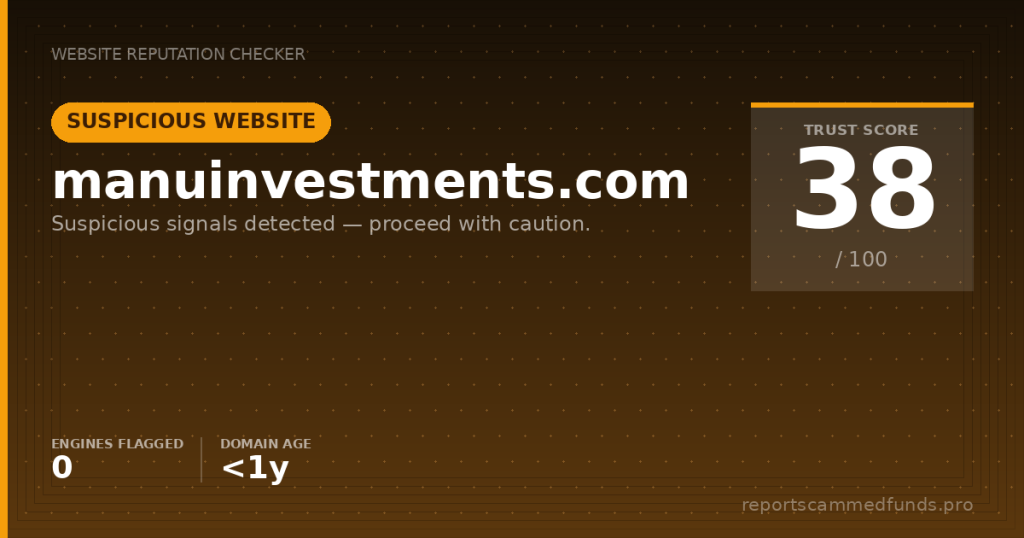
Manu Investments markets the right images—a clean interface, MetaTrader references, and a menu of assets—but the essentials are missing: a verifiable license, a named legal entity with jurisdiction and address, and transparent funding and withdrawal policies. The domain is very new, there are no third‑party reputation anchors, and the partnership claims are unverified. That combination justifies a cautious—if not skeptical—stance.
If the operator wishes to be treated as a serious broker, it should publish its regulatory permissions, corporate documents, and legal terms in plain view, including a detailed order‑execution policy and risk disclosures. It should also provide auditable information on fees, spreads, leverage limits, and retail client protections in each served jurisdiction. Until that happens—and until an independent check confirms authorization—we do not recommend depositing.
Bottom line: treat manuinvestments.com as high risk until proven otherwise. If you proceed despite the warnings, keep deposits token‑small, use payment methods with strong consumer protections, and test withdrawals immediately. Otherwise, consider established, licensed brokers supervised by authorities like the FCA, ASIC, or a comparable Tier‑1 regulator.