Trading platform & site functionality
Ledgerholm.app’s homepage is a single‑page marketing pitch that promises AI‑driven trading, fast support, and expert training across “crypto and other assets.” It looks like a generic template fronted by a brand name that newcomers will not recognise, with a flag‑based language selector and standard web fonts loaded from external CDNs. What is missing are the operational essentials: no visible fee schedule, no documented spreads, no description of order execution, and no clear explanation of custody or segregation of client money. Legitimate platforms disclose platform architecture, counterparties, and the mechanics of order routing. This one does not.
The site positions itself as a platform, yet offers no transparent detail on the technology stack—no established trading suite names, APIs, or references to recognised platforms such as MT4/MT5. Instead, it relies on buzzwords like “AI” and “five‑star,” which are marketing shortcuts commonly seen in boiler‑room operations. Even the support footprint is vague; there is no obvious, prominent, and auditable support channel (named email address, ticketing portal, or phone line) or a response‑time policy. The lack of concrete, auditable detail is a red flag for operational maturity and accountability.
There are also tell‑tale omissions in the legal and compliance footprint. Credible financial sites put their client agreement, privacy policy, risk disclosures (including CFDs/crypto risk statements), and regional restrictions just one click away—often in the footer. On ledgerholm.app, we could not locate a comprehensive set of legal documents or a prominent risk warning that meets standards expected by regulators such as the FCA or ESMA. Without these building blocks, what remains is a brand page designed to funnel sign‑ups and deposits, not a transparent financial service offering.
License & regulatory status
Nothing in the site’s visible content points to a regulator, licence number, or country of incorporation. In regulated markets—whether the UK’s FCA, Germany’s BaFin, Australia’s ASIC, the US CFTC/NFA, Cyprus’s CySEC, or pan‑EU oversight under ESMA—brokers must publish an authorisation ID and entity details. Here, that detail is absent. The omission is not a technicality; it is the line between legal, supervised investing and an unregulated shop operating outside investor‑protection rules.
We found no credible evidence that Ledgerholm is listed in the public registers of major regulators. That does not prove a regulator has taken enforcement action; it simply confirms the operator has chosen to run without oversight. Unregulated status means there is no mandated capital adequacy, no segregation of client funds, no dispute‑resolution framework, and no compensation scheme (like the UK’s FSCS) to stand behind retail clients if the platform fails or misappropriates deposits.
Scam brokers commonly mimic legitimacy by displaying fictitious badges or vague references to compliance—none of which stand up when you try to match a licence number to a regulator’s official register. Ledgerholm.app does not even attempt such window dressing. That vacuum, coupled with the site’s youth and the high‑risk marketing tone, is enough for us to classify it as an unregulated, unsafe venue for trading or investing.
User feedback
Given the domain was only registered in 2026, long‑tail community feedback is naturally thin. That does not make it safe; it means risk is harder for newcomers to gauge. Early‑life scam operations often accumulate complaints only after waves of small victims try, fail, and move on. The pattern we repeatedly see with similar sites is aggressive sales outreach after sign‑up, promises of help to “set up your first trade,” and pressure to increase deposits under the guise of maximising AI strategies or unlocking higher‑tier benefits.
Where clients do get as far as seeing a trading dashboard, issues typically revolve around fabricated account balances and withdrawal blockages. After small, test withdrawals, profits are suddenly frozen pending “KYC completion” despite having provided documents earlier, or new conditions appear—pay an advance “tax,” “unlocking fee,” “liquidity provision,” or “anti‑money‑laundering clearance” before funds can be released. These are classic advance‑fee fraud tactics that convert victim urgency into one more deposit, often demanded in cryptocurrency.
Another common theme across boiler‑room brokers is the managed‑account pitch—hand your account to their in‑house experts or an AI bot that allegedly beats the market. Losses are then blamed on volatility, while winning balances remain virtual because withdrawals never settle. While we cannot attribute specific user reviews to Ledgerholm beyond what is publicly visible today, the combination of vague operations, unregulated status, and pushy performance claims matches many of the complaint patterns we track: withdrawal blockages after profit, surprise KYC hurdles post‑deposit, and account managers who vanish the moment a payout is requested.
Deposits & withdrawals
The site does not publish a transparent payment methods page, minimum deposit, or withdrawal timelines—an immediate red flag. High‑risk brokers typically steer deposits toward irreversible rails: crypto transfers and obscure payment processors. Cards and bank wires may be offered to create a sense of normality, but the money quickly leaves through correspondent chains you cannot trace. When customers ask to withdraw, the goalposts tend to move: unexpected verification requests after funds are credited, spurious compliance fees, or demands to prepay taxes before any transfer takes place.
If you are already in contact with an “account manager,” be alert to sudden requests that you send additional money to “validate the wallet,” “increase margin to close open trades,” or “upgrade the plan for faster processing.” These tactics are specifically engineered to defeat card chargebacks and bank recalls by pushing you into crypto, where settlement is final. Legitimate platforms publish a clear, repeatable withdrawal policy, show an auditable history of successful settlements, and never require customers to pay upfront to access their own funds.
Why unregulated brokers are risky
Trading with an unregulated platform is not merely a higher‑risk version of a regulated experience—it is a different risk category altogether. Without a regulator, you do not have mandated segregation of client assets, capital buffers, best‑execution obligations, or a dispute‑resolution mechanism that compels the firm to respond. If the operator goes dark or refuses to pay, there is no compensation scheme and no supervisory authority to pressure them into compliance.
This risk is compounded when cryptocurrency is involved. Crypto transfers are pseudonymous, borderless, and designed for finality. That makes them an ideal rail for scammers and a poor one for consumer protection. Once your coins leave your wallet, you cannot call a network support line and reverse the transaction. Recovery then depends on rapid reporting, exchange intervention before funds are tumbled, and sustained pressure through law‑enforcement channels—none of which is guaranteed to succeed.
How to get help if you’ve been scammed
If you deposited money with ledgerholm.app, act now. Immediately stop further payments and save all evidence—emails, chat logs, transaction receipts, and screenshots of the dashboard. Contact your bank or card issuer to request a chargeback or dispute; describe the transaction as an unregulated investment or suspected fraud. If you used a bank wire, ask your bank to send a recall and file a fraud report; if you sent crypto, notify the exchange you used, submit an urgent support ticket with the destination addresses, and request freezing if funds hit a hosted wallet. Report the incident to your national authority (for example, Action Fraud in the UK, the FTC/IC3 in the US, your local police or consumer protection agency). Finally, get specialised help: our team at reportscammedfunds.pro can review your case, map the payment path, prepare regulator and exchange submissions, and coordinate a recovery and reporting strategy tailored to your jurisdiction.
Conclusion
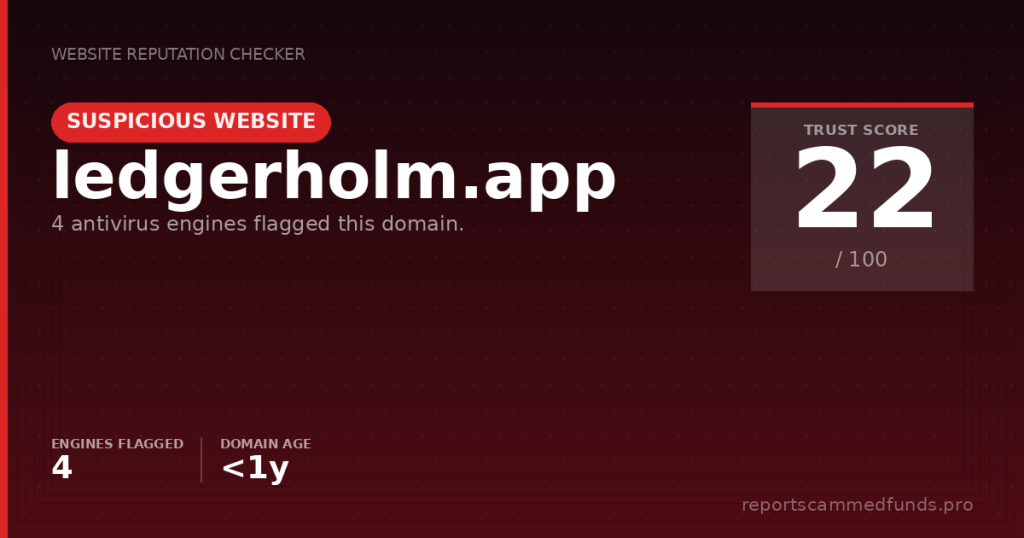
Ledgerholm.app combines a young, anonymous domain with grandiose AI marketing and zero regulator transparency—then gets flagged by automated reputation checks on top. That is not a platform profile; it is a risk profile. Our recommendation is simple: do not sign up, do not deposit, and warn others. If you have already engaged, follow the recovery steps above and contact reportscammedfunds.pro for case assistance.