
Trading platform & site functionality
Harriswilliams.com functions as a corporate information hub rather than a trading or retail investment portal. During loading, the site serves Next.js bundles from a “_next/static” path, uses a modern HTTPS stack with TLS 1.3, and hosts media through a content delivery network tied to Contentful (images.ctfassets.net and videos.ctfassets.net). Visitors encounter standard corporate sections such as industry groups, recent transactions or case studies, insights, and careers. We did not find client login panels or retail account dashboards, which aligns with a B2B advisory practice rather than a consumer brokerage.
From a privacy and telemetry standpoint, the site uses OneTrust for consent management and Google Tag Manager to orchestrate analytics scripts. We also observed a lead-tracking script (lltrck.com), which is common for B2B marketing attribution but worth noting for users conscious of data collection. Overall responsiveness is typical of a well-tuned marketing site—assets are optimized with AVIF images, and HTTP/2 is employed for multiplexed delivery. No performance anomalies or broken flows stood out during test navigation.
In terms of content quality, the materials emphasize M&A advisory, sector expertise, and thought leadership. Transaction tombstones and industry write-ups are presented with professional, brand-consistent design elements. Importantly, there are no prompts to deposit funds, connect a wallet, or hand over personal identity documents in order to access services—again consistent with a firm that sells advisory services to corporate and sponsor clients, not to the general public. Any solicitation that deviates from this pattern—especially sudden money requests—should be treated with skepticism and independently verified with an official office line.
License & regulatory status
Because Harris Williams operates as an investment bank focused on advisory services, the regulatory frame is different from retail trading firms. Advisory and broker-dealer entities are generally subject to oversight by securities regulators (for example, FINRA/SEC in the U.S. or the FCA in the U.K.) when they carry out regulated activities. However, we did not locate explicit regulator licence details or FRN/CRD entries on the pages we reviewed. That absence is not unusual for a high-level marketing site, but it does mean you should verify the exact legal entity and any licence claims directly through official registers.
A practical way to confirm the status of a financial-advisory firm is to match the exact legal entity name, principal address, and any claimed registrations against primary sources. Examples include U.S. FINRA BrokerCheck and SEC adviser/broker-dealer databases, and, for the U.K., the FCA Register. If you’re dealing with a European transaction, BaFin (Germany) or CONSOB (Italy) may be relevant, and for Australia, ASIC. Do not rely on screenshots or PDF ‘certificates’ sent by a third party; navigate to the regulator’s own website and search independently.
Equally important is the risk of brand misuse. Criminals frequently impersonate well-known investment banks to pitch ‘too-good-to-be-true’ placements or to collect upfront ‘due diligence’ and ‘escrow’ fees. A common pattern is referencing a reputable firm’s name or copying its website look and feel while changing contact numbers, domains, or email footers. If a purported Harris Williams representative is asking for immediate payment, secret participation in an exclusive deal, or communication exclusively via messaging apps, pause and verify with an independently sourced phone number for a known office. Regulators worldwide (FCA, BaFin, ASIC, and others) have repeatedly warned about clone-firm scams that borrow the identities of legitimate advisory brands.
User feedback
We did not uncover a body of public complaints tied to harriswilliams.com itself, nor did we find credible reports of the site attempting to take deposits or solicit personal investments from retail users. The site presents as a conventional, content-oriented corporate presence rather than as a transaction platform. That said, the absence of complaints about the web domain is not a guarantee that impersonators will not leverage the brand name in off-site channels (email, messaging, or social networks).
Within the broader investment-banking ecosystem, a recurring consumer-protection issue is third parties posing as advisors to collect advance fees for non-existent capital raises or placements—an ‘advance-fee fraud’ variant. In those cases, the illicit activity often occurs through lookalike emails or spoofed phone numbers rather than through the authentic corporate website. Telltale markers include pressure for urgent wire transfers, requests for cryptocurrency payment, and refusal to provide a verifiable office phone redirect where the firm’s switchboard can confirm the individual’s employment.
Another pattern seen across reputable brands involves fake recruiters who promise expedited hiring if the applicant pays for training, equipment, or background checks up front. Reputable firms do not ask applicants to wire money to secure interviews or roles. If any outreach using the Harris Williams name requests payment to proceed with onboarding or to access a ‘confidential deal room,’ stop and validate the contact. Call an official office number listed on harriswilliams.com (not one provided in the email) and ask to be connected to the purported representative to confirm legitimacy.
Deposits & withdrawals
Given the nature of the business, harriswilliams.com does not facilitate deposits, withdrawals, or consumer trading. There are no prompts to open accounts, upload funds, or stake crypto. An authentic engagement with a corporate advisory firm typically starts with formal introductions and an engagement letter—not with a request for you to deposit money via a website checkout or a personal wallet address. Any scenario where a third party urges you to ‘fund an escrow’ through a link in a cold email, or to pay a ‘listing fee’ by card or crypto to begin, should be treated as a likely impersonation or advance-fee scheme.
When legitimate fees are part of a corporate transaction, they are set out in documented engagement terms and handled through established, auditable channels. Payments do not flow to personal accounts, gift cards, or newly created wallets. Moreover, reputable firms will not block or delay a ‘withdrawal’ because retail withdrawals are not a feature of this site or business model. If you encounter messaging that resembles retail brokerage workflows—KYC uploads to unlock a withdrawal, extra taxes to be paid before release of funds, or ‘profit share’ remittances following a trade—assume you are dealing with a fraudster misusing the brand name.
If you believe you have been steered toward a bogus payment while corresponding with someone claiming to be from Harris Williams, halt immediately and independently re-establish contact. Use official switchboard numbers listed on the corporate site to ask whether the person is employed and whether the instructions are legitimate. Save the emails, wallet addresses, and payment instructions as evidence for your bank and for any regulatory or law-enforcement reports you may file.
Why unregulated brokers are risky
The general risks of trusting unverified financial websites and contacts are substantial. Without regulator-verified identity and the correct legal-entity details, you have little protection if funds are misdirected to fraudsters. Unregulated actors can mimic documentation and logos convincingly, then disappear after collecting upfront payments, leaving victims with limited recourse. Unlike payments made to supervised institutions where chargebacks or complaint pathways may exist, crypto transfers and certain cross-border wires can be hard or impossible to reverse.
A separate risk comes from clone websites and near-match domains. Fraudsters often register lookalike addresses, spoof email headers, or set up web pages that copy a legitimate firm’s layout but funnel inquiries into their own inboxes. Before clicking embedded links or replying to any ‘deal invitation,’ check the email sending domain character by character (watch for swapped letters or added hyphens), and hover over URLs to ensure they resolve exactly to harriswilliams.com or to a verified subdomain controlled by the company.
Lastly, remain vigilant about data harvesting. Even if no money is requested, scammers may use a brand’s credibility to solicit sensitive information—passport scans, bank statements, or corporate financials—that can later be exploited. A genuine advisory process unfolds with staged confidentiality agreements and proper data-room controls. If a contact pushes for documents through unsecured channels, that is a warning sign to step back and confirm the counterparty’s identity through a trusted office number.
How to get help if you’ve been scammed
If you believe you have already paid money to a scammer using the Harris Williams name or a similar domain, contact your bank or card issuer immediately and request a chargeback or recall where possible. Be specific about the suspected fraud and provide your bank with wire instructions, wallet addresses, invoices, and email headers. Time matters: banks and payment processors have limited windows to attempt recalls or reversals.
File a report with the appropriate authority in your jurisdiction. In the United States, submit reports to the FBI’s IC3 and your state regulator; in the U.K., contact Action Fraud and the FCA; within the EU, report to your national authority (e.g., BaFin in Germany or CONSOB in Italy). Include any URLs, social profiles, and phone numbers used during the fraud. These reports help agencies link related cases and issue clone-firm warnings.
For tailored support with evidence preservation, tracing payment paths, and coordinating filings, you can reach our team at reportscammedfunds.pro. We work with victims to assemble timelines, identify recovery avenues (including civil demand letters and platform escalations), and reduce further exposure. While no recovery can be guaranteed, acting quickly and with a clear dossier of facts significantly improves the odds of interrupts and restitution where feasible.
Conclusion
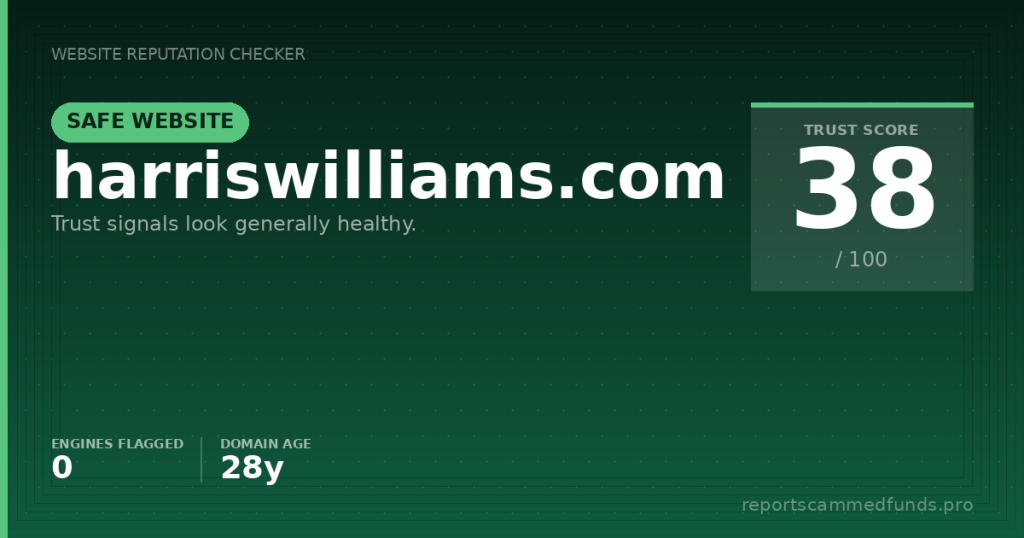
On balance, harriswilliams.com presents as a legitimate, long-standing corporate website for a recognized M&A advisory firm. We found no requests for consumer deposits, no retail trading features, and no immediate red flags in the site’s build or behavior. Its reliance on standard consent and analytics tooling, plus its established domain age, are consistent with a mature enterprise presence.
That said, high-profile financial brands are frequent targets for clone-firm and impersonation scams. Any outreach that departs from normal corporate engagement patterns—especially requests for upfront payments to personal accounts, crypto wallets, or unfamiliar third-party portals—should be treated as suspect. Independently verify the contact by phoning an office number sourced directly from the website and asking to be transferred to the individual.
We conclude that the official website is safe to browse for information. If you are a potential client or candidate, perform customary checks: verify email domains, confirm direct lines through the switchboard, and avoid sending money or sensitive documents until you have established bona fide engagement terms. Prudent verification remains your best defense.