
Trading platform & site functionality
From what can be observed, metugamb.com is presented as an online gambling or sweepstakes-style platform with a crypto-leaning payment posture. The interface and branding appear minimalistic, with a streamlined registration or sign-in flow and strong calls to action. At times, the site sits behind a challenge page, which can be typical of content-delivery and protection layers but also makes it difficult to evaluate stability and reliability. That inconsistency, coupled with the domain’s newness, makes it hard to trust availability or uptime for anything as sensitive as money deposits.
Promotional hooks around the brand, including off-site chatter, trend toward bonus language and gift-type propositions that mirror voucher or prize lures. We have seen links or references that intersect with Amazon-themed giveaways, a common hallmark of phishing campaigns designed to harvest credentials or funnel users into risky funnels. There is no evidence of any official relationship with Amazon, nor is there a verifiable corporate sponsor attached to the promised incentives. When acquisition relies on freebies and urgency rather than transparent credentials, it usually signals an operation seeking fast deposits before the audience asks hard questions.
Technically, the footprint suggests integrations that include Facebook-related scripts and Cloudflare-side analytics, both of which are routinely employed by legitimate websites. However, the presence of mainstream tools is not a substitute for regulatory compliance or corporate transparency. We did not find a clear legal entity in the footer, nor a detailed privacy policy or terms of service that maps out dispute resolution, jurisdiction, and responsible gambling protocols. The combination of thin or generic legal text, aggressive sign-up prompts, and a lack of verifiable operator details is a poor foundation for user trust.
License & regulatory status
Online gambling operators serving consumers in major jurisdictions are obligated to display their license information prominently. The UK Gambling Commission (UKGC) requires a license number and link; Malta Gaming Authority (MGA) operators list their authorization; even Curacao eGaming licensees usually show a seal with a clickable validator. On metugamb.com, we could not identify any specific license number, regulator name, or verified seal, which is an immediate red flag for a site that proposes to take wagers or custody player deposits.
We cross-checked public registers where feasible. Searches against the UKGC, the MGA’s licensee lists, and Curacao’s commonly cited master license operators returned no match for “Metugamb” or the metugamb.com domain at the time of our review. In the United States, online gambling is regulated on a state-by-state basis; there is no sign that this brand is authorized in any regulated state market, nor does it present geofencing or state-specific compliance features. Absence from these registries does not guarantee misconduct, but it strongly implies that the operator is offering services without the oversight expected of a legitimate casino.
If a platform also solicits cryptocurrency ‘investments,’ staking deals, or guaranteed returns wrapped in game mechanics, that may trigger financial regulatory scrutiny as well. In such cases, agencies including the FCA in the UK, BaFin in Germany, ASIC in Australia, and the CFTC in the United States may have jurisdiction. We have not seen any independently verified financial licensing claims tied to this brand. The more an operator mixes gambling appeals with crypto-transfer demands and profit promises, the more vital it becomes to verify regulator authorization — and here, those authorizations appear to be missing.
User feedback
Given how new the domain is, there is little in the way of credible, time-tested user reviews from established consumer forums or watchdog sites. That silence is not a positive sign; it merely means there is no community track record to validate payments, withdrawals, or customer support quality. A recurring pattern in this niche is that new sites attract deposits with bonuses, run briefly, and then vanish or relaunch under another name. Without a demonstrable operating history, any marketing promises about fast payouts or fair odds should be considered unproven at best.
Complaint motifs associated with similarly structured operations tend to recur with striking regularity. Users often report that withdrawals are blocked after the first sign of profit, with support demanding unexpected identity verification only at the cash-out stage — a practice known as ‘surprise KYC.’ Others describe being tripped up by hidden bonus rollover terms that were not explained clearly during signup, effectively voiding balances. A particularly troubling tactic is the request for additional fees, labeled as ‘taxes,’ ‘security deposits,’ or ‘verification charges,’ purportedly required before the withdrawal can be processed — a classic advance-fee fraud red flag.
We also track how such brands recruit new players. Social media or messaging-channel blasts carrying Amazon-themed prizes or seasonal promotions (e.g., “Prime Day” gift drops) are a common lead-generation lure that has long been associated with phishing. Even if the end destination presents as a casino interface, the bait itself is cause for concern because it misrepresents affiliations and leverages urgency psychology. That dynamic, in combination with a young domain and missing licenses, is enough for us to recommend extreme caution pending verifiable proof of legitimacy.
Deposits & withdrawals
Payment posture is critical, and what we can infer from metugamb.com’s ecosystem is a preference for cryptocurrency funding — typically coins like USDT, BTC, or ETH in this niche. Crypto transfers are final and do not carry consumer protections like chargebacks, which is precisely why high-risk operators favor them. Some similar sites also route card payments through opaque third-party processors that complicate disputes and mask merchant identities. When a site won’t confirm a licensed payment processor or a transparent refund policy, deposits should be treated as one-way money.
Withdrawal obstacles surface frequently in user accounts from adjacent platforms. Common tactics include imposing turnover requirements tied to a “welcome bonus” that you never intentionally accepted, declaring winnings void for vague reasons, or marking withdrawals as “pending” indefinitely. Another recurring theme is the sudden demand for highly sensitive identity documents via chat or email, often without any secure upload portal or privacy posture — exposing users to further data theft risk. Legitimate casinos detail their payout timelines, limits, and document checks upfront and provide an auditable complaints pathway.
The most unambiguous red flag is any request to prepay taxes, compliance deposits, or unlocking fees before funds are released. Reputable gambling operators do not ask customers to pay taxes in advance nor charge extra to “verify” a withdrawal after the fact. If metugamb.com, or any representative claiming to be affiliated with it, asks for such a payment, it is a sign to cease all engagement. Keep your funds where the rules are clear, the operator is licensed, and the dispute channels are independent and enforceable.
Why unregulated brokers are risky
Engaging with an unregulated operator eliminates the safeguards that protect players in licensed markets. There is no oversight ensuring fair gaming, segregated customer balances, or transparent dispute resolution; you are effectively trusting an unknown party with both funds and data. If the site goes offline or refuses to honor withdrawals, there is no regulator to compel compliance and no compensation scheme to mitigate loss. That asymmetry — rapid to accept deposits, non-existent when it comes to accountability — is the essence of the risk.
The data privacy dimension is often overlooked but just as perilous. Surprise KYC after deposits means handing over passport scans, utility bills, and bank statements to an operator whose storage, access, and breach-response standards are unknown. Those documents can be abused for identity fraud, sold on, or used as leverage to coerce additional payments under threat of account closure. A licensed operator’s obligations under regimes like the UK’s GDPR enforcement or other data-protection frameworks are enforceable; an unregulated site’s promises are not.
Finally, the cross-border nature of these sites makes redress complex. Even when a victim can identify a jurisdiction, bringing legal action in a foreign court for comparatively small amounts is often impractical. Regulators like the FCA, BaFin, ASIC, and state-level gambling authorities issue repeated warnings: use only authorized operators whose details you can verify on official registers. In the calculus of risk versus reward, unregulated and anonymously run platforms consistently underperform on user safety.
How to get help if you’ve been scammed
If you have already sent money, move fast. For card payments, call your bank and request a chargeback on the grounds of misrepresentation or services not provided; emphasize any blocked-withdrawal evidence you possess. For bank transfers, ask your bank to initiate a recall and report suspected fraud. If you paid in crypto, immediately contact your exchange or wallet provider with transaction hashes to flag the recipient address — while blockchain transactions are final, exchanges sometimes act on timely fraud alerts.
File formal reports. In the UK, report to Action Fraud and retain the reference number; in the US, file a complaint with the FBI’s IC3 and notify your state attorney general; in the EU, contact your national police and your gambling regulator where applicable. Document everything: deposit confirmations, wallet addresses, on-site chat transcripts, emails, screenshots of terms or offers, and any social media messages that led you to the site. This record strengthens chargeback cases and helps investigators map related wallets and domains.
For guided assistance and to avoid secondary ‘recovery scam’ approaches, reach out to our team at reportscammedfunds.pro. We can help structure your evidence for banks and exchanges, identify escalation points, and provide practical next steps tailored to your jurisdiction. Do not pay “unlock” fees, “tax prepayments,” or “verification deposits” to anyone promising a guaranteed recovery — these are nearly always fraudulent. Patience, documentation, and coordinated reporting are your best chances to limit losses and, in some cases, halt further movement of funds.
Conclusion
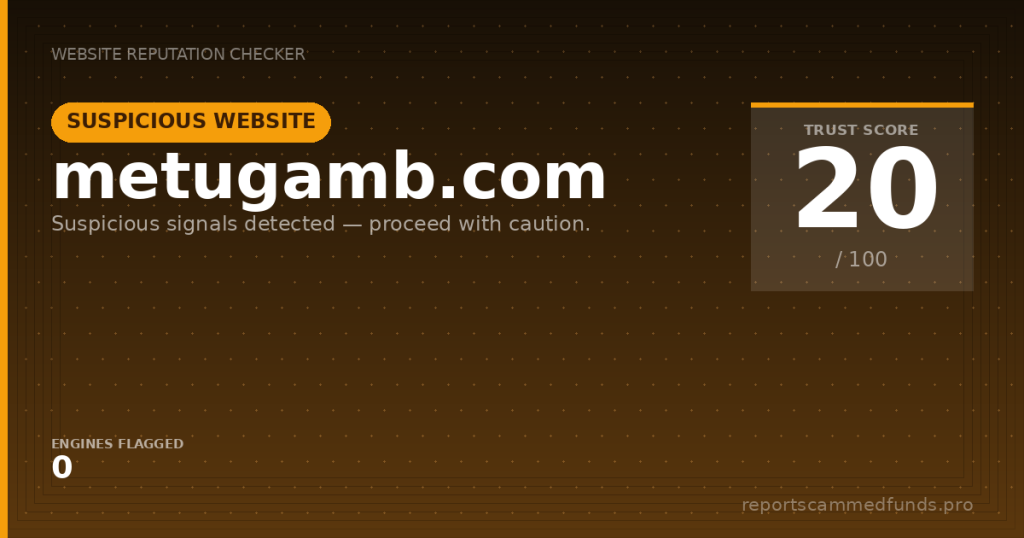
Metugamb.com combines a very young domain with opaque ownership, absent licensing, and promotional cues that overlap with phishing-style lures. These are not small blemishes that a site will “fix later”; they are foundational gaps that legitimate operators address before launch. Even if some pages load cleanly and the interface looks modern, the missing essentials outnumber any superficial positives.
Could the operator eventually disclose licensing and shore up compliance? It’s possible in the abstract, but consumer safety cannot hinge on future promises. Responsible gambling brands publish their licenses, jurisdictional restrictions, and payment policies from day one and can be cross-verified on official registers. Until metugamb.com meets that standard and sustains a transparent, incident-free track record, depositing money or uploading personal documents is an unnecessary risk.
Our position is clear: avoid funding accounts or sharing sensitive information with this domain. If you have already engaged, follow the steps in the help section and consider contacting reportscammedfunds.pro for support. Your security is best served by choosing regulated, transparent operators with independently verifiable credentials and a long-standing history of paying customers promptly.