
Trading platform & site functionality
What 7oxbet.com actually does is difficult to verify because, during our access attempts, the domain resolved to a 'Suspected Phishing' interstitial maintained by Cloudflare rather than a navigable site. That page typically appears when Cloudflare or external reports associate a domain with credential theft or other deceptive behavior, though false positives are possible. The site also loads Cloudflare Turnstile, a browser challenge script that can gate access to visitors. While such measures can be legitimate anti-bot defenses, they are also used by questionable operators to throttle scrutiny, segment visitors, and keep investigators out.
The branding strongly implies online betting—'bet' in the domain, and scan tags mentioning 'Casino' and 'Registration Form' point in that direction. However, we could not reach any internal pages such as a sportsbook lobby, game catalog, promotions, or account dashboard. Reputable betting websites typically showcase game vendors, odds providers, house rules, RTP/return-to-player data for slots, and responsible-gambling links. None of that was visible to us, either because the site is down, is blocking visitors, or because it has been intercepted by Cloudflare pending abuse review.
From a build perspective, all we definitively observed were Cloudflare-hosted assets and the errors stylesheet typical of an interstitial scenario. No content management system signature, no page templates, and no recognizable design language could be captured. This absence matters: genuine operators usually present a consistent front end with standard navigation, legal footers, and clear calls to action. Here, the only discernible 'functionality' is the access challenge, which is not a feature a prospective customer can evaluate or rely on.
Because the purported platform is hidden, we cannot audit any vital quality markers. For a real-money betting site, those markers would include the breadth of sports and casino content, odds competitiveness, withdrawal processing times, and the presence of live chat or 24/7 customer support. The lack of visible terms around fees, bonus rollover, cash-out limits, or verification rules is troubling. In short, 7oxbet.com offers none of the surface-level signs of a transparently run gambling business, and what is visible suggests active phishing suspicion rather than a functioning platform.
License & regulatory status
Any website that offers online betting or casino play to the public must hold an appropriate gambling licence for the jurisdictions it targets. Examples include licences from the UK Gambling Commission (UKGC), Malta Gaming Authority (MGA), Curaçao eGaming, Gibraltar, or Kahnawake, among others. These licences are normally displayed in the footer with clickable seals and clearly named corporate entities. During our review, we could not access any licensing disclosures, no regulator brand marks, and no corporate registrations associated with 7oxbet.com.
If the site also accepts cryptocurrencies or represents itself as an investment/trading service, a parallel set of financial-compliance obligations can apply. That would involve AML/KYC policies, disclosures for who is the regulated entity, and potentially registration with securities or financial regulators when investment-like products are offered. Again, no such disclosures were visible to us, and the Cloudflare phishing banner leaves little room for the benefit of the doubt. At minimum, the operator should be able to point to a licence number or regulator reference; none was independently verifiable.
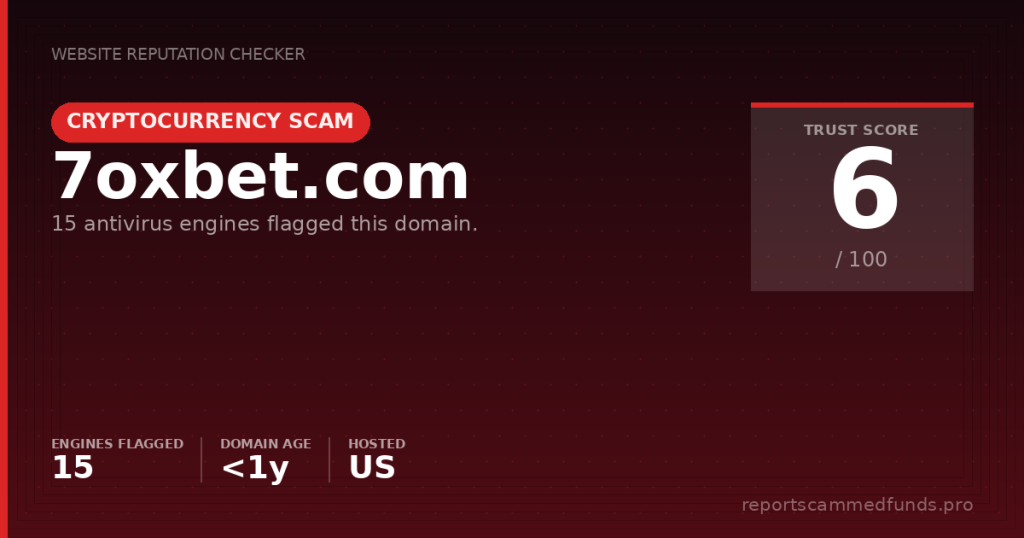
We did not locate public warnings naming 7oxbet.com from major financial or gambling regulators such as the FCA (UK), BaFin (Germany), ASIC (Australia), CONSOB (Italy), FINMA (Switzerland), or the CFTC/NFA (US) at the time of writing. Absence of a warning is not exculpatory—brand-new or short-lived domains often fly under enforcement radar until victims report losses. The lack of a regulator footprint coupled with a phishing interstitial and multiple malware/phishing detections is a convergence of signals we typically associate with high-risk operations.
Offering gambling services into regions without the correct licence is a regulatory breach in many countries, and it leaves customers unprotected if something goes wrong. If an operator is unlicensed or misrepresents its authorisation, disputes over withdrawal delays, voided bets, or account closures happen in a vacuum—there is no regulator to escalate to. In that scenario, the only recourse tends to be chargebacks (if possible) and civil complaints, both of which are much harder if deposits were made in cryptocurrency. Readers should insist on verifiable licence credentials before engaging with any betting or crypto-facing site.
User feedback
Because the domain appears to have been registered only days before our review, there is little in the way of credible, independent customer feedback. Newly minted domains typically lack a rational trail of verified complaints or endorsements; what does appear early is often astroturfed, copy-pasted praise on social media profiles of unknown provenance. We were unable to confirm any sustained community presence, trustpilot-like review corpus, or named brand ambassadors tied to 7oxbet.com. The low signal-to-noise ratio is itself a caution flag.
Complaint patterns for similarly presented betting or crypto sites (especially those behind access challenges or with very young domains) are depressingly consistent. They include withdrawal blockages after profitable bets, surprise KYC demands only after a customer asks to cash out, 'security holds' that reset with every documentation submission, and bonuses with fine print that makes withdrawal practically impossible. Some users report sudden account closures for 'breach of terms' without specifics, or requests for upfront 'tax' or 'unlock fees' that legitimate operators would never demand.
We emphasize that we did not verify such complaints for 7oxbet.com specifically because access was constrained and the domain is so new. However, the combination of phishing flags, casino/crypto signals, and missing legal disclosures maps cleanly onto the archetype above. If you encounter requests for additional payments to process a withdrawal, or if your account is frozen after you win while deposits were accepted instantly, consider those classic red flags. Keep in mind that scammers will sometimes follow up with a recovery scam pretending to be a 'compliance team' or 'lawyer' who can unlock your funds for a fee.
Until there are reliable, third-party, dated reviews from known users with provable transaction histories—and until the operator publishes verifiable licensing details—the safest assumption is that user experience will track the negative patterns. Readers who have already interacted with the domain should document everything, including timestamps, chat transcripts, payment IDs, and email headers. Detailed records often make the difference in a successful bank dispute or regulatory complaint. If you have concrete experiences to share, report them to your national consumer protection body and to us so others can avoid the same traps.
Deposits & withdrawals
We could not view deposit pages for 7oxbet.com, so accepted methods are not disclosed. Typical betting sites accept cards, bank transfers, e-wallets, and sometimes cryptocurrencies; the scan tags here include 'Cryptocurrency' and 'Registration Form', which suggests crypto might be supported. If crypto is the primary or only method, proceed with extreme caution—unlike card deposits, crypto transfers are effectively irreversible, providing scammers near-total control once funds are sent. The lack of visible information on fees, processing times, and withdrawal limits compounds that risk.
Withdrawal friction is a defining feature of dubious platforms. Users often report a smooth deposit funnel followed by a gauntlet of conditions at cash-out: new verification requests, obscure rollover requirements, or late-disclosed 'compliance reviews' that never complete. Some operations add a second injury by asking the victim to pay an 'unlock', 'tax', or 'anti-money-laundering clearance' fee before a withdrawal can be processed. Legitimate operators do not levy ad hoc fees to release your own balance—treat any such request as a major red flag.
Know-your-customer (KYC) checks are normal in regulated markets, but they are disclosed upfront and applied consistently, typically at sign-up or before first withdrawal. Scam operations weaponize KYC to stall and exhaust users: documents are 'too blurry', 'expired', or 'not matching', even when they are pristine. The effect is to keep balances trapped while the operator pushes the customer to deposit more to meet ever-changing conditions. If you face this pattern, stop payments immediately, preserve evidence, and contact your bank.
If you intend to test any unverified site—something we do not recommend here—use a low-risk method such as a credit card with strong chargeback protections, and never deposit amounts you cannot afford to lose. Attempt a small withdrawal early, and only continue after it clears. Screen-capture every step, store email receipts, and avoid handing over additional documents beyond what is strictly necessary. For cryptocurrency, understand there is no chargeback; your only post-payment leverage is through law enforcement and platform reporting, so front-load your due diligence.
Why unregulated brokers are risky
When a site operates without a verifiable licence, you are essentially sending money to a private wallet controlled by an unknown party with no oversight. There is no capital adequacy, no segregation of customer funds, and no ombudsman to adjudicate disputes. If the operator decides to freeze or close your account, there is no regulator to compel them to act fairly. The entire risk migrates to you, and recoveries become extremely difficult, especially if deposits were in crypto.
Unregulated entities also tend to collect sensitive personal data without adequate privacy practices. Copies of passports, utility bills, and bank statements can be misused for identity theft or re-sold to other bad actors. If a site cannot show a compliant privacy policy and data-retention schedule, you should assume your documents could circulate beyond your control. This is a second-order harm that often outlasts the initial financial loss.
New, disposable domains are a hallmark of these operations. They burn a name in weeks, accumulate deposits, trigger complaints, then vanish or hop to a lookalike domain. Content delivery networks can be used to mask origin servers and frustrate takedown requests, buying scammers time to extract more funds. Without a regulator or a known, staffed corporate office, the odds of a clean resolution trend toward zero.
There is also a phishing dimension to consider here. A site flagged for suspected phishing may be attempting to collect login credentials from users who think they are signing in to another, legitimate brand. If you see a login page that mimics a familiar operator but the domain name is different, stop and verify with the official site directly. Never share one-time codes or recovery phrases, and do not reuse passwords across services—phishers count on those habits.
How to get help if you’ve been scammed
If you already sent money or provided personal information to 7oxbet.com, act quickly. For card or bank payments, contact your issuing bank immediately and request a chargeback or recall, citing suspected fraud. Explain that you were prevented from withdrawing and that the site is flagged as suspected phishing; provide screenshots, timestamps, and any correspondence. Ask your bank to block further charges from the merchant and to monitor your account for unusual activity.
If cryptocurrency was involved, move any remaining funds out of wallets you shared with the site, change wallet passwords where applicable, and revoke any API permissions you may have granted. File a report with your local police, and in the United States submit a complaint to the FBI’s IC3 (ic3.gov); in the UK, report to Action Fraud (actionfraud.police.uk); EU residents can use their national cybercrime portals or econsumer.gov for cross-border disputes. Provide transaction hashes, wallet addresses, and platform chat logs—detailed, well-organized evidence improves your case.
Also notify relevant regulators. For financial or crypto-related conduct, inform bodies like the FCA (UK), ASIC (AU), BaFin (DE), or your national equivalent. For unlicensed gambling offers, contact the local gambling regulator (e.g., UKGC or MGA) and consumer protection agency. Even if they cannot directly retrieve your money, coordinated complaints accelerate takedowns and reduce the pool of future victims.
Finally, you can request guidance and case assessment from our team at reportscammedfunds.pro. We document patterns, help you structure your evidence, and provide tailored next steps, including liaising with banks and platforms where appropriate. Beware of 'fund recovery' cold calls that ask for upfront fees—those are often recovery scams layered on top of the original fraud. Reach us via reportscammedfunds.pro for practical, no-nonsense support and to add your experience to a broader intelligence picture.
Conclusion
Taken together—Cloudflare’s 'Suspected Phishing' block, multiple third-party detections for scam behavior, the domain’s very recent registration, and the total absence of verifiable licensing—7oxbet.com reads as a high-risk play. There is no visible corporate identity, no clear regulatory footprint, and no functioning front end that a consumer could reasonably evaluate. Those are not teething problems; they are foundational omissions.
Could this be a false positive? It is theoretically possible. But reputable operators move fast to clear false flags, publish transparent ownership details, and provide regulator numbers that any customer can verify. Here, none of that exists in accessible form. The safer assumption is that the risks are real and immediate.
Our recommendation is simple: do not deposit, do not register, and do not share personal documents with 7oxbet.com. If you are determined to proceed despite these warnings, first obtain written confirmation of licensing from a recognized regulator, test a minimal withdrawal with a fully reversible payment method, and be prepared to disengage at the first sign of friction. For everyone else, there are plenty of licensed alternatives with clear oversight and public track records.
If you have interacted with this site already, pause additional payments and follow the remediation steps outlined above. Reporting quickly increases your chances of recovering funds and helps authorities prioritize investigations. And if you need structured help, contact reportscammedfunds.pro so we can assist you in turning a confusing situation into a plan of action.