
Trading platform & site functionality
The landing page for data-driveninvesting.net markets DDI as a ‘world-leading’ quantitative trading platform that harnesses DeFi, data analysis, and algorithms to deliver strong results. The messaging leans heavily on buzzwords such as ‘AI’, ‘quant strategies’, and ‘global markets’ but provides little plain-English detail about who actually manages the money, where funds are held, or how any trade execution works. In practice, the site behaves as a marketing brochure using WordPress and the Hello Elementor theme, not as a professional-grade trading interface. There is no visible, verifiable order-routing, no disclosed liquidity providers, and no independently auditable performance history.
Under the hood, the website loads standard WordPress assets (Elementor components, jQuery, Google Fonts) along with Cloudflare analytics. That is normal for a content site, but it is not how regulated brokerages or asset managers present institutional-grade platforms. Professional vendors document execution venues, risk disclosures, and client asset segregation; DDI’s pages stick to claims about capturing every investment opportunity even when the market fluctuates. The absence of an authenticated client portal with verifiable data feeds, execution logs, and transparent account statements is striking.
The on-site navigation includes basic brochure sections such as About, Services, and Contact. While there are legal texts labeled Privacy Policy and Terms of Service, they read like generic templates and do not anchor to a named corporate entity with registration numbers, supervisory authority, or dispute resolution body. A PDF and various images promote sophistication—charts, QR imagery, and generic ‘secure platform’ graphics—but none of this amounts to regulated infrastructure or actionable pricing transparency. For an operation claiming quantitative excellence, the technical depth on display is shallow.
We also observe references to an alternate domain (data-driveninvesting.org) in the page code and link set. It is common for boiler-room marketers to spin up parallel or successor domains so they can pivot quickly if complaints surface or a site gets blocked. Reputable firms, by contrast, guard a single, long-standing corporate domain, publish audited reports, and embed their brand into regulated disclosures. DDI’s multi-domain footprint and template-like build are inconsistent with a mature, compliant investment platform.
License & regulatory status
A genuine broker or asset manager that solicits the public must reference its license status prominently and provide a regulator’s register entry you can verify. We searched for an obvious corporate name behind ‘Data-Driven Investing (DDI)’ in the public registers of major regulators, including the UK’s FCA, Germany’s BaFin, Italy’s CONSOB, Australia’s ASIC, and the US NFA/CFTC. We could not locate any clearly matching authorization; nothing on the site provides a regulatory reference number, supervisory entity, or jurisdictional permissions. In short, the operator appears to be unregulated.
Offering portfolio management, investment advice, or derivative access without proper authorization can be unlawful in many countries, especially when marketing crosses borders to retail clients. ESMA rules within the EU, for example, tighten leverage, mandate risk warnings, and restrict bonus incentives; FCA rules in the UK require explicit authorization and ongoing reporting. DDI’s materials do not include the standardized risk warnings or product governance materials expected under those regimes. The mismatch between regulatory obligations and the site’s content is a major reason for caution.
We also assessed whether the website claims affiliation with a known custodian, exchange, or licensed partner. No verifiable affiliations are cited, and no segregation of client money is described. The legal texts lack corporate identifiers such as company number, registered office address, or the name of directors and key personnel. This opacity is at odds with industry norms, where even small licensed managers publish firm details and auditable oversight paths.
At the time of review, we did not see a formal public warning about this exact domain on mainstream regulator alert lists; however, such notices—when they do appear—often lag the harm by weeks or months. The absence of a current warning does not confer safety. The prudent standard for readers is to assume that any investment site without a clear and verifiable license is off-limits, regardless of how polished its marketing appears.
User feedback
Public user feedback for data-driveninvesting.net is scarce, inconsistent, or of low evidentiary value. That is itself a warning sign when paired with sweeping claims of leadership and performance. A legitimate platform usually accumulates verifiable third-party commentary over time, including analyst coverage, basic news mentions, or client discussions that map to a known corporate entity. Here, the vacuum of credible references aligns with a new, unlicensed marketing site designed to solicit deposits without independent scrutiny.
Readers should be alert to recurring complaint themes that surface with similar unregulated operations: withdrawal blockages after small accounts show paper profits, sudden ‘enhanced KYC’ demands designed to stall payouts, pressured upsells into larger ‘tiers’, and ‘managed accounts’ that trade aggressively until balances are wiped. We are not asserting that every one of these behaviors has already occurred at DDI; rather, these are the patterns repeatedly documented across comparable brochure-ware ‘quant’ and ‘DeFi’ offerings. When the structural risks are this high, it is fair to presume comparable outcomes.
We also note the presence of a related .org domain and templated visuals, which are features commonly observed around high-churn investment pitches. Operators use cloned sites to rebrand swiftly, dilute negative search results, and pursue new targets after earlier funnels sour. In authentic finance, continuity and traceability matter—regulated firms cannot simply rename themselves every quarter. The lack of stable, attributable history here undermines any claim of a real track record.
Deposits & withdrawals
The website does not clearly disclose its accepted funding methods, fee schedules, or the identity of any payment processor. That omission is unusual for a professional platform and leaves prospective users guessing whether cards, wires, e-wallets, or crypto are required. In our experience, opaque sites often push customers toward crypto transfers or international wires, both of which are hard or impossible to reverse. If a representative encourages you to scan a QR code, send USDT, or use a peer-to-peer exchange, pause immediately—those are hallmark funnels in high-risk schemes.
Withdrawal policies are equally vague. There is no transparent timetable for withdrawals, no documented cutoffs, no custodian acknowledgment of client assets, and no arbitration forum specified if a dispute arises. Unregulated websites commonly stall withdrawals with last-minute ‘tax clearance’ demands, surprise ‘compliance holds’, or ‘anti-money-laundering fees’—charges that legitimate brokers never ask clients to pay directly. When a platform provides no clear, regulator-backed assurances about how and when you can get your money back, the safest assumption is that you may not.
Another concern is the potential use of ‘performance fees’ or ‘account upgrades’ marketed after an initial deposit. Boiler rooms often claim a higher tier is necessary to ‘unlock’ profits or faster processing—this is pure pressure-selling, not finance. Professional managers disclose fee structures in advance through Key Information Documents, offering documents, or a client agreement packed with defined terms. You will find no such rigor on this website.
Why unregulated brokers are risky
Unregulated investment sites can seize funds without consequence because there is no prudential supervisor holding them to standards for client asset protection. They do not segregate client money in safeguarded accounts, do not participate in compensation schemes, and face no routine audits of their operations. If funds go missing or withdrawals stop, customers discover too late that there is no statutory recourse.
When a platform is not authorized, every promise is just that—a promise. There is no enforceable commitment to fair dealing, best execution, capital adequacy, or complaints handling. The glossy interface may imply reliability, but without a license, there is no legal duty of care that an investor can practically enforce.
In cross-border contexts, unregulated firms can move quickly, close sites, and pivot to fresh domains, making civil recovery complex and criminal referrals slow. By the time local authorities investigate, operators have often changed brands or shifted collection accounts. This is precisely why regulators worldwide urge the public to verify authorization status before sending a cent.
How to get help if you’ve been scammed
If you have already deposited with data-driveninvesting.net, act quickly. Contact your bank or card issuer immediately, explain that you suspect a scam, and request a chargeback or recall. If you paid by wire, ask the sending bank to submit a recall and a fraud report; if you sent cryptocurrency, notify the exchange you used, open a ticket with full transaction hashes, and ask whether they can flag the recipient wallet.
Document everything: screenshots of the site and chats, emails, wallet addresses, transaction receipts, and the URLs involved (including any sibling domains). File an official report with your national authority—US readers can submit to IC3.gov and, where applicable, the CFTC; UK readers should report to Action Fraud and inform the FCA; EU readers should contact their national regulator and consider submitting via econsumer.gov for cross-border assistance. These reports create a record that can help banks and investigators.
For case-specific guidance, recovery triage, and reporting support, you can reach our team at reportscammedfunds.pro. We review documentation, help you prioritize chargeback and recall steps, and assist with regulator and law-enforcement filings tailored to your jurisdiction. Time matters: the sooner you challenge the transactions and notify the right parties, the better your odds of disrupting onward transfers and preserving evidence.
Conclusion
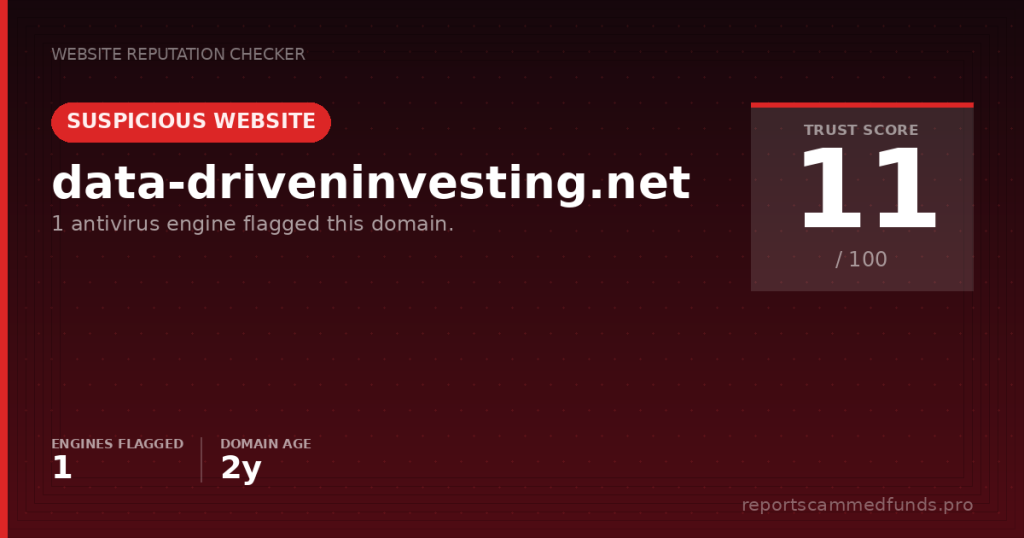
Data-driveninvesting.net displays all the hallmarks of a high-risk, likely fraudulent investment website: no license, no transparent ownership, unrealistic marketing, and a brochure-grade build masquerading as a platform. There is no credible reason to risk funds here when regulated alternatives exist with audited safeguards and real oversight. The short domain history, suspicious reputation signals, and lack of hard facts about custody and execution are disqualifying.
Our recommendation is unequivocal: do not sign up, do not deposit, and do not share personal documents. If you have already engaged, follow the help steps above without delay and consider freezing or replacing any payment instruments you used. Lastly, warn acquaintances who may also have been targeted by similar DeFi-and-‘quant’ themed pitches.
Vetting is simple: licensed firms publish regulator numbers you can verify in minutes. If a website cannot pass that basic test, walk away. Protect your capital and only consider platforms that meet the baseline standards set by reputable authorities.