Trading platform & site functionality
At first glance TeraFX’s public site is a modern promotional front end that redirects from terafx.com to terafx.com.tr, suggests a Turkish footprint, and uses a familiar stack: Bootstrap for layout, jQuery for scripting, and Google Tag Manager and Analytics for telemetry. We also observed Google reCAPTCHA on forms and multiple static assets referenced under a coherent asset pipeline, which is typically a sign of an actively maintained marketing site. The navigation highlights forex, precious metals like gold and silver, and energy commodities; it also features a customer portal link (customer.terafx.com.tr) and a conspicuous “open demo” button. Everything about the UI reads like a conventional retail‑FX broker marketing channel rather than a throwaway scam landing page.
What is missing from public pages, however, are trading‑critical details: spreads by instrument, explicit fee schedules, margin requirements, leverage caps, order execution policy, and named platforms (e.g., MT4, MT5, WebTrader). Many reputable brokers publish at least headline spreads and leverage constraints on their main site to let prospects compare conditions before handing over documents. In the absence of those, prospects are expected to create an account and discover terms inside the portal, which is less transparent and makes third‑party comparison difficult. The content also leans heavily on generic value propositions—fast onboarding, accessible markets—rather than granular, verifiable metrics.
The brand presence includes social links (Facebook, Instagram, LinkedIn, X) and a reference to Tera Yatırım, a Turkish investment firm, which provides some connective tissue to an established financial group. Yet, the TeraFX pages themselves don’t place the specific legal name and license parameters front and center—something we expect any compliant broker to do. This mixture—polished interface and mature domain on one side, sparse up‑front terms and entity details on the other—explains why we view the site as cautiously credible but not above reproach. Those contrasts are precisely where investors should slow down, verify the operator, and obtain the full terms in writing before sending funds.
License & regulatory status
Regulation is the hard dividing line between marketing claims and actual investor protection. In Turkey, leveraged products such as forex fall under the Capital Markets Board (SPK). The site’s Turkish language and reference to Tera Yatırım suggest a domestic focus and imply that the underlying service could be supervised locally. That said, the specific license number, the full legal name of the operating entity, and the scope of permitted activities are not presented in a way we could independently verify from the public pages. Without that clarity, readers are left to infer rather than confirm.
If the brand onboards clients in the European Union or the United Kingdom, separate permissioning would be required under regulators like the FCA in the UK or within the EU under ESMA’s regime (with national leads such as BaFin in Germany, CONSOB in Italy, or the AMF in France). We did not see evidence of FCA, BaFin, ASIC, or other overseas licences disclosed on the pages reviewed. That is not proof they don’t exist; it is simply a disclosure gap that matters a great deal to cross‑border customers. A regulated entity typically cites its regulator, license number, registered office, and complaint escalation channels on every page footer.
The right way to close this gap is simple but crucial: independently verify the legal operator’s name on the site, then search that exact name in the SPK registry (for Turkey) and, if you’re in other jurisdictions, in the FCA Register, ASIC’s Professional Registers, BaFin’s database, the CFTC/NFA in the U.S., or your local authority’s list. If the operating entity does not appear, appears with a different scope, or the brand name is not listed as a trading style of the licensed firm, you should assume you have no regulator‑backed recourse. Until TeraFX publishes a clear, verifiable licence reference, we consider its regulatory status unclear.
User feedback
We looked for a consolidated footprint of user reviews in English and Turkish public forums. There isn’t a large body of feedback either praising or condemning the brand, which in itself is not unusual for regionally focused brokers with marketing concentrated on local channels. The brand’s social profiles exist and are active, but social engagement alone is not a substitute for trustworthy, third‑party reviews that discuss concrete experiences such as onboarding, funding, and withdrawals. The lack of heavy negative chatter is a mild positive; the lack of detailed, verifiable positive case studies is a limitation.
In the retail‑FX world, the complaint patterns worth watching are predictable: withdrawal blockages after accounts turn profitable; surprise, retroactive KYC hurdles after the first payout request; spreads that widen around news to the point of consistent stop‑outs; and “managed‑account” or “copy‑trading” setups that mysteriously generate losses while fees continue to accrue. We did not see a specific, recurring theme uniquely tied to TeraFX in our scan window, but that does not mean such risks are absent. Many issues surface only once a user deposits and begins to trade, at which point leverage can amplify both gains and losses.
Prospective clients should pressure‑test support before committing funds. Ask support to provide the exact legal entity name, regulator, license number, and a link to the regulator’s web register; request the full schedule of fees, spreads, and margin policies; and get confirmation in writing of withdrawal timeframes and methods. If answers are evasive or internally inconsistent, that is valuable feedback in its own right. Given the mixed signals on disclosures, we would not proceed until those basics are met to your satisfaction.
Deposits & withdrawals
Funding and withdrawals are where many brokerage promises are tested. TeraFX’s public pages do not clearly list accepted funding methods, currencies, or minimum deposit thresholds, pushing prospects toward the private portal to discover those details. In the Turkish market, bank transfer (EFT/havale) is common; internationally, reputable brokers typically support cards and SWIFT wires, sometimes with local rails. Crypto funding can be a red flag unless very clearly tied to a regulated entity with transparent reconciliation.
Because the site does not publish the full cashier menu or withdrawal SLAs on open pages, treat all claims as unverified until the broker provides them in writing. Before you send funds, ask for itemized information: whether instant deposits are allowed, any third‑party processors used, the precise withdrawal methods available back to your origin account, daily and monthly caps, and processing timeframes for each method. Also ask whether fees are absorbed by the broker or passed on to you, and under what conditions any promotional credits or “bonus” offers might restrict withdrawals.
Once trading begins, the most common friction points are documentation requests at payout time, anti‑money‑laundering checks that delay transfers, or arguments about “abusive trading” when your strategy turns profitable. The remedy is preparation: upload complete KYC documents early, keep a ledger of every transaction, save platform logs and account statements, and do a small test withdrawal shortly after funding to confirm the pipe works in both directions. If the first payout fails or prompts shifting goalposts, stop trading, record everything, and escalate before your balance is at risk.
Why unregulated brokers are risky
Trading on platforms with unclear or unverified licensing exposes you to material risks that go far beyond market volatility. Without a regulator‑backed complaints process and segregation of client funds, you may have limited recourse if the broker delays withdrawals, changes terms without notice, or closes your account. You are effectively relying on the operator’s goodwill and solvency rather than on legally binding standards enforced by a supervisory body.
Jurisdiction also matters. SPK in Turkey, the FCA in the UK, the CFTC/NFA in the U.S., and ESMA‑aligned regulators in the EU impose leverage caps, marketing restrictions, and conduct rules designed to reduce harm in high‑risk products like CFDs. Brokers that operate outside those frameworks can offer eye‑catching leverage or bonuses, but those perks often come at the expense of fund safety, fair execution, or transparent dispute resolution. When things go wrong, offshore or unregulated setups leave customers with little more than emails and unanswered tickets.
Even with a regulated entity, customers must check that the specific brand and domain are actually covered as trading names of that entity, and that you are contracted with the licensed company, not an unregulated affiliate. If a site’s footer lacks the full legal name, registered office, and licence reference, treat that as a significant gap. Until TeraFX makes its regulatory status plain and verifiable on the site, we consider it prudent to approach as if investor protection is limited.
How to get help if you’ve been scammed
If you have already deposited with TeraFX and are now facing unexplained delays or changing conditions, act quickly. First, stop sending additional funds and gather evidence: screenshots of the portal, chat logs, emails, transaction receipts, and a diary of dates and names. Attempt a documented withdrawal request through the official channel, and give a reasonable deadline for response in writing. Do not accept verbal assurances—insist on written replies that can be shown to your bank or a regulator.
Next, contact your bank or card issuer. For card payments, ask about a chargeback under the relevant scheme rules; for bank wires, ask your bank to initiate a recall or an investigation, and make them aware of the reason (misrepresentation, non‑delivery of service, suspected fraud). If you are in the UK, report the matter to Action Fraud; in the EU, notify your national authority (e.g., BaFin, CONSOB, AMF) as appropriate; in the U.S., file a complaint with the FTC and IC3. If you believe a Turkish entity is involved, consider notifying the SPK as well.
For tailored guidance, you can reach our team at reportscammedfunds.pro. We help victims document their case, assess realistic recovery avenues, and communicate with banks and platforms to escalate disputes. While no recovery is guaranteed—particularly with lightly regulated brokers—swift, well‑documented action gives you the best chance. Contact us via reportscammedfunds.pro so we can review your timeline, evidence, and jurisdiction and advise you on next steps.
Conclusion
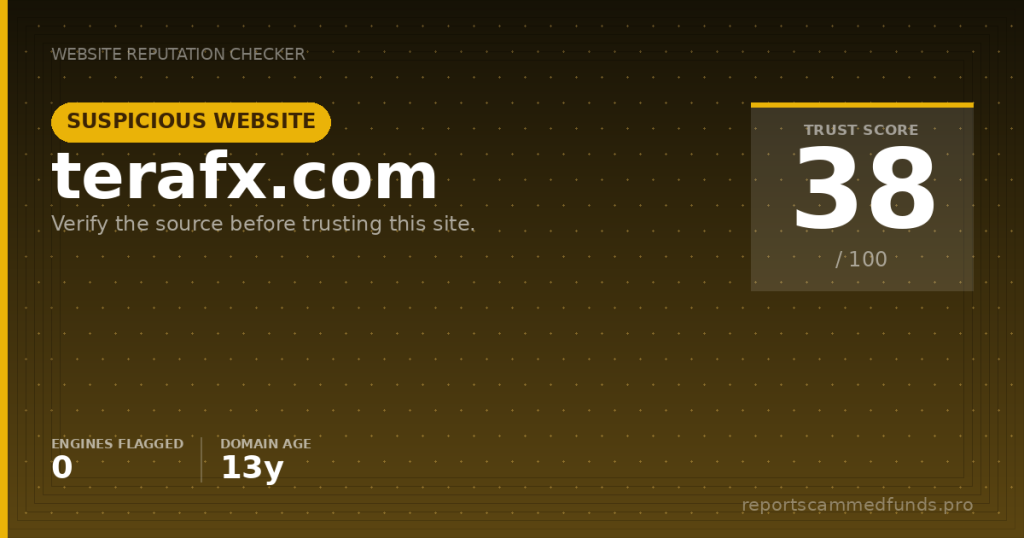
On balance, TeraFX’s web presence looks polished and technically clean, with a long‑registered domain and normal marketing integrations, and it references a known Turkish investment group. Those are points in its favor. However, essential investor‑protection disclosures—like the operating legal entity, regulator licence number, and clear trading conditions—are not presented on public pages in a way we could independently verify. For a leveraged‑products broker, that is not a small omission.
If you are considering opening an account, proceed only after independently verifying the legal entity and its licence in the SPK registry (if you are in Turkey) or in your own jurisdiction’s register if you are abroad. Obtain the fee schedule, spreads, leverage, margining rules, and withdrawal policies in writing, and perform a small test withdrawal early. Decline any “bonus” or managed‑account offers that condition access to your principal or profits.
We do not label TeraFX a scam, but we cannot call it unequivocally safe either based on the public information available. The prudent position is caution: do not send funds until you have documentary clarity. If those disclosures are provided and verified, the risk profile improves; absent that, look for a broker that publishes its licence and terms plainly and passes a regulator‑register search without ambiguity.