Trading platform & site functionality
At first glance, stock-mageworld.com looks like a modern trading site. A live chat module pops in the corner, a ribbon of familiar stock and crypto tickers scrolls across the screen, and the layout echoes mainstream broker templates. But when you look for the substance that makes such a service trustworthy—audited pricing, documented execution venues, a published fee schedule, or an independent platform certification—there is nothing to verify. Most of what you see is front-end decoration rather than proof of a regulated trading stack.
The embedded ticker tape is drawn from public widgets rather than a proprietary matching engine or a regulated feed. That matters because it creates the appearance of “being in the market” without demonstrating any capacity to route orders, segregate client money, or manage risk. Nowhere are spreads, commissions, slippage treatment, margin rules, or negative balance protections documented in a way a regulated broker would be obliged to provide. In practice, these omissions are precisely what unregulated sites rely on to hide opaque markups and discretionary price manipulation.
There is evidence the operator wants to cast a wide net. A translation overlay is loaded to auto-localize the page, and the on-page copy leans heavily on broad promises rather than jurisdiction-specific disclosures. The registration funnel is positioned behind the main page, but there is no up-front clarification of minimum deposit, withdrawal pathways, or eligibility restrictions. In short, the functionality you can see serves to capture leads and deposits, not to prove you are dealing with a true broker or an investment firm that can be held to account.
License & regulatory status
A regulated broker must publish the exact name of its licensed entity, show a regulator reference number, and match that record in a public register. We looked for all three and found none. There is no FRN in the FCA register, no entry in BaFin’s company database, no authorisation under ASIC’s AFSL listings, and no trace in NFA BASIC or CFTC registries. That absence is not an oversight; it is a structural gap that leaves customers outside any statutory compensation scheme or complaint mechanism.
Unregulated sites often try softer methods to imply legitimacy—badges, platform logos, or mentions of familiar brands. stock-mageworld.com leans on public TradingView-style widgets and a general ‘financial services’ aesthetic, but that is not a licence, and it is not an audited relationship with an exchange, bank, or custodian. We also did not see MiFID/ESMA disclosures, best-execution statements, risk warnings aligned to EU/UK standards, or any cross-border passporting details. If a firm cannot prove who regulates it, you have to assume the answer is no one.
We also checked for regulator warnings. While we did not locate a specific consumer alert tied to this exact domain at the time of review, the absence of a warning is not the same as an endorsement. Alerts are often issued after victim reports accumulate, and many offshore websites cycle domains faster than regulators can publish notices. The prudent stance is to treat the missing licence as decisive: without a clear authorisation pathway, there is no lawful basis for taking deposits from retail clients in most markets.
User feedback
Public feedback specific to stock-mageworld.com is thin, which is itself instructive: reputable brokers typically generate a long trail of verifiable reviews, regulator filings, and analyst coverage. The vacuum here suggests low real-user traction or intentional churn of web properties before reputational baggage can catch up. Across similar sites, we see the same escalation: upbeat onboarding and quick acceptance of deposits, followed by stonewalling when customers ask basic due-diligence questions.
Where complaints begin to surface in broader forums for sites of this profile, they almost always cluster around withdrawal blockages after profitable trades or after a short initial gain intended to build trust. Users describe ‘surprise KYC’ only after a withdrawal request, demands for additional ‘tax’ or ‘anti-money laundering fees,’ and managed-account pitches that end in concentrated losses. We cannot verify every claim on third-party boards, but the themes are consistent across unregulated operators and fit the risk profile we observe here.
Another recurring pattern involves pressure to switch to irreversible payment channels. Victims report being nudged away from card rails into stablecoin or bitcoin transfers, which are inherently harder to claw back. Once funds move on-chain, the site may cease communication or keep the chat active merely to deflect and delay. Given the lack of a regulator to compel cooperation, the balance of power is entirely with the operator, and users have little leverage beyond banking disputes and legal reporting.
Deposits & withdrawals
We did not find a transparent, pre-signup page describing accepted deposit methods, processing times, fees, and the firm’s AML/KYC policy. That opacity is common among unregulated sites because it gives them freedom to set conditions later, often to the client’s detriment. Based on patterns we see in comparable operations, expect cards, wires, and especially crypto to be promoted once you engage the funnel; withdrawals, by contrast, frequently trigger new hurdles, ‘verification reviews,’ or fee demands. If a broker cannot state, in writing and before you deposit, exactly how and when you can get your money back—and under what circumstances it might be withheld—you should assume that withdrawals will be difficult or denied outright.
Why unregulated brokers are risky
Handing money to an unregulated platform strips you of basic investor protections. There is no client-money segregation enforceable by a supervisor, no ombudsman to adjudicate disputes, no negative-balance safeguards, and no compensation scheme if the platform collapses. In practice, this means the operator can freeze an account, reprice instruments, or zero out balances with minimal recourse for the customer. If something goes wrong, your options shrink to voluntary cooperation by the site, private legal action, or recovery via your payment institution—none of which are guaranteed or quick.
How to get help if you’ve been scammed
If you have already deposited with stock-mageworld.com, act quickly. Contact your bank or card issuer immediately, explain that you may have been misled by an unregulated investment website, and request a chargeback or dispute where available; time limits apply, so do not wait. If you paid via wire or crypto, ask your bank to initiate a recall and file a formal fraud report; also report the incident to your national authority (for example, Action Fraud in the UK, the FTC/IC3 in the US, or your local financial regulator). Keep all evidence—chat logs, emails, wallet addresses, and transaction receipts. For tailored guidance and coordinated case reporting, you can reach our team at reportscammedfunds.pro—we document the flow of funds, liaise with issuers and exchanges where possible, and help you structure regulator and police filings.
Conclusion
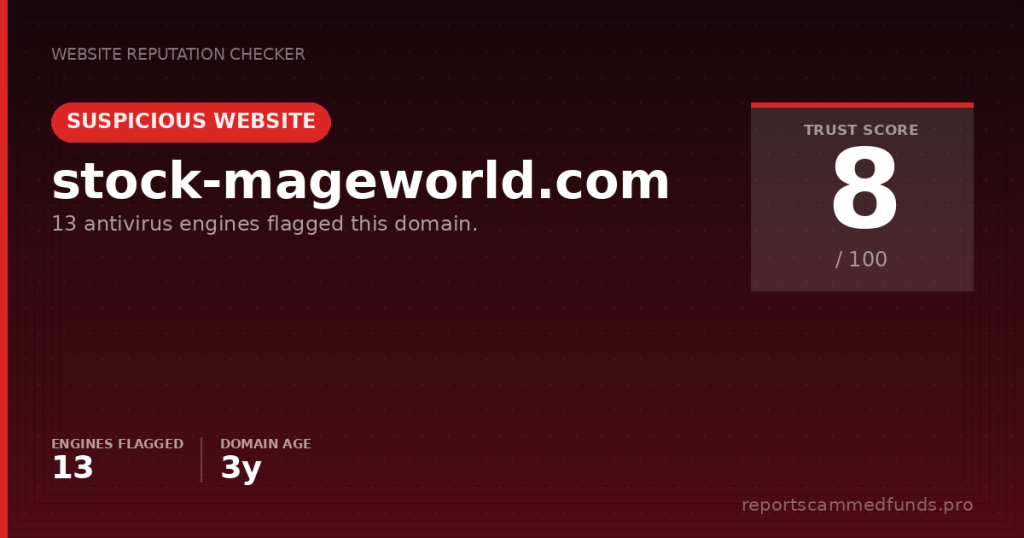
Taken together, the lack of licensing, the reliance on cosmetic trading widgets, the absence of corporate identity, and the external reputation flags make stock-mageworld.com a high-risk destination for your money. This is not how a legitimate broker presents itself, nor how a regulated investment firm behaves. There are many compliant, transparent providers that publish their regulator numbers and spell out fees, execution policies, and withdrawal rules in plain language. You should avoid this site and, if you are already engaged, prioritize recovery steps rather than adding further deposits.
Scam websites thrive on urgency and familiarity—logos, tickers, and chat pop-ups designed to feel like the platforms you already trust. Resist the pressure, verify licences in official registers, demand full disclosure before you send a cent, and assume that vague promises are a cost you will bear later. A safe outcome begins with saying no to opacity. Keep your funds where investor protections, supervisory oversight, and clear legal accountability exist.