Trading platform & site functionality
The branding and domain suggest Samstar Capital positions itself in the investing or brokerage sphere, possibly offering account-based access to markets. Legitimate brokers typically display a clear product menu that includes asset classes, fees, margin requirements, and platform compatibility. By contrast, here we found no independently verifiable disclosures outlining spreads, commissions, or the nature of the instruments on offer. The lack of a transparent product sheet or a downloadable platform client is a practical barrier to evaluating what, exactly, the site provides.
Well-run brokerages and investment platforms usually detail their technology stack, whether MetaTrader (MT4/MT5), a proprietary web platform, or a mobile app with a verifiable listing. They also publish server locations, uptime expectations, and policies for emergency outages. Samstarcapital.com offers none of these verifiable points, and repeated attempts to access the site were unsuccessful during our review window. Without live access or a reliable status page, it is impossible to assess execution quality, pricing integrity, or latency, all of which matter for trading outcomes.
Another hallmark of a legitimate operator is the presence of thorough legal documentation: client agreement, risk disclosure, order execution policy, conflicts of interest statement, and fee schedules. The inability to locate these core documents leaves prospective clients without a baseline understanding of rights and obligations. In practice, a missing or skeletal legal section often correlates with later disputes over fees, surprise KYC hurdles, or arbitrary account freezes. Transparent firms tend to expose their legal stack prominently, often in the footer and onboard flows, precisely to avoid ambiguity.
We also look for a coherent funnel: demo accounts, educational content, and a transparent path from inquiry to account funding. Established brokers offer a demo environment to test spreads and execution and to reassure newcomers before they commit capital. With Samstarcapital.com, there is no evidence of a demo environment, structured education, or a properly described onboarding process. The overall absence of clear functionality and documentation is not a trivial omission—it is a critical warning signal in a sector where transparency is table stakes.
License & regulatory status
Regulatory status is the single most important factor in evaluating a financial platform. We searched public registers maintained by major authorities—specifically the FCA in the UK, ASIC in Australia, BaFin in Germany, the CFTC/NFA in the United States, and CONSOB in Italy—for any entity matching “Samstar Capital” or variants connected to the domain. We could not locate a confirmed authorization or registration linked to this brand or website. This does not mean no registration exists anywhere, but it strongly suggests the operator is not licensed by leading market regulators.
Missing registration has direct consequences for customers. Regulated firms must meet capital adequacy standards, segregate client funds, submit to audits, and maintain dispute resolution pathways (for instance, via the Financial Ombudsman Service in the UK or AFCA in Australia). Unregulated sites rarely follow these standards, and customers typically have far fewer options if something goes wrong. When a platform lacks readily verifiable regulatory credentials, the default assumption should be that investor protections are minimal or nonexistent.
We also check for false claims of affiliation, which are common among high-risk operators. Some platforms display fabricated license numbers, misuse logos, or cite expired authorizations in an attempt to appear legitimate. For Samstarcapital.com, we did not see any verifiable license references during our review and could not confirm legitimate affiliations. If the site presents a license claim at a later time, readers should independently verify it on the regulator’s official register rather than accepting screenshots or PDFs as proof.
Finally, we looked for regulator-issued warnings or consumer alerts naming this brand or domain. We did not find a formal warning at the time of writing, but absence of a warning is not an endorsement; many fraudulent sites operate for months before a regulator posts an alert. Therefore, the lack of a warning should not temper the core concern: without a clear, validated license, customers bear disproportionate risk. In finance, the burden of proof lies with the operator to prove authorization—not with the public to prove malfeasance.
User feedback
User feedback can be a powerful cross-check, yet for Samstarcapital.com, the public record is thin. References to a low Trustpilot rating exist, though the sample size appears limited and individual entries are not sufficient to establish a trend. Sparse feedback is common for very new domains and does not absolve risk—it simply reduces the amount of data available for analysis. When feedback is scarce, other due-diligence pillars like licensing and corporate identity must carry greater weight.
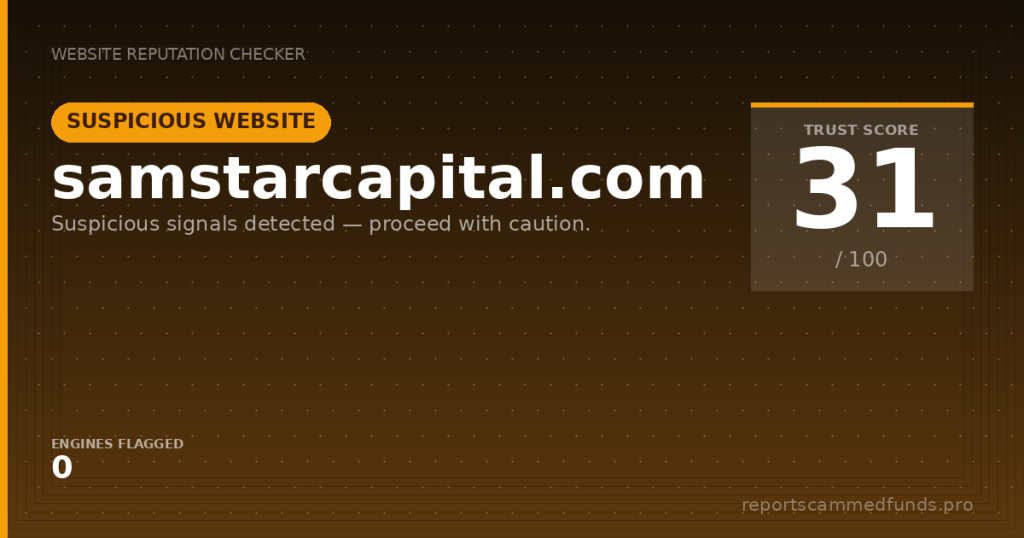
We also skimmed public forums and social channels for consistent complaint patterns such as withdrawal blockages after profit, surprise KYC requests post-deposit, or managed-account losses controlled by unlicensed ‘advisers’. No cohesive body of reports exists yet that can be independently verified, which is typical for a recently launched domain. At the same time, the domain’s low trust reputation and blacklisting flag temper any optimism. Caution is prudent until a credible track record emerges.
In the absence of robust reviews, we look for indirect signals: responsive customer support footprints, named leadership with verifiable histories, and engagement with regulatory inquiries. We were unable to find credible, attributable executives or support channels that inspire confidence. Even if scattered positive remarks appear over time, investors should insist on structural proofs—licensed status, segregated accounts, and clear complaints handling—before allowing these anecdotes to influence risk decisions.
Deposits & withdrawals
Legitimate platforms disclose funding channels with specificity: card processors, wire instructions to named beneficiary entities, and any crypto wallet addresses with clear billing references. They also enumerate all fees—deposit, withdrawal, inactivity—and give timeframes for each operation. Samstarcapital.com does not provide verifiable details we can cite, so we cannot confirm whether it accepts cards, bank transfers, or crypto. This opacity is concerning because payment rails define your recourse options if a dispute arises.
If you are considering testing the platform despite the risks, never begin with a large transfer. Use the minimum possible amount and immediately test a withdrawal, even before trading, to validate that funds can return to the original payment source in a timely manner. Capture the terms and conditions at the time of deposit, paying close attention to bonus clauses, volume requirements, or ‘account manager’ permissions that can be weaponized to block payouts. Early KYC requests should be completed before any significant deposit to avoid the ‘surprise KYC after deposit’ pattern.
Crypto-only funding, if present, is a strong red flag because crypto transfers are final and difficult to reverse. Unregulated platforms sometimes steer customers to stablecoin or bitcoin deposits through convoluted instructions, then later allege technical or compliance delays when withdrawals are requested. Without clarity on Samstarcapital.com’s funding methods, assume conservative odds for friction, especially if bonuses, managed accounts, or unusually high promised returns are involved. The safest course is to avoid depositing until transparent, regulated funding processes are demonstrated.
Why unregulated brokers are risky
Unregulated platforms present a structural risk: you are not dealing with an institution held to statutory standards of conduct. There is usually no investor compensation scheme, no guaranteed segregation of client funds, and no binding complaints ombudsman. If a dispute arises, your leverage often ends with the firm’s own support desk, which may be slow, opaque, or unresponsive. This imbalance explains why regulators repeatedly warn the public to use only authorized providers.
Beyond the absence of formal protections, contract terms at unregulated shops can be unusually one-sided. They may include nontransparent fees, broad rights to close positions, or arbitrary thresholds before withdrawals are allowed. We frequently see ‘bonus’ terms used to lock accounts—clients are told they must reach unrealistic turnover targets for access to their own funds. In high-risk settings, even straightforward requests like a name change or an address update can become friction points used to delay or deny payouts.
Another subtle risk is data handling. Unregulated operators can mishandle personal information, reuse documents across related entities, or share contact details with cold-calling ‘recovery’ outfits once users complain. These downstream harms can persist long after the initial deposit, compounding losses through phishing, identity fraud, or secondary scams. The best mitigation is prevention—avoid exposing personal data and funds to entities that have not earned trust through licensing and verifiable transparency.
How to get help if you’ve been scammed
If you have already sent money to Samstarcapital.com and suspect wrongdoing, act quickly. First, contact your bank or card issuer and request a chargeback or dispute, citing misrepresentation or services not rendered as appropriate. For wire transfers, ask your bank to initiate a fraud recall or SWIFT recall immediately—time is critical. For crypto, gather the transaction hashes and wallet addresses; while refunds are unlikely, this evidence will aid investigations.
Next, file reports with the relevant authorities in your jurisdiction. In the UK, report to Action Fraud; in the EU, contact your national regulator or police cybercrime unit; in the United States, file with the FTC and IC3. Include screenshots, emails, chat logs, and any contracts, and keep a timeline of events with dates and amounts. These reports create a paper trail and can help others avoid the same trap.
Be alert to recovery scams that emerge after an initial loss. These outfits often claim insider relationships or guaranteed chargebacks for an upfront fee, then disappear or recycle your data. A legitimate recovery effort never guarantees outcomes and will not pressure you to pay on the spot. Vet any service provider carefully and refuse to share remote desktop access or additional identity documents unless you have independently verified the organization.
For structured assistance, you can reach our team at reportscammedfunds.pro. We review cases, help you triage next steps with your bank, and prepare documentation to support disputes and regulatory reports. While no outcome is guaranteed, early, organized action materially improves your chances. Contact us if you need help assessing your options or compiling evidence in a way that maximizes impact.
Conclusion
Taken together, the lack of licensing, short domain history, blacklisting status, and unreliable site availability place Samstarcapital.com firmly in the high-risk category. None of these factors alone proves intent to defraud, but collectively they signal a platform that has not earned trust. In finance, the operator must prove legitimacy up front; it should not be the customer’s job to reverse-engineer basic disclosures.
If you still consider engagement, insist on independent verification of regulatory status and company identity, then start with a nominal deposit and an immediate withdrawal test. Decline bonus offers and avoid ‘managed account’ arrangements where an unlicensed party controls your trades. Never send crypto or wire transfers to unnamed beneficiaries, and do not rely on screenshots or PDFs as proof of authorization—validate claims on the regulator’s official website.
Our recommendation is to avoid funding an account with Samstarcapital.com unless and until it demonstrates clear, verifiable regulation and a transparent corporate footprint. There are many authorized, well-reviewed alternatives that publish their licenses, policies, and pricing in plain view. Your capital and personal data are worth protecting; until this operator meets industry norms, keep your distance.