
Trading platform & site functionality
Kviku Finance positions itself as a peer-to-peer investment hub where retail participants can fund portions of consumer loans that are part of the Kviku Group’s portfolio. The landing pages emphasize breadth across several countries with prominent national flags and a web-based dashboard implied, rather than specialist trading software. Technically, the site uses standard content-delivery and analytics tooling and loads quickly, which is consistent with a basic, modern marketing website. However, beyond the marketing veneer, the functional details of how investors interact with the loan pool—precise selection, auto-invest rules, or secondary market capability—are not clearly spelled out pre-registration. That lack of up-front operational detail is atypical of mature P2P platforms that usually publish granular FAQs and investor terms before asking for sign-up.
The technology stack observed includes Google Tag Manager and analytics, Yandex Metrika, and Cloudflare’s browser insights. This is fairly routine for web tracking and performance optimization, but it also means significant data collection occurs, and some of it routes through third-party analytics endpoints. For users in regulated jurisdictions, that raises familiar questions about GDPR/CCPA handling, cookie consent, and international data transfers, none of which are addressed in a way we could independently verify. The platform appears to employ Cloudflare for DNS and certificate management, which is normal but also obscures the origin server location—fine for security, but less helpful for independent checks of hosting geography.
On the content side, the site links out to multiple external reviews and blog posts in several languages. This suggests a reliance on affiliate-style marketing and influencer commentary rather than on internal, fully documented disclosures. That is not inherently negative, yet experienced investors typically look for downloadable loan performance reports, NPL (non-performing loan) ratios, net yield curves after defaults, and stress-scenario results. Here, those performance artifacts are either absent or not easily found by a non-registered visitor, leaving a gap between marketing claims and verifiable portfolio analytics.
We did not encounter interactive elements like live order books, open APIs for portfolio analytics, or a public status page for platform uptime. For a platform promoting diversified loan exposure, transparent metrics such as delinquency buckets, recovery timelines, and cash drag figures would help a prospective investor calibrate expectations. The omission does not prove misconduct, but it does lower the evidentiary quality for an investor’s pre-commitment analysis. In comparison, more mature European P2P marketplaces often publish comprehensive monthly statistics and loanbook snapshots without requiring a login.
Lastly, the public pages do not specify whether investors can choose individual loans or invest via a pooled or auto-algorithmic strategy. Nor do they detail fees—such as platform commissions, currency conversion spreads, or withdrawal charges—before registration. Absent fee tables and user guides, any economic assessment of net yield versus risk remains speculative. This combination of a polished front end but sparse operational disclosures keeps our assessment firmly in the cautious category.
License & regulatory status
A central question for retail-facing P2P sites is who regulates the platform and under what permissions. In this case, we could not find a published license number, named national regulator, or authorization register entry directly on the public pages. There is also no immediate evidence of passported permissions or gray passport claims into major markets such as the UK (FCA), EU (BaFin, CONSOB, CSSF, CNMV), Australia (ASIC), or the US (SEC/CFTC). Without a verifiable regulatory umbrella, investors lose the safety backstops that come with capital-adequacy standards, conduct rules, and formal complaints mechanisms supervised by a statutory body.
The website presents several country flags (for example, Spain, Kazakhstan, the Philippines, India, and Russia), implying geographic reach. However, the presence of flags does not constitute legal permission to solicit investments in those jurisdictions, nor does it indicate that investor funds are protected under local investor-compensation schemes. We did not locate regulator warnings specifically naming the site in public lists during this review, but absence of a warning does not equal authorization. The appropriate framing is that we could not independently verify any claim of licensure or supervision, and the operator has not made that task easy by publishing clear documentation or references to an official register.
User feedback
Public sentiment around P2P lending platforms often swings with the credit cycle, and we have seen commentary that ranges from praise for yield to criticism over communication delays during stress periods—this is true across the sector. For kviku.finance specifically, third-party blogs and aggregator write-ups exist, but such content can be affiliate-incentivized and is not the same as audited reporting or regulator-facilitated complaint outcomes. We saw references to external reviews in multiple languages, suggesting an international marketing footprint, yet we were not able to validate consistency across those sources or confirm their independence.
We did not find a single, consistent body of verified user complaints corroborated by a public authority during this review. That said, typical P2P investor grievances—when they occur—include delayed withdrawals during portfolio stress, surprise KYC escalations after deposits, slow support response during grace-period extensions, and questions about how buyback guarantees are honored if the originator’s own liquidity deteriorates. None of these are asserted as fact for Kviku Finance here; rather, they are sectoral patterns that prudent investors should pressure-test with the operator before sending funds. If you cannot obtain precise, written explanations about cash-out timelines, default-handling mechanics, and the financial health of the loan originator, you should view advertised yields with skepticism.
Deposits & withdrawals
Funding and withdrawal processes are not described in sufficient granularity on the public pages. We did not see a pre-registration summary of accepted payment methods—such as bank wire, card, or e-wallet—nor any standard timelines for settlement or cash-out. Without those, an investor cannot price liquidity risk, which is a core dimension in P2P lending because loans are not exchange-traded and redemptions can depend on borrower repayments or buyback mechanisms.
It is also unclear whether the platform uses segregated client accounts, pooled omnibus structures, or commingled operational accounts. This matters because segregation reduces the risk that an operator’s creditors could claim investor funds if the platform entity becomes insolvent. We could not find confirmation that a third-party custodian or trustee ring-fences investor money, and the site did not present reconciliation or attestations that would substitute for such controls.
Withdrawal friction is a common pain point for retail platforms during market or credit stress: queues can grow, payout cutoffs extend, and documentation requests escalate. The site does not pre-commit to processing windows or escalation steps in plain language. Before depositing, ask the operator in writing about how withdrawals worked during the last significant stress period, whether there were any payout moratoria, and what service levels are guaranteed if the originator’s collection rates dip. If you cannot get unambiguous answers, assume higher liquidity risk than the landing pages imply.
Why unregulated brokers are risky
Unregulated or non-verified investment platforms present layered risks: there is no prudential oversight, no statutory complaints route, and no investor-compensation scheme if things go wrong. If a P2P operator commingles client and company funds, an insolvency event can strand investor money with little recourse beyond civil litigation in a potentially foreign venue. Geopolitical and cross-border banking frictions further complicate matters; correspondent banks may decline or delay payments from certain jurisdictions, disrupting cash flows even when underlying borrowers are current. In short, the absence of a visible regulator does not prove malfeasance—but it does remove guardrails that many retail investors rely upon for redress and transparency.
How to get help if you’ve been scammed
If you have already transferred money and are now facing delays, blocked withdrawals, or unresponsive support, act quickly. First, contact your bank or card issuer and request a chargeback or recall where applicable, documenting the timeline of your requests and the operator’s responses. Second, file a report with your national authority—examples include the FCA in the UK, your state regulator or the CFTC/SEC in the US (depending on scope), BaFin in Germany, or your local consumer protection body in the EU. Third, if you suspect fraud or misrepresentation, also report the case to your cybercrime unit (for example, Action Fraud in the UK or IC3 in the US) so a formal record exists.
For tailored guidance on evidence preservation, recovery avenues, and regulator escalations, you can reach our team at reportscammedfunds.pro. Provide transaction screenshots, email headers, KYC prompts, and any signed agreements so we can map the fastest escalation route and help you avoid common pitfalls like follow-on “recovery scams.” Timely, well-documented action improves the odds of a successful dispute or remedy, especially when cross-border transfers and multiple intermediaries are involved.
Conclusion
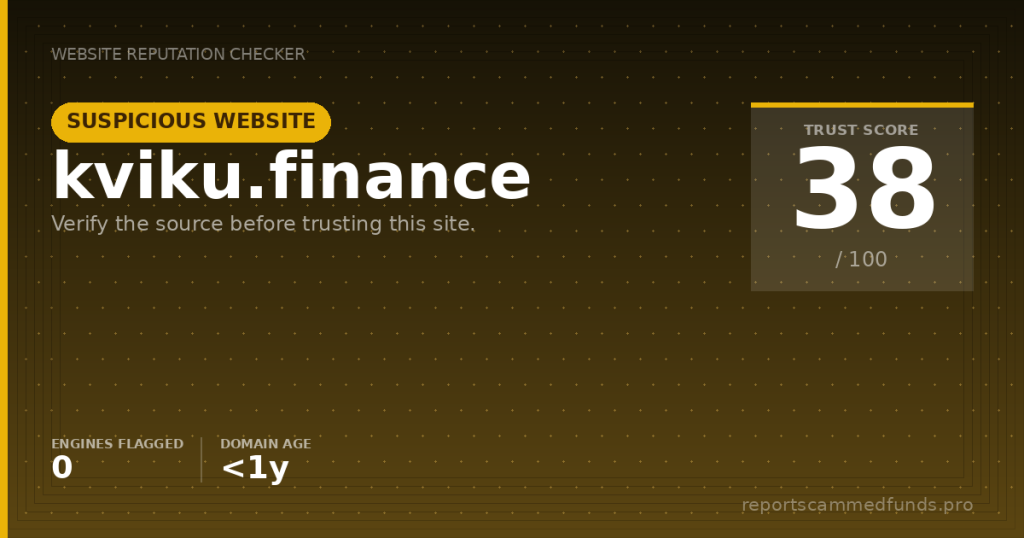
Kviku Finance presents a professional-looking gateway into consumer loan exposure, but it does not provide the level of regulatory clarity, audited performance data, and investor-protection detail we expect from a platform soliciting retail funds. Automated checks show no obvious malware or phishing indicators, which is positive; however, safety for investors is determined less by code hygiene and more by governance, licensing, segregation of funds, and transparent disclosures. Until verifiable regulator authorization, independent audits, and robust investor safeguards are published, we recommend extreme caution and limited exposure at most—if any. At a minimum, obtain written answers to the critical questions outlined above and cross-check those answers against official registers before proceeding.