
Trading platform & site functionality
At the time of our review, commonwealthtrade.io does not operate as a functional website. Visiting the domain loads a 404 page with a 'deployment not found' indicator, pointing to a misconfigured or dismantled hosting setup. A financial service that cannot keep its homepage online is not merely experiencing a hiccup; it is signaling operational neglect or abandonment. This is not how compliant brokers, which must maintain robust client portals and status transparency, conduct themselves.
Automated checks on the domain’s code footprint suggest it was positioned as a trading or investment portal, with hints of cryptocurrency and forex themes and a standard registration flow. Yet none of the essential pages are available: not a platform description, not a pricing sheet, not even a reliable login screen. That mismatch between the apparent pitch and actual operability is a hallmark of short-lived campaigns that capture deposits before going dark. The absence of even basic content prevents users from evaluating spreads, execution model, fees, or risk disclosures—information that legitimate firms provide up front.
Even if the operators later restore the site, the present opacity is already disqualifying. We found no visible company name in the footer, no legal entities listed, no address, and no customer-support framework one could test. There is also no published status page, no incident reporting, and no historical uptime evidence. For a supposed broker or investment platform, failing to meet these basic operational thresholds is a critical red flag that should stop prospective clients in their tracks.
License & regulatory status
We found no licensing or registration statements on commonwealthtrade.io—no regulator logos, authorizations, or reference numbers. Because the site is currently broken, even the usual legal pages (Terms and Conditions, Client Agreement, Risk Disclosure) cannot be consulted. Licensed brokers typically display their supervising authority prominently and link to their authorization pages; this brand does not. Taken together, the omissions strongly indicate the operation is unregulated.
Independent verification attempts did not uncover any authorization we could validate with major regulators. We could not independently verify this brand or domain on the public registers of the FCA (UK), BaFin (Germany), ASIC (Australia), CONSOB (Italy), or the CFTC/NFA (US). The use of a generic offshore-friendly domain and cloud infrastructure is common among entities that avoid the consumer protections these bodies enforce. Without regulatory oversight, there is no mandated segregation of client funds, no capital adequacy standards, and no verified complaint resolution framework.
The brand’s use of the word 'Commonwealth' risks confusion with legitimate financial institutions that include that term in their names. We have repeatedly documented how boiler-room scripts lean on such familiar words to imply legitimacy without proof. We did not see a specific public warning about this exact domain at the time of review, but the lack of a disclosed legal entity and a licensing footprint is decisive on its own. Absent clear, verifiable authorization, this website should not be trusted to hold client money or provide trading services.
User feedback
Reliable, independently sourced user feedback about commonwealthtrade.io is scarce to non-existent. There are no enduring forum threads from established communities, no traceable third-party audits, and no transparent complaint histories. That vacuum is consistent with a very new or already-abandoned operation rather than a maturing broker with years of mixed but traceable commentary. The lack of a public footprint is a warning sign, not a neutral data point.
Complaints we receive about similar setups tend to follow a predictable arc. Users report withdrawal blockages after their accounts show profit, followed by 'surprise KYC' demands levied only after they ask to cash out. Others are told to prepay invented items—'taxes', 'liquidity fees', 'unlock charges'—to release funds, a hallmark of advance-fee fraud layered on top of the original ruse. Some are pushed into 'managed accounts' with aggressive leverage, quickly generating losses that then become the pretext for refusing withdrawals.
Because the website is currently broken, we cannot test or verify any support channels or ticketing systems, and no alternative contact details are publicly visible. Scam operations often respond to complaint pressure by abandoning inboxes and standing up a new domain with the same scripts and sales playbook. Any glowing testimonials you might encounter—especially those hosted by the operator itself or on low-quality review farms—should be treated as marketing artifacts rather than evidence. In this context, the absence of credible, independent feedback reinforces the risk.
Deposits & withdrawals
Accepted payment methods are not disclosed because the site is not functioning, but the pattern with comparable offshore operations is familiar: cards, bank wires, and cryptocurrency deposits. Crypto is favored by fraudsters because it is hard to reverse; cards are used to capture quick deposits; and wires enable higher sums under the radar. Minimum deposits in the $250–$500 range are common bait, accompanied by pressure to 'upgrade' to larger tiers. Without published legal terms or a working dashboard, there is no way to confirm fees, cut-offs, or processing times.
Withdrawal experiences reported across similar websites are bleak. The moment a user requests a payout, undisclosed conditions materialize: volume targets attached to a 'bonus' you never knowingly accepted, 'compliance reviews' that drag on for weeks, or sudden claims that taxes must be prepaid outside normal channels. Some victims are told a small 'verification' top-up is required to release the existing balance—a textbook advance-fee gambit that only deepens the hole. Properly regulated brokers do not fabricate new hurdles post-deposit, and they never ask you to prepay tax to unlock your own funds.
If you have already shared bank or card details, understand that the risk does not end with the first transfer. Recurring charges can reappear under different merchant descriptors, and mid-risk payment processors are frequently rotated to evade detection. If you used cryptocurrency, addresses may change between deposits, but funds typically consolidate through mixers or major exchanges—speed matters if you want transfers flagged. In short, a website that cannot keep its homepage online is not going to process your withdrawal reliably, if at all.
Why unregulated brokers are risky
Unregulated platforms offer you virtually no protection. There is no FSCS-style safety net in the UK, no SIPC backstop as in the US, and no mandatory segregation of client assets. If the operator goes dark or misappropriates funds, you face cross-border complexities, unresponsive intermediaries, and limited civil recourse. Regulators can warn, but retrieving money from an offshore-controlled wallet is a different battle entirely.
The products and incentives typically pushed by such sites are precisely those restricted or banned under modern rules. Excessive leverage, trading 'bonuses' that quietly lock your funds, and the promise—or even suggestion—of guaranteed returns are the tell-tale signals. Bodies like the FCA, ESMA, and ASIC have clamped down on these practices because they harm retail investors. When an offshore brand leans on them, it is exploiting a regulatory gap, not competing on service quality.
Technical opacity compounds the harm. Unsupervised web platforms can display manipulated prices, selectively reject winning trades, and simulate profits to coax ever-larger deposits. Without third-party audits, verified liquidity relationships, and strong segregation controls, there is nothing to stop an operator from editing your 'balance' at will. Trusting an unregulated, opaque venue with your capital is functionally the same as handing it to a stranger and hoping for the best.
How to get help if you’ve been scammed
If you already sent money or documents to commonwealthtrade.io, act immediately. Stop all further funding, disengage from any 'advisor' or 'account manager,' and preserve all records: emails, chat logs, phone recordings, wallet addresses, transaction hashes, bank receipts, and screenshots. File a written withdrawal request and save the response or silence as evidence. Do not pay any additional 'tax', 'verification', or 'unlock' fees—those are classic recovery-scam tactics designed to extract more.
Contact your bank or card issuer without delay. For card payments, request a chargeback due to misrepresentation or services not provided; be specific and provide documentation. For bank transfers, ask for a recall and file a fraud report so the receiving bank can attempt to freeze beneficiary accounts. If you used cryptocurrency, immediately notify the exchange you used, submit transaction details, and request that the counterparty be flagged—time is critical for any meaningful tracing.
Report the incident to the appropriate authorities. In the UK, file with Action Fraud; in the US, report to IC3 and your state regulator; in the EU, use national police channels and econsumer.gov. Also alert financial regulators like the FCA, BaFin, CONSOB, or ASIC if you were solicited in their jurisdictions. Multiple reports help link domains and payment rails across campaigns that routinely rebrand and migrate.
For professional guidance and to reduce the risk of secondary scams, reach out to our team. Visit reportscammedfunds.pro to request case assistance, document your evidence, and map realistic recovery options. We will never promise guaranteed results or demand upfront 'unlock' payments, and we will tell you frankly when a chargeback or trace stands a chance and when it does not. Early, informed action improves outcomes—do not wait.
Conclusion
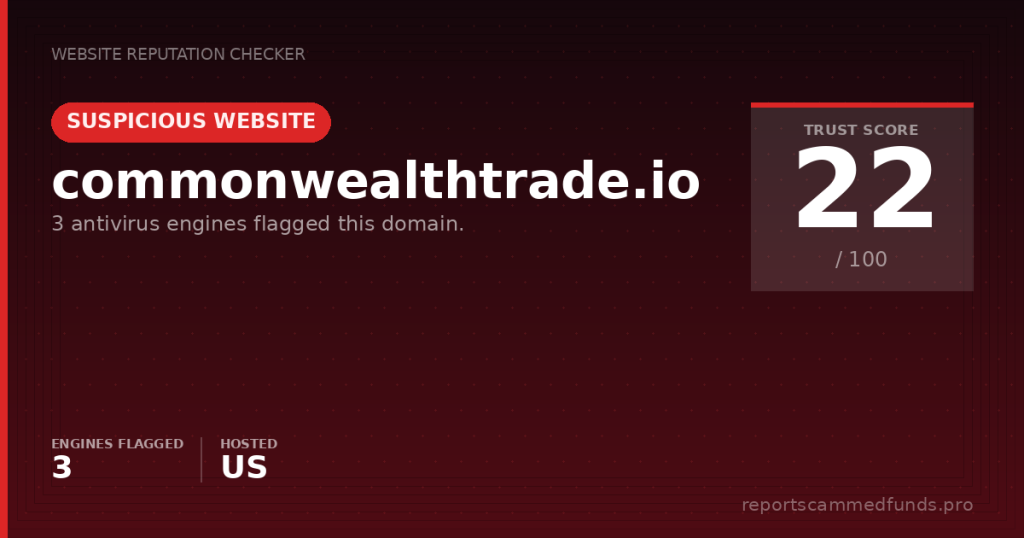
Our verdict is straightforward: avoid commonwealthtrade.io. The website is broken, the operator is anonymous, regulation is absent, and external reputation checks raise concrete concerns. This combination places the domain squarely in high-risk territory where user losses are common and recoveries are difficult.
Legitimate brokers make verification easy: they publish their legal entity, regulator, license details, and full legal documents, and they operate stable, well-maintained platforms. Commonwealth Trade does none of that. In its current condition, it resembles a disposable shell rather than a trustworthy financial service, and nothing about it merits your deposit or your personal data.
If the brand reappears under the same or a similar name, apply first principles: confirm regulation directly on the regulator’s register, read the legal documents, and test support before funding. Until those checks pass, treat this site as unsafe. Share this warning with anyone who might be targeted by similar pitches, and remember that if a platform cannot demonstrate who it is and who regulates it, you should walk away.