
Trading platform & site functionality
Our review of finmarket.com found no usable website content. Visiting the domain produces a transient “Just a moment…” gate and quickly redirects users to an atom.com page titled with the name “FinMarket,” characteristic of a domain marketplace listing rather than a functioning business. There are no pages for services, pricing, legal disclosures, or customer support on finmarket.com itself. From a consumer’s perspective, the site does not deliver a product or interface; it simply points elsewhere.
Technically, the domain uses HTTPS with a valid certificate and modern transport encryption, which is normal and expected in 2026. A security or DDoS-protection challenge appears during access, a mechanism often used by real businesses to manage abusive traffic. However, in this case the protective layer sits in front of a redirect to a marketplace listing, not a customer platform. That combination is not inherently malicious but is atypical for a financial brand that should be showcasing detailed content and a secure client area.
Because the domain behaves like a parked or resale asset, users looking for a trading platform, pricing information, or account onboarding will not find anything. There is no trading terminal, no WebTrader login, no mobile links, and no references to spreads, fees, or leverage. The absence of even a basic “About” or “Contact Us” page leaves no responsible way to evaluate the business behind the name. In short, the site’s functionality today is limited to redirecting prospective buyers of the domain name, not serving retail clients.
This matters because scammers frequently exploit recognizable, finance-sounding names to create off-domain funnels. We have seen patterns where a parked domain is invoked in messages, while the actual deposit link is a different, high-risk URL or a direct crypto wallet. The current behavior of finmarket.com provides no verification path, no disclosures, and no support channels to counter that risk. If someone claims finmarket.com is their official trading venue, their claim does not match the site’s observable reality.
License & regulatory status
Legitimate financial brokers and investment platforms detail their regulatory standing clearly: firm name, license number, and regulator (for example, FCA in the UK, BaFin in Germany, ASIC in Australia, CONSOB in Italy, or the CFTC/NFA in the United States). Finmarket.com presents none of this. There are no headers or footers with compliance references, no risk warnings, and no links to a client agreement or terms. With no service content and no legal disclosures, there is nothing to verify against an official register.
We conducted regulator register searches for any obvious match between this domain and a licensed firm but found no public information tying finmarket.com to a supervised entity. That does not automatically mean the name was never used in a regulated context, only that there is no accessible, current, and verifiable link. Importantly, even if an unrelated company branded “FinMarket” exists somewhere, the absence of disclosures on this domain means you cannot assume any affiliation. Clone-site operators often borrow a real firm’s name while using different domains to make illicit solicitations.
Consumers should approach any licensing claims connected to finmarket.com with skepticism until they can be independently verified on the relevant regulator’s site. Genuine authorizations are searchable: the FCA Financial Services Register, BaFin Unternehmensregister, ASIC Professional Registers, CONSOB’s registers, FINMA’s license lists, and the CFTC/NFA BASIC database. If a contact points you to this domain yet cannot demonstrate an exact legal entity name and corresponding registration on those lists, treat the claim as unsubstantiated. Absent a clear, verified regulator link, consider the domain unregulated.
User feedback
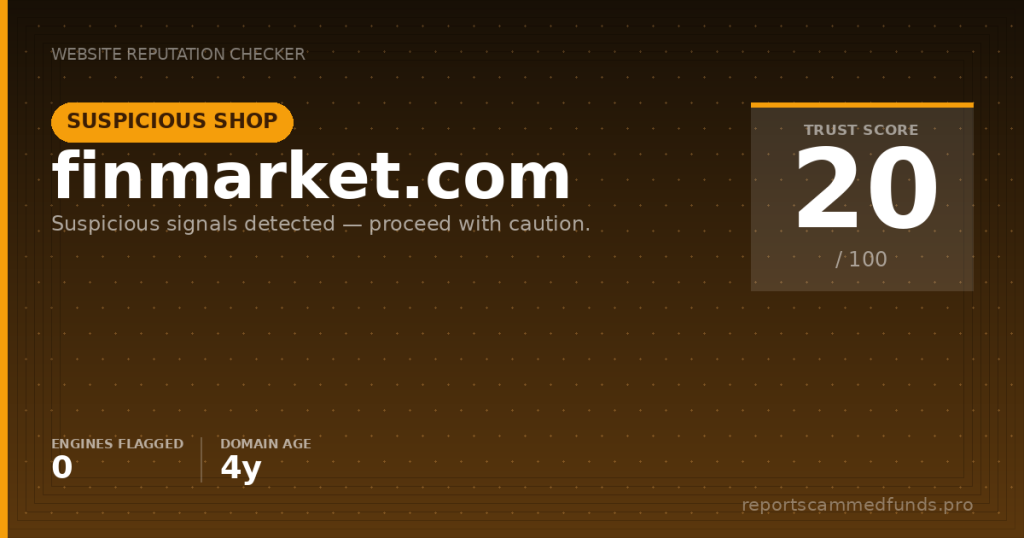
At the time of this review, we did not find verifiable first-hand user experiences specific to finmarket.com as an operating service, which aligns with the site’s non-functional state. External reputation checks do flag the domain as suspicious and note low public ratings in some trackers, but the lack of active service content makes direct, recent customer reviews scarce. That void is meaningful; when real platforms operate, they leave a trail of discussions—support experiences, onboarding notes, and withdrawal timelines. Here, the silence mirrors the fact that there is no customer-facing product online.
Separately, we encountered forum chatter and aggregator write-ups over the years referencing similarly named “FinMarket” brokers, with mixed to poor user experiences. These references cannot be cleanly tied to finmarket.com in its present state and may involve different operators or older sites entirely, so we do not treat them as definitive evidence against this domain. What they illustrate is the confusion that finance-themed brand names can create: identical or near-identical labels migrating across domains and operators over time. When names recycle but domains shift, consumers lose the ability to anchor trust.
Common complaint themes in high-risk trading schemes include withdrawal blockages after showing profit, surprise KYC only after deposit, managed-account losses that outpace the market, and unresponsive support once larger sums are committed. If someone invoking finmarket.com exhibits these behaviors—steering to off-domain payment links, pushing fast top-ups, or delaying withdrawals behind vague compliance reviews—you are likely dealing with a boiler-room or advance-fee setup. Because the domain itself offers no transparent contact or escalation path, recovery in such scenarios becomes harder. The safest course is to disengage before sending any funds or documents.
Deposits & withdrawals
Finmarket.com does not list any payment methods because it is not operating as a service site. If you are being asked to deposit to a trading account that allegedly corresponds to this domain, pause immediately. Legitimate brokers publish clear funding options—cards, bank wires, and sometimes e-wallets—alongside fee schedules, processing times, and refund/withdrawal policies. Here, none of that is present, which is a significant red flag when someone is seeking your money.
If your interest is in the domain listing itself, be aware that any payment you make for a domain purchase would occur on the marketplace you see after the redirect, not on finmarket.com. Only transact through the official checkout and escrow systems provided on that marketplace’s site; do not accept off-platform wire requests, crypto wallet addresses, or claims of “expedited transfer fees” outside the published process. Advance-fee tactics—extra taxes, urgent release charges, or custom “escrow” emails—are hallmarks of domain-sale fraud. Insist on platform-native messaging and invoices that match the marketplace’s terms.
For anyone who already moved money based on a pitch connected to finmarket.com, act fast. If you paid by card or bank transfer, contact your bank to attempt a chargeback or recall, explaining that you suspect misrepresentation. If you used cryptocurrency, immediately notify the exchange you sent from and file a fraud ticket with the transaction hash; while reversals are rare, exchanges can sometimes flag counterparties and assist with reports. Preserve all emails, chat logs, invoices, and wallet records, as they’re crucial for dispute filings and law-enforcement reports.
Why unregulated brokers are risky
Engaging with unverified or non-operational finance-themed sites exposes you to substantial risks. Without a regulator, you lack investor protections such as segregated client funds, compensation schemes, and mandated complaint handling. If funds go missing or withdrawals stall, there is often no enforceable framework compelling the operator to act. The lack of a verified company identity compounds this risk by leaving you with no reliable jurisdiction in which to seek redress.
Even when the site itself is inactive—as finmarket.com appears to be—the brand name can be used in messages or social media to channel victims to off-domain payment forms. This tactic leverages a plausible-looking name to create trust while ensuring the actual transfer happens where there is minimal oversight, often through crypto or unvetted processors. By the time a victim realizes the domain offers no real support or accountability, the funds have already moved. The absence of on-site disclosures becomes part of the problem because it prevents verification.
Data risk sits alongside financial risk. Submitting identity documents to an unverified operator can lead to identity theft, account takeovers, and further fraud, including so-called recovery scams that circle back to exploit previous losses. Once copies of your passport or driver’s license are in the wild, cleaning up the fallout can take months. The best mitigation is preemptive: verify the operator on a regulator’s register before sharing any documents or making any payments.
How to get help if you’ve been scammed
If you already transferred money after being approached in connection with finmarket.com, contact your bank or card issuer immediately. Request a chargeback or wire recall and flag the transaction as potential fraud or misrepresentation. For cryptocurrency payments, open a ticket with the exchange you used, providing the wallet address, transaction hash, dates, and any associated communications. Time is critical: early reports can help exchanges and banks place flags or gather evidence that supports recovery and law-enforcement referrals.
Next, file reports with your relevant authorities. In the United States, submit to the FBI’s Internet Crime Complaint Center (IC3) and consider alerts to the CFTC or your state regulator if a trading pitch was involved. In the United Kingdom, file with Action Fraud and, if financial services were claimed, check and notify the FCA. In the EU, report to your national police and, where applicable, the regulator overseeing investment services; in Australia, report via Scamwatch/ACCC and consider ASIC notifications if a broker pitch was used. Include every document and screenshot you can.
For structured help, our team can review your case and coordinate practical next steps. Visit reportscammedfunds.pro to submit details securely; we can assess chargeback prospects, prepare regulator-ready summaries, and help you avoid follow-on recovery scams that demand new fees to release “blocked funds.” Do not pay anyone who promises guaranteed recovery or insists on upfront crypto or gift cards—those are common secondary frauds. If you are uncertain, reach out to reportscammedfunds.pro before engaging further so we can pressure-test the claims against known patterns.
Conclusion
Finmarket.com, as it stands, is not an operating financial platform and provides no verifiable corporate, regulatory, or support information. The domain redirects to a marketplace listing for the name “FinMarket,” and external reputation checks classify it as suspicious. That does not make the domain itself malicious, but it does mean there is no trustworthy basis for sending money or documents to anyone citing this address as their official site.
The larger risk lies in brand confusion. Finance-sounding names migrate, and clone operations routinely claim association while moving deposits through entirely different links or wallets. In the absence of transparent on-site disclosures and regulator-verified details, treat all solicitations tied to finmarket.com as unverified at best, and potentially predatory at worst. A legitimate broker would make its licenses, policies, and funding channels easy to find, read, and verify.
Our recommendation is simple: do not engage financially with pitches that reference this domain. If you are evaluating a broker, verify the exact legal entity and license on the relevant regulator’s register and ensure the domain matches what the regulator lists. If you have already paid, follow the recovery and reporting steps above and contact reportscammedfunds.pro for case assistance. Your safest option is to work only with clearly regulated providers whose online presence can be independently validated.