Trading platform & site functionality
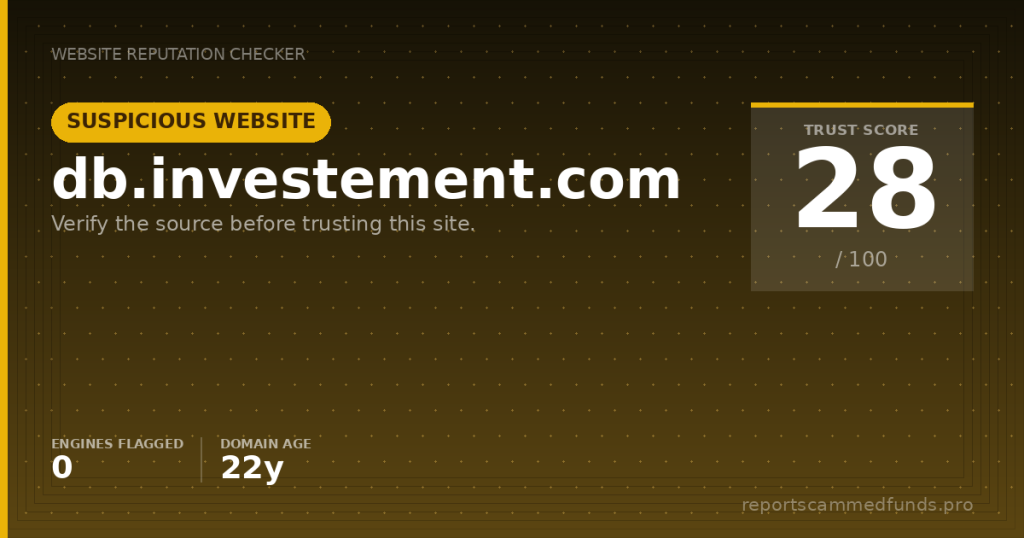
Our visit to db.investement.com presented a brief anti-bot verification sequence and then no accessible public-facing content. There is no homepage narrative, no navigation, no pricing or product terms, and no visible corporate identity. That is unusual for any financial brand purporting to solicit clients or hold funds, as regulated firms are expected to present risk warnings, disclosures, and contact channels. The parent domain, investement.com, displays a ‘domain for sale’ message, which strongly suggests the brand is not currently operating a consumer service on the main hostname.
Technically, the subdomain does respond over HTTPS and sets session cookies, indicating a gated or internal-facing application rather than a public website. We also observed multiple A records at the DNS layer, which often points to load balancing or distribution among several servers, but this by itself tells us nothing about legitimacy. More telling is the absence of any branding, legal pages, or a privacy policy, all of which are table stakes for financial or data-collecting sites. In other words, the site appears to exist, but offers no transparent explanation of what it is or who stands behind it.
Legitimate investment platforms typically outline their services, list supported instruments, provide fee schedules and trading conditions, and cite the license numbers issued by their home regulators. Here, none of those markers are present. Even if the subdomain is an internal portal, leaving it publicly reachable without context creates confusion and invites misuse by impersonators. If a third party ever directs you to log in at db.investement.com or claims it is a customer portal, you should assume high risk until the operator can be verified independently through official regulatory registers and direct corporate contacts.
License & regulatory status
We found no licensing claims on db.investement.com, and the parent domain’s for-sale notice offers no hint of authorization by any regulator. In all major jurisdictions, a firm offering investment services would be expected to cite its permissions: an FCA FRN in the UK, an ASIC AFSL in Australia, a BaFin registration in Germany, or relevant oversight under the CFTC/NFA in the US and ESMA across the EU. Absent those disclosures, there is no basis to assume oversight, investor-compensation coverage, or adherence to conduct-of-business rules.
Our review of public regulator databases did not surface specific warnings naming investement.com at the time of writing, but that absence should not be mistaken for endorsement. Regulatory warnings can lag actual misconduct by months, and many small operations never attract sufficient complaints to trigger a bulletin. The more important point is that a bona fide institution proactively publishes its license details, links to regulator entries, and displays jurisdictional risk notices; this site does not.
The only concrete registration evidence available is domain-level information: the .com is registered through a well-known registrar, which speaks only to domain ownership, not to financial authorization. Registrars do not vet business models or licenses; they simply sell domains. Accordingly, the presence of a mature domain name registered since 2004 should not be conflated with a regulatory green light. Until an operator publicly discloses verifiable licensing and corporate identity, treat any investment-related claims tied to this domain with caution.
User feedback
We found no credible, independent user reviews or case reports tied specifically to db.investement.com. There is also no recognizable brand footprint across mainstream review portals, social media, or industry forums that would normally surround an active financial service. This vacuum does not prove misconduct, but it denies would-be clients the benefit of collective experience. In risk terms, it leaves prospective users blind to how deposits, support, or dispute handling would actually perform under pressure.
Because there are no grounded testimonials to analyze, it is useful to recall the recurring complaint themes that surface around opaque, investment-themed websites. Investors often report withdrawal blockages that appear only after making a profit, sudden and conveniently timed KYC demands after deposits have cleared, or unsolicited ‘managed account’ offers that end in aggressive losses. Others describe pressure from so-called account managers to top up balances in order to unlock withdrawals or qualify for bonuses—classic boiler-room tactics that separate clients from more money while delivering nothing in return.
Another pattern, unfortunately common, is the hijacking of generic finance-sounding domains for phishing. Criminals like to park malicious payloads or login forms on internal-sounding subdomains such as db., vault., or app., then send victims messages that mimic legitimate institutions. We cannot say this is happening here, but the combination of a for-sale parent domain and an unexplained subdomain presents precisely the kind of ambiguity that fraudsters exploit. If you receive a link to db.investement.com in a message urging urgent action, treat it as suspect unless you can verify the sender and the business independently.
Deposits & withdrawals
There are no deposit, payment, or account funding options visible on db.investement.com, which aligns with the overall absence of a public service. If, despite this, you are ever asked to pay money related to this domain—whether for an investment plan, account activation, or service fees—pause and scrutinize the request. High-risk patterns include demands for cryptocurrency transfers, instructions to wire funds to personal accounts or offshore beneficiaries, or the use of third-party processors with no contractual tie to a named, regulated entity. Reputable financial providers list transparent methods, fee schedules, and reconciliation procedures, and they never pressure clients into irreversible payment rails.
Withdrawal problems are one of the most documented red flags around unverified operators. These problems can take the form of repeated document resubmission requests, fabricated compliance delays, or demands for ‘tax prepayments’ and ‘release fees’ paid outside the platform before any funds are returned. Such practices are unambiguous hallmarks of fraud because taxes and fees are, in regulated contexts, netted transparently and never conditioned on sending more money out-of-band. If an entity tied to this domain ever imposes such hurdles, disengage immediately and escalate to your bank or card issuer.
If you encounter the domain in a different context—for example, someone claiming to sell the domain name itself—insist on an established escrow solution with clear buyer and seller protections. Do not wire funds directly to individuals or accept ad hoc escrow arrangements. For anything labeled as an investment service, require the basics first: licensing proof, full legal entity name, physical address, and regulator register links. Only after that due diligence should you test with a trivial amount you can afford to lose, and even then, only on regulated platforms.
Why unregulated brokers are risky
Relying on an unverified, unregulated website for financial transactions exposes you to severe, often irrecoverable, loss scenarios. Without licensing under bodies such as the FCA, ASIC, BaFin, CONSOB, FINMA, or CFTC/NFA, there is no investor-compensation scheme, no mandated segregation of client funds, and no ombudsman to adjudicate complaints. If the operator decides to freeze your account, refuse withdrawals, or vanish, your primary recourse becomes private legal action, which is both costly and jurisdictionally complex. Cross-border setups often use that complexity as a shield against consumer recovery.
Beyond monetary risk, there is also a material data-security risk. Opaque sites may solicit identity documents and banking details under the guise of KYC, then repurpose that information for identity theft or to open accounts elsewhere. The presence of a login- or database-themed subdomain like db. can be used to lend false legitimacy to phishing messages, tricking recipients into entering credentials that are later reused against their brokerage, exchange, or email accounts. The safest posture is to distrust and verify, starting with regulator registers and independent corporate records.
No matter how professional a site or email looks, investor protection is not about appearances; it is about enforceable oversight. Regulated firms cite their license numbers and are easily found in public registers; they publish addresses, directors, and complaint procedures, and they do not hide behind for-sale landers or anonymous subdomains. When those guardrails are missing, assume the burden of risk is entirely on you. If you cannot validate the operator, do not send funds, documents, or passwords.
How to get help if you’ve been scammed
If you already paid money or shared sensitive information tied to db.investement.com, act quickly. Contact your bank or card issuer to file a dispute and request a chargeback; for bank wires, ask for a recall and lodge a fraud report. If cryptocurrency was sent, notify your exchange immediately to flag the destination and seek any available mitigation, and preserve every transaction hash and message. Document everything: screenshots, emails, chat logs, invoices, and any names or phone numbers you were given.
Report the incident to the appropriate authorities. In the United States, file at the FBI’s IC3; in the United Kingdom, report to Action Fraud; in the EU, contact your national police and consumer-protection body; and in all cases, notify the relevant financial regulator (FCA, BaFin, ASIC, CONSOB, FINMA, or your local equivalent). These reports create an official record that can support bank disputes and help protect others. Do not be discouraged if you are told recovery may be difficult—the earlier you act, the better your chances.
For tailored guidance and hands-on case support, reach out to our team at reportscammedfunds.pro. We specialize in documenting fraud patterns, coordinating with banks and payment processors, and preparing regulator-ready dossiers that improve your recovery odds. Be alert to follow-on ‘recovery scam’ approaches—fraudsters often re-target victims with offers of miracle retrievals for upfront fees. Work only with organizations you can vet, and consider reportscammedfunds.pro your first stop for safe, no-pressure triage.
Conclusion
Taken together, the signals around db.investement.com argue for caution. The main domain is explicitly for sale, the subdomain reveals no consumer-facing service, and no operator or licensing information is disclosed. Even if the subdomain hosts an internal tool, its public visibility without context creates confusion and a vector for impersonation. Until a legitimate company steps forward with verifiable credentials and regulatory permissions, this is not a domain to trust with funds, documents, or credentials.
If you encounter anyone claiming affiliation with investement.com, ask them to prove their corporate identity and regulatory status using official registers, not screenshots or unverifiable PDFs. Check that the legal entity name, physical address, and regulator reference number are consistent across filings and the website. Refuse to proceed if you are pushed toward cryptocurrency-only payments, offshore wires, or private escrow arrangements. The lack of transparency here should be interpreted as a red light, not a mere oversight.
Our recommendation is straightforward: avoid engaging with db.investement.com for any financial purpose. If the domain is only being marketed for sale, keep negotiations on reputable marketplaces and use recognized escrow services. We will update our assessment if a bona fide operator with clear licensing and disclosures emerges, but for now, your safest move is to steer clear and verify any claims involving this domain with an abundance of skepticism.