
Trading platform & site functionality
Aurex Global Investment’s homepage is a marketing-led landing page with a navigation bar, a prominent login to a “member-dashboard,” and visual elements suggesting market coverage. The site references external market data through TradingView links (for example, currencies and XAUUSD), which are commonly embedded to convey legitimacy but do not demonstrate the operator’s own execution capability. Static assets (styles, images, and JavaScript) load over HTTPS, and the page features several award-style badges; however, none link to independently verifiable issuing bodies. There is no obvious disclosure of spreads, commissions, or fee schedules on the public pages, which makes it difficult to evaluate ongoing costs or total cost of ownership for anyone thinking of depositing funds.
We saw no evidence of standard third‑party platforms such as MT4 or MT5, nor a detailed platform feature list that would let potential clients judge execution quality, order types, latency, or historical performance. The single “member-dashboard” reference suggests a proprietary web interface behind registration, but nothing public indicates what traders will actually receive after onboarding. This pattern—prominent login behind a thin public façade, with little else—appears regularly among unregulated brokers and high‑risk investment schemes. Taken together, the lack of platform transparency, missing demo access, and absence of back‑tested or audited performance data mean users cannot properly evaluate the service before risking money.
We also note the site does not surface essential legal and operational documentation from the landing page: no clearly linked Terms and Conditions, no Risk Disclosure, no Client Agreement, and no Privacy Policy visible up front. While some providers gate documents to the signup process, best‑practice operations make key disclosures easy to find pre‑registration so that prospects can assess rights, responsibilities, and dispute processes. Instead, the emphasis here is visual polish—awards graphics, a slick hero image, and trading chart references—without the substance needed to rely on the operator. In short, the site functions as a glossy intake funnel but withholds crucial details a prudent investor would need to proceed.
License & regulatory status
We found no license claims, registry numbers, or regulator badges anywhere on aurexglobalinvestment.com. In regulated markets such as the United Kingdom, the European Union, Australia, Canada, or the United States, any company inviting the public to deposit for trading or managed investment services must clearly identify its supervisory authority and provide a verifiable license reference. Legitimate firms typically display these details prominently and link out to the regulator’s public register.
For example, a UK‑facing broker would name the Financial Conduct Authority (FCA); an EU broker would align with a national competent authority under ESMA rules; an Australian provider would carry an Australian Financial Services Licence (ASIC); an Italian‑facing entity might appear on CONSOB registers; and a US‑derivatives operation would need to square with the CFTC and NFA frameworks. None of those anchor points are present here. The absence of any regulator link or license number is a major gap that should halt prospective clients until independent verification is possible.
We did not find public warning notices specifically naming Aurex Global Investment on major regulator sites at the time of this review. However, absence of a warning is not an endorsement; many unlicensed operators fly under the radar until victim volume compels an alert. The correct standard is affirmative proof of authorization, not the absence of a ban. Without such proof, users have no statutory recourse, no complaints ombudsman, and no compensation scheme (for example, FSCS in the UK) if funds go missing or withdrawals stall.
User feedback
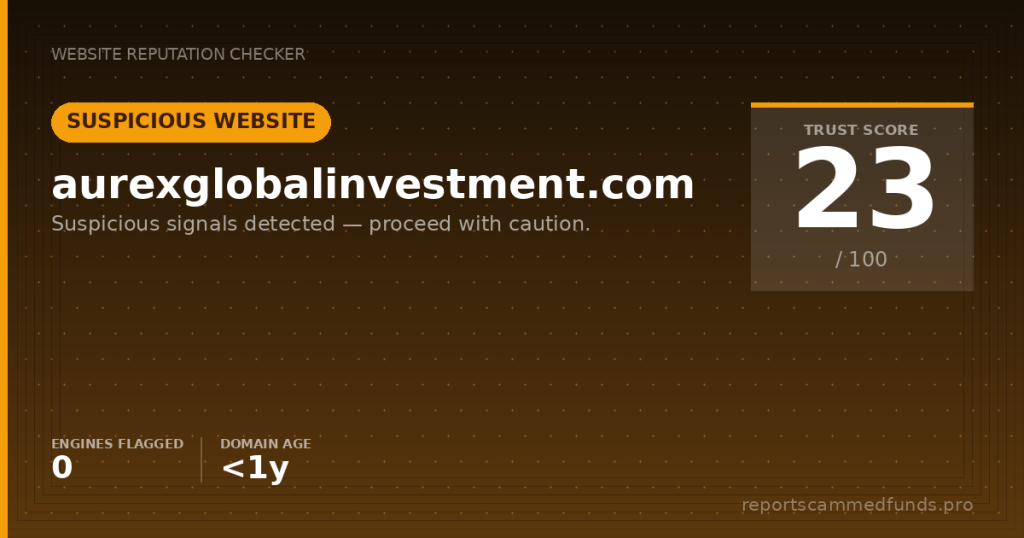
We looked for substantive third‑party feedback in common channels—consumer forums, social networks, and independent review aggregators—and did not find credible, verifiable commentary about Aurex Global Investment. With a domain registered only since February 2026, this lack of footprint is not surprising; new operators often have no digital trail. But the absence of user history also means there are no verified withdrawal reports, no long‑form experiences, and no community scrutiny to cross‑check the operator’s reliability.
Because we could not confirm real customer accounts, it is not possible to attribute specific complaint patterns to this site. That said, similar unregulated investment sites often exhibit repeating themes: withdrawal blockages after showing a paper profit; sudden “surprise KYC” requests triggered only at the point of withdrawal; coerced deposit top‑ups to “unlock” funds or meet invented margin requirements; and managed‑account losses supposedly attributed to market volatility. These patterns are presented for consumer awareness only—we do not assert they have occurred here—but they are common enough to warrant preemptive caution.
Until documented user experiences surface, anyone considering engagement should adopt a safety‑first test protocol: verify licensing directly with a named supervisor; demand full, dated legal documents before sending money; test a token‑sized deposit and attempt a prompt withdrawal; and monitor the operator’s responsiveness in writing (not just by phone). Firms that fast‑talk deposits but postpone or complicate withdrawals are a familiar red flag in this sector. The safest stance is to assume nothing is proven until you can independently validate it.
Deposits & withdrawals
The public pages do not disclose accepted funding methods, minimum deposits, or payout timelines. Many unregulated platforms prefer bank wires and cryptocurrencies because these rails reduce the customer’s ability to reverse a payment. Card payments and reputable e‑wallets sometimes offer more recourse, but even then, operators can stall withdrawals by citing incomplete KYC or fabricated compliance reviews. The key point is that you should know the available methods and the exact withdrawal procedure and timeline before you deposit a single cent.
Another hard lesson from prior cases: scrutinize the Terms carefully for obscure clauses that operators invoke later—dormancy penalties, bonus conditions that lock funds, or vague language permitting an indefinite “security review.” If the site couples instant deposit buttons with hazy or missing withdrawal instructions, that asymmetry is intentional. Always document the process: take screenshots of the cashier page, save confirmation emails, and log any reasons given for delays. This paper trail is vital should you need to pursue a chargeback or escalate to a regulator.
Be especially cautious of so‑called tax or compliance prepayments demanded before releasing your balance. Legitimate brokers net legally due fees from the balance or produce formal invoices that can be independently verified; they do not demand ad‑hoc crypto payments to unknown wallets. A telltale escalation sequence is repeated deposit pressure, then sudden profit displays in the dashboard, and finally new “fees” that must be paid externally to free the funds. If you encounter anything like this, stop paying immediately and seek help.
Why unregulated brokers are risky
Placing money with an unregulated platform means you are operating outside the safety net. There is no prudential supervision of client‑fund segregation, best‑execution policies, conflict‑of‑interest management, or capital buffers. If the operator disappears or freezes accounts, you are left to your own civil remedies across borders—a long, expensive, and usually fruitless path. In contrast, licensed brokers must follow stringent rules, answer to supervisors, and routinely undergo audits.
The domain’s short history compounds the risk. Younger sites have fewer public footprints, scant audit trails, and limited reputational exposure—all of which lower the operator’s costs of vanishing if withdrawals become inconvenient. Legitimate firms invest years building track records under their legal names and advertise regulator oversight precisely because those signals lower perceived risk for clients. Here, you are asked to accept a lot on faith with very little verifiable substance.
Data security and privacy are also at stake. Unregulated operators often collect passports, proof of address, and bank card images “for KYC” without clear disclosure of storage, processing, or cross‑border transfer. Once uploaded, these documents can be misused far beyond the original context—fueling identity theft or facilitating further fraud. If the site cannot name its data controller, jurisdiction, and complaint mechanism, treat any request for sensitive documents as high risk.
How to get help if you’ve been scammed
If you have already deposited and now face withdrawal delays or pressure to pay more, act quickly. Contact your bank or card issuer at once, explain the situation, and request a chargeback or recall if your payment method allows it. Ask your bank to block further payments to the merchant and to note the dispute on your account. If you paid by crypto, preserve all transaction hashes and wallet addresses—the details will be critical for any investigation, even though reversals are unlikely.
Report the incident to the appropriate authorities in your jurisdiction. In the UK, file with Action Fraud and consider notifying the FCA if financial services are being offered without authorization. In the EU, contact your national regulator (under ESMA’s umbrella) and the police. In the United States, submit a complaint to the FTC and the FBI’s IC3. These reports create an official record and can support downstream recovery or enforcement efforts.
For practical, case‑level assistance, you can also reach our team at reportscammedfunds.pro. We review documentation, help structure strong chargeback submissions, and guide victims on escalation pathways with banks and regulators. Even if you have not yet deposited, we can help you evaluate risk indicators and decide whether to disengage before harm occurs. The earlier you act, the more options you retain.
Conclusion
Aurex Global Investment is a very new, opaque, and unlicensed operation presented through a glossy landing page and a concealed member dashboard. There are no regulator references, no independent audits, no named corporate entity, and no visible legal agreements up front. Those are not superficial omissions; they go to the core of whether a firm is accountable and fit to hold client money.
We do not claim this site is definitively fraudulent, but the balance of evidence does not support trusting it with funds. At a minimum, demand regulator‑verifiable authorization, comprehensive legal documents, and a small, promptly honored withdrawal before considering any serious deposit. Without that baseline, you are effectively wiring money into a black box with no oversight and no recourse.
Our recommendation is to avoid engaging until clear, independently verifiable proofs of legitimacy are provided. If you decide to test it anyway, treat the deposit as expendable, document everything, and attempt an early withdrawal. There are many regulated brokers and platforms with years of operating history—choose one of those instead of gambling on a brand‑new, unregulated website.