
Trading platform & site functionality
Wealth-nexus.net presents itself, at least by name, as an investment or wealth platform, the kind of hub that might offer trading access, managed accounts, or portfolio tools. In a legitimate setting, you would expect prominent pages explaining the service model, fees, risk warnings, and regulatory status alongside a stable, responsive site. Here, the experience is different: there are no verifiable details about platforms used (such as MT4/MT5 or a proprietary web trader), no published spreads or commissions, and no guide to account types. When a platform is opaque about how it executes trades, safeguards funds, and calculates performance, users are left without the minimum information required to evaluate suitability and risk. That gap is not cosmetic; it is a core warning sign in a sector where transparency is a legal necessity in many jurisdictions.
On well-run financial sites, you can typically navigate a clear structure: About Us with a legal entity, Contact with a physical office and phone, Terms and Conditions and Client Agreement spelling out rights, and a Risk Disclosure consistent with regulations like ESMA product intervention rules or FCA Conduct of Business Sourcebook obligations. The absence of these anchors, or their replacement with generic language and contact forms, suggests a site built to collect deposits without offering reciprocal accountability. Even non-trading investment platforms will provide details like custodian arrangements, performance methodologies, and advisory certifications. Where those are missing, it implies either a very immature project not ready for client funds or a deliberate avoidance of scrutiny. Neither option is compatible with entrusting money.
Functionally, serious trading or investment operations also showcase technology lineage—naming their liquidity providers, audit partners, or at least describing order routing and execution quality. Even fintechs without legacy platforms regularly publish whitepapers, SOC2 or ISO certifications, or code-of-conduct statements to demonstrate a compliance mindset. In the case of wealth-nexus.net, there is no confirmable platform lineage, and no performance or execution methodology that a user could test via a demo account. This vacuum makes it impossible to assess slippage, spreads, or downtime risks, and it prevents comparison against regulated brokers whose stats are subject to oversight. Users should not have to guess at mechanisms that directly determine their trading outcomes or capital safety.
Lastly, genuine financial brands invest in uptime, redundancy, and clear status communication. If a site is intermittently available or missing core pages, that is an operational red flag—especially if combined with the absence of a status page, incident history, or security disclosures. A serious custodian of client funds has to demonstrate resilience and reliability because outages can lead to missed exits, margin calls, or irreversible price moves. Without that reliability, a client is effectively gambling not just on markets but on platform availability, a risk that responsible firms work tirelessly to minimize and document. The silence here speaks louder than any marketing line could.
License & regulatory status
Financial services that solicit clients in the UK, EU, Australia, or the US must typically be authorized by a recognized regulator. That means brokers are listed on the FCA register in the UK, BaFin in Germany, CONSOB in Italy, ASIC in Australia, or registered with the CFTC and NFA in the US if they offer derivatives. Investment advisers have their own registries and disclosure obligations as well. For wealth-nexus.net, we found no regulator license numbers, passporting statements, or authorizations presented that could be independently verified. Such omissions matter because they determine whether you have recourse if something goes wrong.
Firms sometimes imply legitimacy through vague badges or wording like "fully compliant" or "regulated" without naming the authority and license number. The acceptable standard is specific: regulator name, license number, and a link to the public register entry. Without those, claims of compliance cannot be taken at face value. In this case, there were no substantiated claims to examine, and we could not independently verify authorization with bodies like the FCA, BaFin, ASIC, FINMA, or the CFTC/NFA. An unregulated entity providing trading or investment services is operating outside the consumer-protection perimeter by design.
We routinely check for negative signals such as public warnings from regulators. While we did not locate a formal blacklist notice tied to wealth-nexus.net in the sources we track, the absence of a warning does not imply safety; many troubled schemes operate for months before a regulator issues an alert. Crucially, investor protection schemes like the UK’s Financial Services Compensation Scheme (FSCS) or the EU’s Investor Compensation Scheme typically do not cover losses with unlicensed entities. This means that if the operator defaults, mismanages client money, or disappears, legal recourse is severely constrained and often impractical across borders.
Another recurring pattern in high-risk websites is corporate obfuscation: offshore incorporation in secrecy jurisdictions, privacy-protected domain records, and no trail of responsible directors. That structure can be legal, but when paired with investment solicitation and no regulator oversight, it creates a high-stakes asymmetry for the client. You send money into a black box and hope goodwill and competence fill the void—an unreasonable ask in a market that is already volatile by nature. Until wealth-nexus.net discloses its legal entity, jurisdiction of registration, and supervision details—and those can be corroborated on official registers—it should be treated as unregulated and unsafe for client funds.
User feedback
User reviews can offer early warnings, but they can also be manipulated. We did not find a credible, verifiable body of user testimony—positive or negative—attached to wealth-nexus.net across trusted consumer forums and financial communities. That absence is not a green light; it simply indicates a low public footprint or a very new operation. Fraudsters sometimes seed glowing testimonials early on, then pivot to high-pressure sales after a few deposits come in. Conversely, legitimate firms tend to accumulate a wide range of feedback and maintain visible support presence across multiple channels.
Where complaints do arise in similar cases, common themes include withdrawal blockages after profits are shown on-screen, surprise KYC demands only after a user requests a payout, and demands for extra "taxes" or "liquidity fees" before a release—classic advance-fee fraud hallmarks. We have also documented cases where purported account managers encourage clients to install remote desktop tools or to deposit in crypto under the guise of faster onboarding. Once funds move to cryptocurrency wallets, reversibility is nearly zero, and communications typically degrade from responsive to evasive. Without transparent policies and a proven operations desk, users have no way to counter these tactics.
A further pattern to watch for is the so‑called managed-account lure: promises of an "expert" who will trade for you or a proprietary algorithm that minimizes risk while delivering outsize returns. This is structurally incompatible with how regulated firms present performance, where past results are not a guarantee and leverage warnings are explicit. When glossy dashboards show rapidly compounding balances but withdrawals stall, the underlying numbers are often fabrications designed to prompt larger deposits. If wealth-nexus.net relies on these tropes—and we cannot verify at this time—the risk profile would be extreme. In any case, the lack of clear, auditable performance data is already a reason to remain on the sidelines.
Deposits & withdrawals
Safe platforms set expectations early: exactly which funding methods are supported, how long deposits and withdrawals take, and what documentation is required. Regulated brokers typically allow cards, bank transfers, sometimes e-wallets, and they publish fee schedules and timelines governed by local laws. With wealth-nexus.net, we could not confirm accepted methods, processing times, or fee transparency. That uncertainty alone raises operational risk because you cannot plan a liquidity runway if payout procedures are ambiguous. It also opens the door to arbitrary requirements that appear only when clients attempt to withdraw.
We caution strongly against sending funds via cryptocurrency to any operator that does not have a proven, regulated track record. Crypto transfers are effectively cash with no chargeback option, which is why recovery scam rings push them. If a site like wealth-nexus.net were to insist on crypto-only deposits or offer a sizable "bonus" to use crypto, consider it a high-risk tell. Similarly, be skeptical of wire transfers to personal accounts or newly created fintech IBANs with no company name match. Professional firms use segregated client accounts, name-matching KYC, and published beneficiary details aligned with their legal entity.
Another recurring issue is so‑called bonus schemes or trading credits that come with hidden withdrawal conditions. Unregulated operators commonly add clauses that profits or even principal cannot be withdrawn until an arbitrary turnover is met—conditions that would be unacceptable under FCA or ESMA standards. If wealth-nexus.net presents any kind of incentive or "welcome bonus," demand to see the full terms in writing and compare them to what regulated peers offer. The safest position, given the current information vacuum, is to avoid funding entirely until clear, written policies are published and independently confirmed.
Why unregulated brokers are risky
Sending money to an unregulated platform is not just a bet on market outcomes—it is a bet on governance, controls, and honesty with no referee on the field. In regulated environments, client money rules, audit trails, and dispute resolution frameworks impose discipline. Without them, an operator can freeze accounts, alter terms retroactively, or disappear without the friction that formal oversight creates. For retail users, this translates into elevated odds of unilateral losses that have nothing to do with trading performance.
Consumer protections such as segregated client funds, best-execution policies, and compensation schemes do not automatically apply to unlicensed entities. If an unregulated operator goes insolvent, even a clear-cut case of mismanagement can leave clients empty-handed due to jurisdictional issues, asset tracing complexity, and the costs of recovery. This is why regulators like the FCA, ASIC, and BaFin emphasize verifying authorization before engaging. The oversight regime is designed to give you a path back to your money if rules are broken; absent that, your leverage as a consumer is thin.
The risk surface also extends to data security and identity exposure. KYC documents submitted to a non-compliant operation can be abused for account takeovers or used as leverage in extortion attempts. Reputable institutions disclose their data-handling standards, encryption practices, and audit certifications. When a platform like wealth-nexus.net fails to publish that information, you must assume worst-case scenarios: weak security, limited incident response, and no independent checks. Your identity and funds deserve better than guesswork.
How to get help if you’ve been scammed
If you have already deposited with wealth-nexus.net and are facing delays or refusals to withdraw, act quickly. For card payments, contact your issuing bank and request a chargeback citing misrepresentation or non-delivery of services. For bank transfers, ask your bank to initiate a recall or file a fraud report; speed is crucial, especially within SEPA or SWIFT windows. If crypto was used, gather transaction hashes and wallet addresses immediately; while on-chain transfers are hard to reverse, this evidence supports investigations and potential tracing.
Report the incident to your national authority: in the UK use Action Fraud, in the EU contact your national financial supervisor (such as BaFin in Germany or CONSOB in Italy), and in the US file with the FTC and IC3 while also notifying the CFTC/NFA if trading services were advertised. Include screenshots, emails, contracts, and any chats with purported account managers. The more specific your timeline and documentation, the higher the chance of meaningful action. Keep a detailed log of every interaction and maintain copies off the affected device.
Our team can assist you with structured next steps, evidence packaging, and escalation pathways tailored to your jurisdiction. Reach us at reportscammedfunds.pro for a confidential assessment of your case and guidance on realistic recovery options. We can help you avoid secondary harms such as recovery scam approaches that inevitably target recent victims with false promises of quick refunds. Early consultation often prevents mistakes that scammers exploit during the critical first days of dispute and reporting.
Conclusion
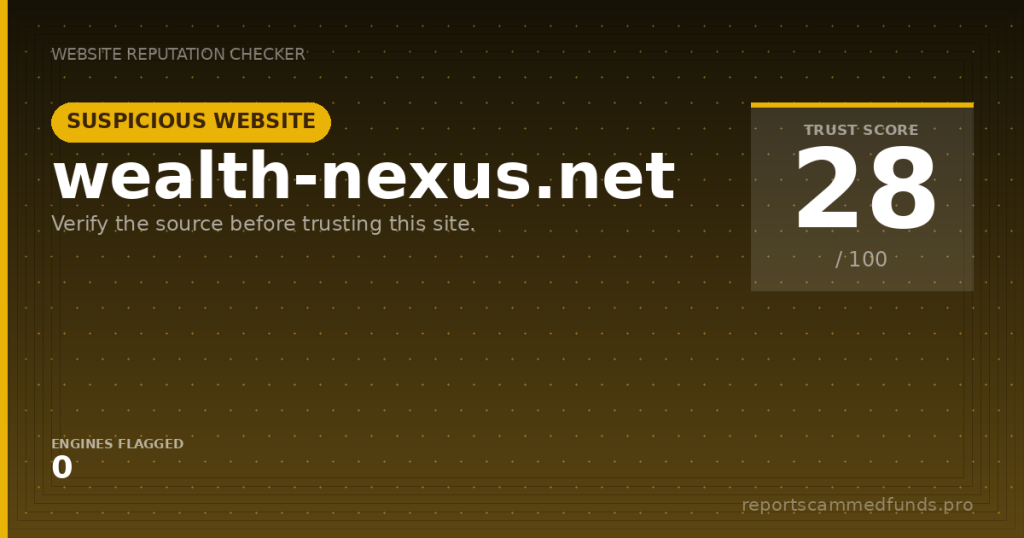
Wealth-nexus.net raises more questions than it answers. Without a verifiable legal entity, clear regulatory authorization, and transparent operating policies, it does not meet the baseline thresholds we expect before users risk any capital. The intermittent site availability compounds those concerns by signaling potential instability or a lack of professional infrastructure. In a field where good actors are proud to evidence their compliance, silence is its own kind of statement.
Until compelling proof emerges—public license records, named management, auditable policies, and a reliable platform—we recommend steering clear. There is no shortage of regulated alternatives whose credentials you can verify instantly on the FCA, BaFin, ASIC, or NFA registers. If you are researching this site because of a cold call, unsolicited message, or social media pitch, recognize that these are the very channels boiler-room operations prefer. A legitimate wealth manager does not need to corner you on a messenger app to win your trust.
Your best defense is disciplined due diligence. Verify the license on an official register, insist on written terms, and test withdrawals with small amounts only after those checks are satisfied. If any step meets friction or evasion, stop. And if you have already engaged and sense something is off, document everything and get help early—your options shrink as time passes, and prompt action is often decisive.