
Trading platform & site functionality
Temonex presents itself as a crypto-facing venue with a casino-like aesthetic, where deposits purportedly unlock games, rewards, or accelerated earnings. While the site was not available during our visit, the surrounding signals and references paint a picture of a single-page or few-page funnel that prioritizes deposit capture over verifiable utility. Crypto addresses or QR codes are often surfaced after basic signup, steering users toward Bitcoin, Ethereum, or USDT. In past scams of a similar flavor, the interface emphasizes dopamine triggers—ticking timers, live “winner” tickers, and leaderboards—without providing transparent mechanics or independent fairness audits.
Technically, the site appears to use Cloudflare for delivery and analytics, and the codebase references social integrations such as Facebook. Those integrations can be repurposed to create the illusion of social proof through embedded comments or counters, even when genuine user communities are absent. What we do not see is the kind of nuts-and-bolts product detail that reputable platforms disclose: rules for gameplay and payouts, a provably-fair algorithm with published seeds, or a granular fee schedule. The absence of durable, verifiable documentation contrasts sharply with the polished marketing devices typically used to coax quick deposits.
The business model is also ambiguous. Is Temonex a licensed casino, a staking service, or a high-yield program? In trustworthy operations, that question is answered unequivocally on the homepage and the terms of service. Here, the promotional signals hint at an all-things-to-all-people proposition: quick growth for investors, fast-paced entertainment for gamblers, and celebrity endorsements for the social crowd. That ambiguity is not a sign of breadth; it is a sign that the operator wants as many on-ramps to deposits as possible while remaining opaque about the actual mechanism that generates returns. Without verified mechanics and a clear, regulated category, users are depositing into a black box.
License & regulatory status
Any platform that solicits the public’s money and promises returns needs to answer a simple question: who authorizes it to do so? We found no evidence that Temonex is registered or supervised by a financial regulator such as the FCA in the UK, BaFin in Germany, ASIC in Australia, or the CFTC in the United States. Absent such supervision, any investment-like language—fixed daily yields, doubling offers, or managed accounts—is simply marketing without legal backing. In many jurisdictions, marketing investment returns without authorization is illegal, and users have no access to investor-compensation schemes if things go wrong.
If Temonex intends to function primarily as a casino, a different licensing track applies, typically involving Curacao eGaming, Malta Gaming Authority, or other national gambling commissions. Legitimate casinos display license seals, list their operator of record, and publish full terms that name the licensed entity and its registration. We saw no such disclosures. In the online gambling sector, vague claims like “provably fair” or “blockchain-verified” must be supported by open-source verification tools and seed reveals; otherwise, the terms are hollow and should be treated as red flags rather than assurances.
We also checked for regulator warnings, as scam domains often accumulate alerts quickly. At the time of this review, we did not locate a formal notice specific to Temonex from major agencies; however, the absence of a warning is not an endorsement. Scam sites frequently rotate domains faster than warning lists update, and clone operations tweak names to avoid detection. What matters most to a consumer is the presence of verifiable licenses and a named, traceable corporate entity—neither of which is available here. Until a regulator number and legal corporate details are published and independently confirmed, users are dealing with an unregulated and non-transparent operator.
User feedback
A review of prominent forums and rating platforms did not reveal a credible body of user feedback for Temonex. That vacuum is telling given that reputable gaming or investment platforms accrue reviews—good and bad—fairly quickly. Instead, the outward-facing references look more like generic social embeds and ticker-style notifications, which can be fabricated or syndicated across unrelated sites. In practice, a lack of third-party community discussion leaves prospective users with no peer-to-peer reference point to evaluate risk.
Patterns in similar crypto-gambling and high-yield sites point to a consistent complaint profile: withdrawals blocked after initial profit, support ceasing communication once larger sums are requested, and sudden KYC demands after deposits are made. Users often report being asked to pay “unlock fees,” “tax prepayments,” or “anti-money laundering clearances” before withdrawals are processed—fees that legitimate operators do not require upfront and that scammers never honor. While we cannot attribute these specific behaviors to Temonex without more user testimony, the operational template matches the profile closely enough to warrant a preemptive warning.
It is also common to see astroturfed endorsements—short, enthusiastic blurbs on social media from newly created accounts with no transaction history. Real platforms have real customers who can show transaction IDs, blockchain confirmations, and screenshots that survive scrutiny. When that substance is missing, and when the domain is brand-new, there is no empirical basis for trust. Until Temonex is able to show a durable customer base, verifiable payouts, and independent audits, prospective users should assume that the risks outweigh any promised returns.
Deposits & withdrawals
All indicators suggest that Temonex steers users toward cryptocurrency deposits, likely via addresses provided after sign-up. Crypto rails are attractive to bad actors because transfers are final, global, and fast, and because customers cannot request traditional chargebacks. We did not see evidence of card processing by recognizable acquirers or clear banking relationships—elements that impose compliance and accountability. If a platform cannot support mainstream payment methods transparently, that alone reduces the odds of fair dispute resolution dramatically.
Withdrawal mechanics deserve particular scrutiny. High-risk operators often permit a small initial withdrawal to build trust, then block larger requests with new conditions: identity checks that loop endlessly, additional security deposits, or fabricated tax obligations. A reputable platform lists withdrawal timelines, fee schedules, identity requirements, and limits in advance, and those policies are consistent across customers. In contrast, scams improvise rules that maximize friction and extract additional funds once users are emotionally and financially committed.
We could not find a published minimum deposit or a clear fee schedule for Temonex. The lack of pre-deposit transparency is a significant operational red flag. If you are determined to test the site despite these warnings, never deposit more than a trivial amount you can afford to lose and attempt an immediate micro-withdrawal. Declines, new-fee requests, or evasive support responses at that stage are decisive indicators to stop further funding.
Why unregulated brokers are risky
Unregulated platforms present a structural risk that no amount of slick marketing can offset: there is no backstop. Without a license, customers lack recourse through ombudsmen, financial authorities, or gambling commissions, and the operator has little incentive to honor withdrawal obligations. If the site goes dark, rebrands, or blocks your account, you are effectively self-insuring the entire risk. That dynamic is precisely why regulators exist in the first place, and why legitimate businesses submit to their oversight.
Crypto-specific risks compound the unregulated problem. Digital currency transfers, once confirmed on-chain, cannot be reversed. Fraudsters exploit that finality by rushing users through onboarding and pushing for large deposits under time pressure—limited-time bonuses, expiring slots, or doubling offers. Even if you later identify the destination address, tracing funds does not equal recovery unless law enforcement can link the operator to a KYC’d exchange and intervene in time.
Finally, the data you hand over can outlast the domain. Copies of your passport, driver’s license, and selfies—often demanded after you deposit—can be resold or used to open accounts elsewhere. Phone numbers and email addresses become targets for follow-on schemes, including recovery scams that pose as investigators who promise to get your money back for a fee. In the absence of a licensed framework and a verified corporate steward, the rational course is to avoid depositing funds and to guard your identity.
How to get help if you’ve been scammed
If you have already sent money to temonex.com, act quickly. For card payments, contact your issuing bank immediately and request a chargeback on the basis of fraud or services not received; emphasize any misleading claims and the absence of a licensed operator. For bank transfers, ask your bank to submit a recall or fraud report—speed is crucial, and success varies by jurisdiction. Document everything: transaction IDs, emails, chat logs, screenshots, and the domain URL.
For cryptocurrency transfers, reach out to your exchange or wallet provider and file a fraud report with the transaction hashes; ask whether they can flag the receiving addresses or issue a suspicious activity report if the funds hit a KYC exchange. While crypto payments are not reversible, timely reporting increases the chance of accounts being frozen if the perpetrators cash out through regulated venues. Preserve device logs and avoid installing any additional “verification” apps or remote-access tools that the operator may push.
Report the incident to your local authority: in the UK use Action Fraud, in the US file with the FBI’s IC3, and in the EU consider your national cybercrime unit and econsumer.gov for cross-border matters. If the scheme involved investment claims, notify the relevant market supervisor (FCA, BaFin, ASIC, or your national equivalent); if it framed itself as gambling, inform your gambling regulator as well. Parallel reporting helps build the case and may be necessary for banks and exchanges to act decisively.
For tailored guidance and assistance compiling evidence, contact our team at reportscammedfunds.pro. We can help you structure your timeline, prepare bank and exchange submissions, and identify recovery and reporting options suitable for your jurisdiction. We do not require upfront crypto payments, and we will tell you candidly what is realistic based on the facts of your case. The sooner you reach out, the better your chances of preventing further loss and disrupting the operators’ cash-out routes.
Conclusion
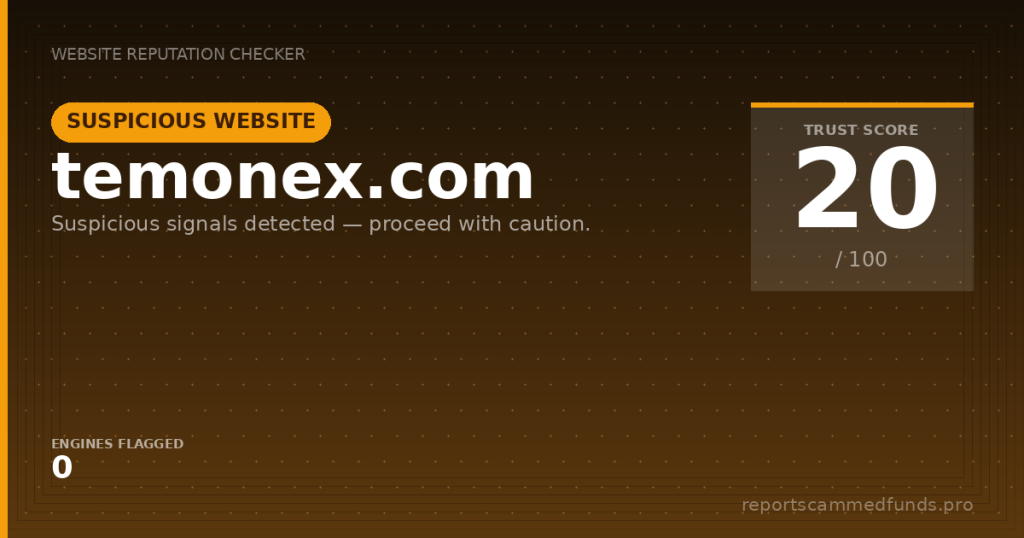
Temonex carries too many hallmarks of a high-risk operation: a brand-new domain, unreachable site behavior, lack of licensing, and reliance on crypto deposits paired with celebrity-style hooks. There is no visible corporate spine—no named operator, license number, or transparent fee and payout policy—to support user trust. In our judgment, this is not a platform to test with significant funds, nor is it a place to risk personal identity documents.
If you insist on probing further, conduct rigorous due diligence first: demand a regulator license and verify it directly with the authority’s register, request the legal entity’s full name and jurisdiction of incorporation, and attempt a micro-withdrawal immediately after any deposit. Refuse to pay any “unlock,” “clearance,” or “tax” fees, and treat such requests as definitive walk-away moments. Do not rely on testimonials, comment widgets, or countdown timers as evidence of legitimacy.
We will continue monitoring for new warnings or corporate disclosures linked to temonex.com and will update our assessment if verifiable facts surface. Until then, the prudent course is avoidance. Preserve your capital, protect your identity, and favor only platforms that meet the basic standards of transparency and regulation that safeguard consumers.