
Trading platform & site functionality
GoxEU presents as a crypto-facing operation with a mixed identity: part investment pitch, part casino theme, wrapped in a name that suggests an EU footprint. Landing-page traces and advertising snippets point to a registration-first funnel with age gating (18+) and social login hooks. That combination—crypto plus wagering motifs—tends to attract users seeking quick upside, but it also demands stronger-than-normal transparency about who is running the platform and under what rules. We did not find those disclosures in any accessible materials or cached previews tied to goxeu.com.
The user journey appears to prioritize sign-up before substance. Prospective customers are encouraged to register to learn about the features, bonuses, or returns, instead of being given a clear view of fees, withdrawal restrictions, dispute channels, or licensing up front. This arrangement is inherently risky for consumers because the most consequential information is not provided until after personal data has been handed over. Legitimate financial and gambling platforms typically present concrete legal terms, house rules, and fee schedules on publicly accessible pages before onboarding.
On the technical side, the site seems to rely on a CDN and JavaScript-heavy assets, a common setup for modern funnels. That by itself is not problematic; however, we did not see any evidence of third-party fairness audits for casino-style games or independent performance validation for any purported investment features. There is no visible status page, independent uptime monitor, or community-run incident log that would allow users to gauge platform stability. The absence of such markers, combined with the reliance on a closed registration wall, leaves users guessing about core functionality and reliability.
We also note references to social media integrations, including what appears to be Facebook SDK calls and tracking beacons found in public resource catalogs. These elements indicate a retargeting and referral strategy rather than a product-first orientation. Again, that is not proof of wrongdoing, but it does show the operation is optimized for acquisition. In this context, ‘EU’ branding on the name risks becoming a veneer of credibility if it is not backed by clear jurisdictional disclosures and recognized licensing for the activities being marketed.
License & regulatory status
For any platform touching consumer funds, two regulatory lanes are relevant: financial services and gambling. We found no explicit license numbers, regulator names, or jurisdictional disclosures on publicly visible materials associated with goxeu.com. There were no footprints indicating authorization by widely recognized European or UK bodies such as the FCA (Financial Conduct Authority), BaFin (Germany), AMF (France), CONSOB (Italy), or CySEC (Cyprus). Nor did we see evidence of US-facing authorization such as CFTC/NFA oversight, which would be relevant if derivatives or solicitations to US residents were involved.
If the operation includes casino-style games, it would typically display a gambling license from a known authority such as the UK Gambling Commission, Malta Gaming Authority (MGA), or, less stringently, Curaçao eGaming. Absence of a verifiable license badge, license number, and linked regulator record is a critical omission for a site advertising wagering features. Equally important, licensed operators usually publish responsible-gambling policies, independent testing certifications (e.g., eCOGRA for RNG fairness), and explicit jurisdictional restrictions. None of those customary signposts were clearly present in association with goxeu.com.
If the operation solicits crypto deposits framed as investment or trading, authorization under financial services rules is also relevant. European retail-facing investment platforms normally require authorization in their home state and comply with ESMA-driven rules, including clear risk warnings and leverage caps. In the UK, the FCA’s strict marketing rules apply to cryptoasset promotions. We did not find any evidence that goxeu.com or an identified corporate operator is listed on the FCA, BaFin, ASIC, or other comparable public registers; this is a strong indicator that the site is unregulated for the services it appears to market.
We did not locate formal warning notices about goxeu.com on the major regulator portals at the time of writing. The absence of a public warning is not an endorsement; many sites run under the radar for weeks or months before an alert is posted, if ever. What matters for consumer safety is whether the operator has preemptively disclosed verifiable licenses, a real-world corporate identity, and enforceable terms. Here, those basics appear to be missing, and that should guide your risk assessment more than the current lack of formal notices.
User feedback
Feedback for goxeu.com is understandably thin given the domain’s short life. We did, however, encounter scattered social-media comments and aggregator snapshots hinting at classic problem themes: withdrawals being delayed or blocked after an account shows profit, and support going quiet when documentation is requested. These remarks were not abundant and could not be independently verified, so they should be treated as signals rather than proof. Still, the patterns described are consistent with what we see across many high-risk crypto and casino crossovers.
Another recurring theme involves the introduction of ‘account managers’ who steer users toward higher deposits on the promise of amplified returns or VIP perks. This is a well-known tactic in boiler-room style operations and ‘pig butchering’ schemes, where rapport building and staged wins encourage victims to commit more funds. The reported next step—surprise KYC demands or system errors surfacing only once a withdrawal is requested—is a classic maneuver used to delay or defeat payout. These sequences do not prove goxeu.com behaves this way, but the resemblance to established fraud patterns is hard to ignore.
We also observed marketing content that appears to capitalize on celebrity mentions. The use of famous names in crypto ads is a hallmark of deceptive endorsements, often without the celebrity’s knowledge or permission. Readers should be wary of any pitch implying backing from prominent figures or institutions—those claims are easy to forge and difficult for a consumer to verify. If a site cites an endorsement, always cross-check by looking for the claim on the celebrity’s official channels; if it is absent there, treat the endorsement as false.
Finally, there is a vacuum of credible third-party reviews from recognized consumer watchdogs or long-standing trading communities. A handful of five-star blurbs on a site’s own pages carry little evidentiary value, as they are trivial to fabricate. Trustworthy platforms accumulate detailed, critical discussion threads that cover fees, outages, and customer support over years. GoxEU has none of that history yet, which forces prospective users to accept a significant blind risk.
Deposits & withdrawals
The site keeps crucial funding information behind registration, so we could not independently verify the accepted methods. Given the crypto-heavy branding and casino-crossed features, it is reasonable to expect a crypto-first payment posture (e.g., BTC or USDT) and potentially limited card or wire options. That matters because crypto transfers are irreversible by design; once you send coins to a third party, recovery depends entirely on the recipient’s willingness to return them. Any platform that asks you to deposit crypto without a license, a real company name, and a published address is asking you to trade away your last meaningful consumer protections.
Where online reviews mention difficulty, the sticking points often involve bonus terms and undisclosed conditions. A typical scenario is that a ‘welcome bonus’ or ‘promotion’ silently carries wagering requirements that must be met before any withdrawal is allowed. On the investment side, we frequently see sudden requests for an ‘unlocking fee,’ ‘liquidity provision,’ or ‘tax’ to be paid upfront, an advance-fee fraud ploy designed to extract more money after the victim has mentally counted their profit. If you are asked to send additional funds to release a withdrawal, treat that as a red line.
Another recurring obstacle is the ‘surprise KYC’ tactic: documentation requests introduced only after a withdrawal ticket is opened, or demands for notarized papers that were never listed in T&Cs. Legitimate platforms do require KYC, but they make the requirements transparent at onboarding and do not use them to arbitrarily freeze funds. Be skeptical of moving goalposts—when the rules change only after you try to cash out, you are likely dealing with a stalling strategy rather than compliance.
If card or bank transfer options are offered, scrutinize the merchant name in your statement and retain all receipts. If anything looks off, contact your bank immediately to discuss chargeback or dispute routes; delays reduce your options. Above all, do not send more money to ‘fix’ the problem or to speed up a release. That is how victims are lured deeper into a loss spiral.
Why unregulated brokers are risky
Unregulated platforms sit outside the safety rails that protect consumers in licensed markets. There is no recognized ombudsman to hear your complaint, no insolvency scheme like the UK’s FSCS to step in if the operator fails, and no regulator (FCA, BaFin, ASIC, etc.) to sanction bad actors and compel restitution. When your counterparty is anonymous and offshore, legal recourse becomes theoretical even if you win a judgment. The real-world consequence is stark: money sent may be money gone.
The risks extend beyond funds. Unregulated sites still demand rich personal data—IDs, selfies, proof-of-address—while offering little clarity about storage, jurisdiction, or breach notification duties. That creates an identity theft vector, and we routinely see stolen KYC packets resurface in later ‘account opening’ or money-mule recruitment scams. A platform that is opaque about its licensing is rarely transparent about data security.
Operational risk is another factor: without audited controls, customer balances can be commingled with operating funds, and withdrawal queues can be throttled at will. If the site mixes investment-style language with casino lures, volatility and house-edge dynamics merge in a way that can be misrepresented as ‘strategy’ or ‘signal-based gains.’ This blurring of categories is fertile ground for mis-selling and creative excuses when payouts stall. In regulated markets, those practices attract swift penalties; outside them, they persist unchecked.
Consumers sometimes underestimate how much platform risk eclipses market risk. You can be right about a market move or meet all wagering conditions and still lose if the operator refuses to pay, vanishes, or invents new hurdles. Regulation is not a cure-all, but it erects deterrents and gives you escalation mechanisms. Without it, trust is a leap into the dark.
How to get help if you’ve been scammed
If you have already deposited with goxeu.com, act quickly. Contact your bank or card issuer to request a chargeback or dispute if you funded via card; provide screenshots, email trails, and any on-site chat logs. If you wired funds, ask your bank to initiate a recall and file a fraud report; while success rates are lower for wires, speed and complete documentation help. For crypto transfers, immediate recovery is unlikely, so focus on cutting off further losses and preserving evidence.
File a report with the appropriate authorities in your jurisdiction. In the UK, report to Action Fraud and consider notifying the FCA if you were pitched an investment. In the US, submit a complaint to the FBI’s IC3 and your state regulator; international victims can use econsumer.gov to lodge cross-border complaints. Mention the domain, amounts, payment methods, all known wallet addresses, and the names or handles of any ‘account managers.’
Be on guard for recovery scams—fraudsters who trawl public reports and then promise to get your money back for an upfront fee. These operations often impersonate regulators or ‘blockchain forensics’ firms and recycle the same pressure tactics. If anyone claims they can unfreeze your funds by paying a ‘tax’ or ‘unlock fee,’ assume it is an advance-fee fraud. Instead, contact our team at reportscammedfunds.pro for a no-obligation case assessment and guidance on legitimate next steps.
Finally, harden your accounts. Change passwords reused on the disputed site, enable multi-factor authentication wherever possible, and monitor your credit and bank statements for unusual activity. If you uploaded identity documents, consider placing a fraud alert or credit freeze depending on your country. Keep a complete record—timestamps, transaction IDs, phone numbers, social handles—as this will help both your bank and any investigators connect the dots.
Conclusion
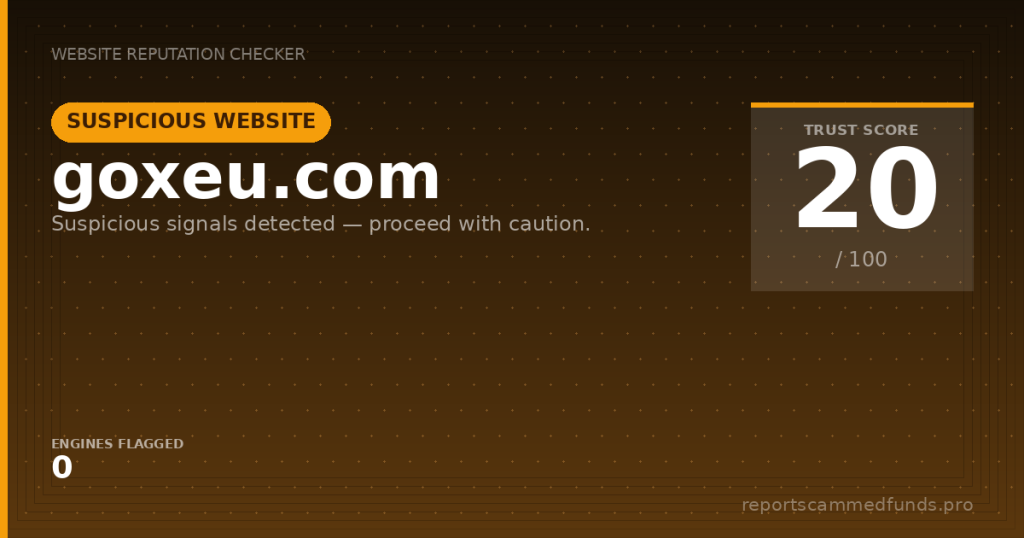
GoxEU (goxeu.com) presents too many unanswered questions for us to recommend engagement. It is a very new domain with anonymous operators, no verifiable licensing for either gambling or investment activities, and marketing cues that align with high-risk patterns such as celebrity-name promotions and registration-first funnels. At least one independent reputation engine has already flagged it as a cryptocurrency scam, and our own checks found no countervailing markers of trust like regulator listings, audit attestations, or a transparent corporate identity. In this risk-reward calculus, the odds are stacked against the consumer.
If the operators wish to overturn this assessment, the path is straightforward: publish the legal entity’s full name, registered office address, and jurisdiction; provide regulator-issued license numbers and links to those entries on the FCA, BaFin, CySEC, UKGC, MGA, or comparable registers; and commission independent audits for any RNGs or financial claims. They should also make fee schedules, withdrawal rules, and dispute processes accessible without registration. Until that happens, the burden of proof remains unmet.
For readers evaluating whether to proceed, our advice is to walk away and consider regulated alternatives with long, reviewable track records and clear consumer protections. If you have already interacted with goxeu.com, follow the help steps above and reach out to reportscammedfunds.pro for assistance in documenting and escalating your case. The most effective defense is to avoid sending funds or documents to opaque, unlicensed operators at the outset.
We will continue to monitor this domain and update our assessment if credible, verifiable information emerges. In the meantime, treat unsolicited pitches, aggressive bonus offers, and name-dropping campaigns with healthy skepticism. Your attention and money are valuable; do not hand them to a site that has not earned your trust.