
Trading platform & site functionality
DesignRush positions itself as a destination where brands discover top verified agencies across web design, development, branding, SEO, PPC, social media, product design, IT services, and adjacent professional categories. The home page emphasizes directory navigation by service type and geography, supported by editorial content that highlights campaigns, brand moves, and trend analyses. You can browse agency profiles, filter results by capability or location, and request proposals through a guided brief. This model is straightforward: the site is an introduction layer that aims to reduce noise for buyers, then hands off deeper diligence and contracting to the brand and the chosen agency. It is not a financial, trading, or investment platform.
From a technology standpoint, the site is fronted by Cloudflare and serves a modern stack that includes Google Tag Manager, Google Analytics, LinkedIn Insight Pixel, and Cloudflare Browser Insights. These integrations are typical for a commercial media property and support analytics, performance metrics, and advertising attribution, but they do increase third‑party data collection. The site supports HTTP/3 (QUIC) and HSTS, uses a valid certificate, and loads assets from multiple subdomains (for example media.designrush.com) to deliver images, fonts, and scripts at scale. We did not encounter broken navigation or obvious page integrity issues in our test journey. Response times were consistent with a mature CDN-backed build.
The directory experience itself is familiar if you have used other B2B marketplaces: profile pages summarize each firm’s services, industry focus, selected case studies, and contact details, while category pages show ranked lists with filters and badges. A sponsorship/advertising component appears available, as suggested by visible “sponsorship” links and calls to “submit” an agency, which implies that monetization likely includes paid placements, lead fees, or subscription tiers for participants. While that is standard in this industry, it makes independent evaluation of ranking methodology important for buyers. The site helps discovery; the onus remains on you to confirm the right fit.
Beyond the directory, DesignRush runs a newsroom and trends sections that aggregate marketing and design developments, brand features, and campaign roundups. Embedded videos and social embeds (YouTube, Instagram, LinkedIn) are widely used, and the site syndicates some content via RSS. The editorial layer is useful for staying informed, but as with any outlet that mixes paid and organic presence, readers should distinguish promotional material and sponsored content from neutral reporting. All of this makes the site useful as a first pass to map the market, not as a final arbiter of vendor capability.
License & regulatory status
Because DesignRush is a directory and media platform, not a broker or investment service, there is no direct financial regulation applicable to its operation. We found no claims that the site holds financial licenses nor evidence that it must be authorized by regulators such as the FCA, BaFin, ASIC, FINMA, ESMA, or the CFTC. That said, any agency discovered via the site that offers regulated services in your jurisdiction (for example, certain cybersecurity audits in sensitive sectors, or specialized compliance consulting) should be vetted for the correct licenses where those are required by law. The platform helps you find candidates; it is not a compliance gatekeeper.
The more salient governance question for a directory is editorial independence, disclosure of paid placements, and clarity about ranking criteria. The presence of sponsorship/advertising and agency submission pathways suggests the platform monetizes its listings and audience — a standard model in B2B media. Buyers should therefore look for labeling of “sponsored” or “featured” placements and understand how those placements affect ordering on list pages. Where ranking algorithms are proprietary, we recommend treating all lists as a starting point and cross‑checking an agency’s case work, references, and external reviews before engagement.
We did not identify regulator warnings about designrush.com from major financial or consumer‑investor watchdogs during this review window. That absence does not certify any specific agency listed on the site. Some agencies will be exceptional; others may be new or untested; and a few may be poor fits for your brief. This is inherent to marketplaces: a reputable host can still contain a wide quality spectrum of third‑party offerings that require case‑by‑case evaluation.
In short, there is nothing in this site’s model that triggers the sort of red flags we look for on high‑risk financial or trading portals (for example, false license claims, unrealistic returns, unverified asset trading, or offshore shell entities soliciting deposits). However, we always recommend reading the site’s terms, privacy policy, and any sponsorship disclosures, and then conducting independent verification on any agency you shortlist — including corporate registration checks, reference calls, and small paid test projects where feasible.
User feedback
We did not find pervasive or credible accusations that DesignRush itself withholds funds, manipulates transactions, or engages in the classic boiler‑room patterns we track on financial scams. Instead, the typical critical themes that surface around directory platforms in general are about perceived “pay‑to‑play” bias in rankings, mixed quality among listed providers, and variable responsiveness to buyer inquiries. Those are not signs of fraud; they are structural realities of any open or semi‑open marketplace where commercial sponsorship is present.
It is helpful to distinguish between complaints aimed at the host platform versus those aimed at individual agencies. When a buyer has a poor experience with a specific vendor discovered through a directory, frustration often reflects on the platform. In fairness, responsibility for delivery rests with the engaged agency and the terms you negotiate together. We recommend that buyers document scope in a detailed statement of work, include milestone sign‑offs, and stage payments to outcomes so that disputes are less likely to escalate.
Positive commentary we have seen about DesignRush centers on the breadth of categories, the speed of initial responses via the marketplace brief form, and the convenience of discovering multiple agencies in one place. Negative commentary, when it appears, usually concerns the opacity of ranking criteria and whether “featured” placements overshadow organic ordering. As long as you treat lists as a discovery tool, not a definitive quality ladder, you can benefit from the platform while minimizing selection bias.
Finally, feedback on editorial content tends to be favorable: readers cite trend summaries and campaign spotlights as useful context for stakeholder discussions. Even here, keep a healthy skepticism: industry news in any outlet can be subject to PR cycles and brand storytelling. The most valuable diligence will still be your own side‑by‑side comparisons, RFP scoring matrices, and reference calls with past clients of the agencies you shortlist.
Deposits & withdrawals
This site is not a wallet or brokerage and does not accept client investment deposits. Instead, its transactional elements sit around profile management for agencies, promotional packages, and lead facilitation. If you are a vendor paying for sponsorship, listings, or lead programs, review the billing terms closely: check renewal cycles, cancellation windows, and refund policies. For buyers submitting briefs, there is typically no charge to browse or request proposals through the marketplace form, but always confirm the current terms on the site.
Account control is relevant in a non‑financial way: know how to update, export, or delete your data, and learn how to unsubscribe from marketing emails. Directory sites integrate multiple marketing trackers to route conversions back to ad platforms; DesignRush uses Google Tag Manager, Google Analytics, and LinkedIn Insight, among others. You can manage consent where the site offers a cookie banner, and you can use browser controls or extensions to limit cross‑site tracking if that privacy posture better suits your organization’s policies.
If you do contract with an agency discovered here, handle payments directly with the vendor under a signed contract, not through unsolicited third parties. We advise using standard corporate payment rails with milestone‑based invoicing and escrow where appropriate for larger builds. Never wire funds to new beneficiaries without callback verification on independently sourced phone numbers — a routine step to avoid invoice‑redirect fraud. The platform’s role should be discovery and communication; all money movement should follow your company’s procurement policies.
Why unregulated brokers are risky
Because directory platforms are unregulated in the financial sense, you do not get investor protections, recourse to a financial ombudsman, or coverage by schemes such as FSCS in the United Kingdom. That does not make the site unsafe; it means the traditional consumer‑investor safeguards are simply not the right frame here. Your real protections are contractual — the terms you negotiate with an agency and the diligence you perform before funding work.
The most relevant risk pattern to watch for is the classic “advance‑fee” dynamic: a vendor you just met insists on a large upfront retainer before any defined deliverables exist. The correct mitigation is an incremental, milestone‑based statement of work, escrow or staged payments, and internal approval workflows. If a vendor refuses reasonable protections that are standard in your industry or jurisdiction, treat that as a selection signal and proceed to the next candidate.
Also be mindful of recovery or follow‑on scams that target company submitters after they post briefs online. If you receive cold outreach purporting to be from the platform or a regulator offering guaranteed project recovery, preferred listing in exchange for unusual fees, or urgent payment instructions via crypto, treat that as a red flag. Keep communications through the official site, verify sender domains, and escalate unusual requests to your infosec or procurement team.
How to get help if you’ve been scammed
If you have already paid an agency you found through any directory and believe you were misled, act quickly. First, gather your documentation: contracts, statements of work, invoices, emails, chat transcripts, and any deliverable artifacts that show scope and performance. Contact your bank or card issuer to request a chargeback or dispute where the payment method allows it, referencing nondelivery or misrepresentation per the card scheme’s rules. If a wire was sent, ask your bank’s fraud team to initiate a recall or a hold with the receiving institution — speed matters.
Report the incident to the appropriate authority in your jurisdiction. In the United States, file at IC3.gov for internet crime, and consider reporting to your state attorney general or the Federal Trade Commission. In the United Kingdom, report at Action Fraud; in the EU, check your national cybercrime portal or consumer protection body; in Australia, see ReportCyber and the ACCC’s Scamwatch. These reports help investigators see patterns across cases and can support your recovery attempts.
For guided assistance, you can contact the publisher’s team at reportscammedfunds.pro. We review documentation, help you triage next steps, and — where viable — assist with evidence packages for banks, payment processors, and law‑enforcement referrals. We do not promise guaranteed recovery, but early, well‑documented action measurably improves outcomes. Whether your issue stems from a single vendor dispute or a broader fraud, reach out so we can assess your options.
Conclusion
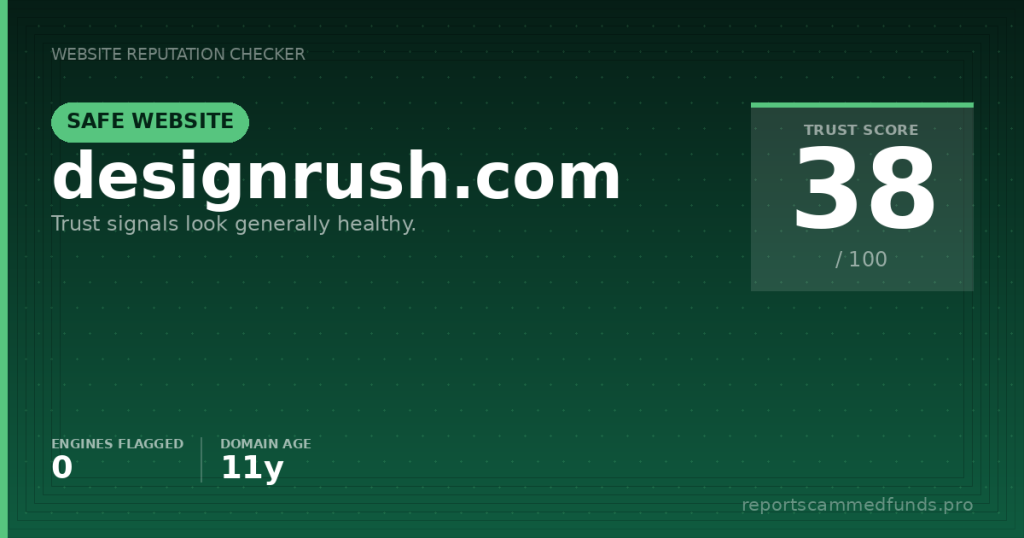
On balance, designrush.com appears to be a legitimate, established agency directory with a functioning editorial arm and the technical hallmarks of a professional commercial site. Our automated checks raised no malware or phishing alarms, the domain shows a long operating history, and the platform’s purpose — discovery, not custody of funds — limits direct exposure to many of the risks we track on financial scams. That said, the presence of sponsorship and tracking means you should treat rankings as input, not judgment, and protect your privacy according to your policy.
If you decide to use the marketplace, shortlist several agencies, hold structured discovery calls, demand concrete deliverables in a scoped statement of work, and test with small paid pilots before committing meaningful budgets. Verify each agency’s corporate registration, leadership, and references; confirm that their named team will actually work on your account; and insist on milestone‑based payments administered under your company’s standard procurement controls. These modest steps remove most of the downside that occasionally colors directory‑driven matches.
Our recommendation: you can use DesignRush as a research and RFP feeder with confidence, provided you still verify independently and manage contracting and payments through your own processes. If a vendor contact — whether found here or elsewhere — pressures you into unusual payment methods, large prepaid retainers without scope, or off‑platform communications that feel evasive, step back and reevaluate. Cautious diligence remains the best defense in any marketplace.