
Trading platform & site functionality
At first glance, cryputa.com offers almost no substance. The site’s page title and description fields are blank, and the only notable resource reliably loading is a Cloudflare Insights beacon script—useful for telemetry but not for users. We did not observe conventional navigation menus, disclosures, or legal pages that would typically appear on a legitimate service. This level of minimalism is not the spartan efficiency of a focused app; it reads like a staging ground or a single-purpose capture page.
The brand name strongly suggests a cryptocurrency angle, yet the site does not present a documented product, wallet, or exchange interface. That vacuum is important because crypto phishing often deploys barebones pages that mimic wallet connections, seed-phrase inputs, or too-good-to-be-true bonus screens. Without an ‘About’ section, company ownership details, or a clear service description, users are left with guesswork—precisely the environment that enables deceptive flows. Given the security flags and lack of context, the site’s probable purpose is to lure users into surrendering sensitive data or initiating irreversible transfers.
Technically, the page loads via Cloudflare and posts real user monitoring data (RUM), a common practice to gather performance metrics. In isolation that is benign; combined with the absence of credible content and the site’s young age, it adds to the impression of a rapidly deployed, telemetry-instrumented landing page. We did not find a working sitemap, footer links to policies, or any hallmark of a legitimate platform—no pricing, no FAQs, and no documented team. What remains is an opaque shell with measurably little for informed users to evaluate.
Quality signals are conspicuously missing. A genuine platform would normally specify core features, supported regions, contact channels, and legal terms. Cryputa.com does not. If any forms or prompts surface for visitors (for example, requesting wallet connections, seed phrases, or personal details), those would be profoundly unsafe given the total lack of accountability and regulatory context. In short, the site’s functionality profile mirrors a modern phishing implementation: tiny surface area, heavy content opacity, and enough infrastructure to capture data and disappear.
License & regulatory status
We searched for licensing claims and regulatory identifiers on cryputa.com and found none. There is no mention of authorizations, no company registration numbers, and no identifiers that would tie the website to a regulated financial service. For a site that appears to orbit cryptocurrency or potential financial interactions, that silence is significant. Legitimate operators trumpet their permissions because they confer trust and legal standing.
In major markets, crypto-facing businesses generally need to adhere to specific regimes. In the UK, an FCA cryptoasset registration is required for certain activities; in the US, money service businesses must register with FinCEN and often comply with state-by-state requirements; in the EU, national regulators like BaFin enforce licensure; in Australia, ASIC authorizes financial services and enforces conduct. We could not independently verify any listing for cryputa.com or an associated legal entity in these registers. The lack of published regulatory ties is a bright red flag for consumer risk.
We also looked for formal warnings and did not find any regulator naming cryputa.com specifically at the time of review—this is common for very new domains and does not equal safety. Threat intelligence sources and automated scans, however, do categorize the site as high risk and potentially phishing-related. False-affiliation claims—such as name-dropping regulators without verifiable registration IDs—are a known tactic, but we did not even see that here; the site simply withholds all compliance information.
The WHOIS trail runs to a mainstream registrar and Content Delivery Network, which says little about the operator itself. Using Cloudflare and a large registrar is not proof of legitimacy; bad actors routinely rely on these services for speed and shielding. Absent any corporate identity on the site, there is no way to match the domain to a responsible party or to pursue formal redress if money or data is lost. That vacuum of accountability is precisely why unlicensed, opaque sites are so dangerous.
User feedback
We looked for credible user feedback on neutral forums, Trustpilot-style platforms, Reddit, and major social channels. Given the site’s very short lifespan, there is little to nothing in the way of authentic reviews. That absence, on its own, would not convict a brand—new services do exist—but paired with security engine detections and no published identity, it moves the risk profile sharply into the danger zone. People tend to leave some trail of discussions or community presence; this domain leaves almost none.
We did encounter automated and curated threat reports that describe the domain as suspicious or potentially phishing-focused. These sources often get there before mainstream consumer complaints have time to accumulate. In parallel cases, patterns are consistent: withdrawal blockages after purported profits, surprise KYC demands only triggered when users try to cash out, or ‘unlocking fees’ that must be prepaid—classic advance-fee fraud. While we cannot attribute those specific acts to cryputa.com without direct evidence, the overlap in signals is too strong to ignore.
Another common pathway in this niche involves social engineering via Telegram, WhatsApp, or direct messages on X/Instagram. Victims are nudged to a landing page to ‘claim an airdrop,’ ‘verify a wallet,’ or ‘stake for extraordinary yields,’ then pushed into entering a seed phrase or connecting a wallet to a drainer. The minimalistic page structure we observed at cryputa.com would be fully compatible with that modus operandi. In other words, what is missing may be exactly what a phishing operator prefers.
Until transparent ownership and real, verifiable user experience evidence surfaces, consumers should assume the worst-case scenario. With regulated platforms, even negative reviews are plentiful—and traceable. Here, the combination of youth, opacity, and security flags creates a void that is dangerous rather than merely inconvenient. If you encounter any pitch linked to cryputa.com, step back; if you have already interacted, proceed as though your information may be compromised and act quickly.
Deposits & withdrawals
Cryputa.com does not disclose accepted payment methods or withdrawal procedures, which is itself a major warning sign. On genuine financial platforms, funding pages and fee schedules are among the most detailed sections of the site, including card, bank wire, and crypto address handling with clear timelines. Here, we see no such transparency. In similar cases, this silence precedes demands for deposits in crypto (irreversible) or pressure to use bank wires where reversals are difficult and contested.
A hallmark of fraudulent operations is the sudden appearance of conditions only after users attempt to withdraw. These can include fabricated ‘taxes,’ ‘liquidity fees,’ or ‘compliance holds’ that must be paid up front—advance-fee tactics designed to extract more money while never releasing funds. If a site requests payment to ‘unlock’ a balance, treat it as a red flag; tax authorities and legitimate brokers do not collect taxes through ad hoc transfers, and compliance is never a pay-to-play gate. The absence of a published withdrawal policy at cryputa.com raises the probability of such traps.
In the crypto context, we also see drainer workflows: the page convinces users to connect a wallet or paste a seed phrase, then scripts quietly authorize malicious transactions. No ‘withdrawal’ exists because the site never actually holds your funds; it simply drains what you already control. If any interface at cryputa.com invites you to input a seed phrase, private key, or sign unusual approvals, stop immediately. No legitimate service will ever ask for a seed phrase.
Finally, with no terms of service or dispute process in view, there is no stated avenue for reclamation. Regulated firms outline complaint procedures and channels for mediation; unregulated, anonymous websites offer nothing but a dead end. If a platform cannot tell you—clearly and in writing—how you get your money back and under what conditions, assume that you won’t.
Why unregulated brokers are risky
Using an unregulated website for any financial or crypto-related activity exposes you to total loss without recourse. There is no prudential oversight, no mandated segregation of client funds, and no independent complaints mechanism. If the operator vanishes or blocks you, you do not have a regulator to compel cooperation or an ombudsman to escalate your case. That is the reality of dealing with anonymous, offshore-style sites.
Investor protection schemes—like the UK’s FSCS, the US SIPC framework for brokerage custody, or EU equivalents—do not apply to shadow platforms. When losses occur, victims are often told to chase their bank or card issuer for a chargeback, but the evidence burden is steep and time-limited. With crypto transfers, the finality is even harsher: once sent, coins cannot be ‘recalled’ in the traditional sense. This underscores why licensing, audited custody, and named executives matter.
Unregulated operations also lack transparent conflict-of-interest controls. An opaque platform can manipulate pricing, fabricate account balances, or alter displayed outcomes without consequence. A brand-new domain like cryputa.com, with no public track record and no stated jurisdiction, has every structural incentive to exploit asymmetries of information. It is a textbook setup where the house writes the rules—and can change them mid-game.
Technically, the domain’s youth means infrastructure churn is likely. Phishing operations rotate domains quickly to stay ahead of blacklists and takedowns. Even if no overt harm is visible during a fleeting visit, the combination of short-lived domains and minimal content is a signature to heed. Trust requires time and transparency; cryputa.com offers neither.
How to get help if you’ve been scammed
If you already paid money or shared sensitive data through cryputa.com, act immediately. For card or bank payments, contact your issuing bank to initiate a dispute or chargeback and to place a fraud alert on your account. Provide screenshots, transaction IDs, emails, chat logs, and the domain URL as evidence. Time is critical; many card schemes impose strict deadlines for contesting transactions.
For crypto interactions, stop any further transactions, disconnect your wallet from suspicious sites, and revoke token allowances via reputable tools supported by your wallet ecosystem. If funds were sent to an exchange deposit address, notify that exchange’s compliance team with transaction hashes to request a freeze; while not guaranteed, speed improves your odds. Preserve all on-chain evidence (TXIDs) and consider filing a ‘no-further-transfers’ notice with services you control to prevent cascading losses.
Report the incident to the appropriate authorities in your jurisdiction. In the US, file at reportfraud.ftc.gov and ic3.gov; in the UK, use actionfraud.police.uk; in the EU, consult your national cybercrime portal; globally, econsumer.gov can be used for cross-border complaints. You can also alert the registrar and CDN listed in public records; the registrar’s abuse contact for this domain is trustandsafety@support.aws.com and can accept evidence-based abuse reports to support potential takedown actions.
For hands-on assistance with case triage, documentation, and reporting strategy, contact the specialist team at reportscammedfunds.pro. We handle evidence review, coach you on optimal chargeback narratives, liaise with exchanges or payment providers where appropriate, and help you avoid the next trap—‘recovery scams’ that demand upfront fees for fake refunds. Reach out via reportscammedfunds.pro to discuss your situation; early intervention materially improves the chance of a recovery or at least containment.
Conclusion
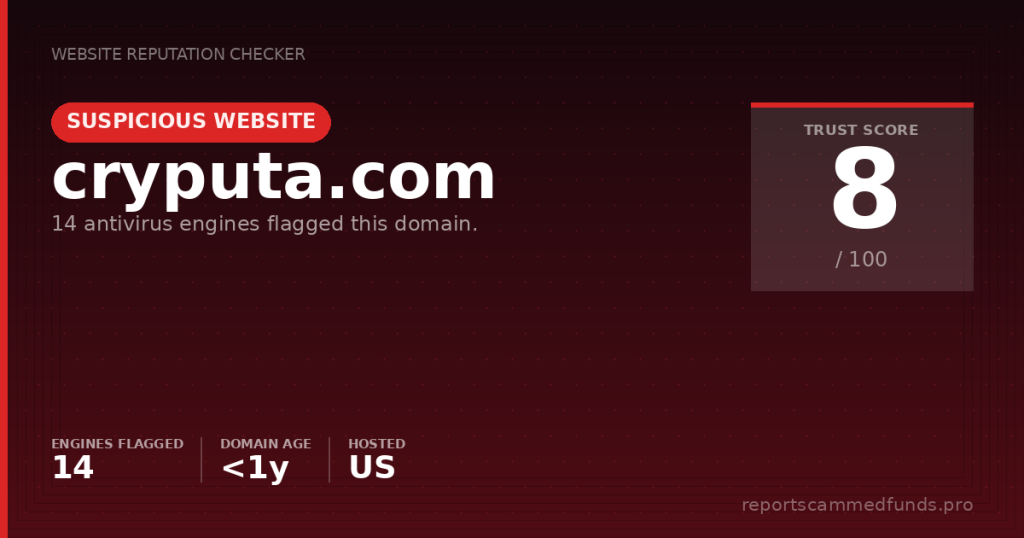
Cryputa.com bears the hallmarks of a phishing or scam operation: a brand-new domain, multiple security-engine detections, no regulatory footprint, and effectively no legitimate web presence. There is no reason to grant it the benefit of the doubt when safer, regulated alternatives exist for any genuine crypto or financial need. Our recommendation is categorical—do not visit the site, do not connect wallets, and do not transfer any funds.
If you were referred here by a cold message, an unsolicited ‘investment opportunity,’ or an ‘airdrop claim,’ assume the entire funnel is fraudulent. Sophisticated fraudsters now stage slick but content-thin pages precisely to convert a small percentage of visitors into high-value victims. Resist pressure, verify independently, and consult official registries before you move money anywhere.
Finally, document everything if you have already interacted with cryputa.com and begin the recovery steps immediately. Engage your bank or exchange without delay, file formal reports, and seek expert guidance at reportscammedfunds.pro. With speed and evidence, you maximize your odds of containing the damage and, where possible, clawing back losses.