
Trading platform & site functionality
At face value, claimcrypto.in presents as a multi-coin crypto faucet that “rewards” users with small amounts of cryptocurrency for minimal effort. The landing page advertises free instant payouts, Telegram-based bonuses, and a referral program, all of which are attempts to maximize sign-ups and virality. From a technical perspective, the site loads behind Cloudflare and deploys jQuery, Bootstrap, and Google Tag Manager/Analytics—commoditized front-end components that do not, by themselves, signal trustworthiness. There is a login/registration component and typical session/csrf cookies, but that technical plumbing reveals nothing about the operator’s integrity or whether any payouts are genuine.
The value proposition is intentionally frictionless: earn crypto with a few clicks, boost returns by inviting friends, and unlock extra bonuses via Telegram. This cocktail is standard for low-effort, high-churn funnels where the primary ‘asset’ is user acquisition, not real rewards. Importantly, the site provides no independently verifiable evidence of consistent, on-chain payouts nor any third-party audit trail of distribution addresses or smart contracts. In the absence of transparent proof-of-payout, the “instant” tagline functions as marketing copy—useful for conversion, not assurance.
Where a trustworthy rewards program would set clear eligibility criteria, provide verifiable payment histories, and name a responsible company, claimcrypto.in discloses none of those basics. There are no audited financial statements, no jurisdictional disclosures, no named founders, and no compliance or AML statements. The wording prioritizes “bonuses” and “referrals” over risk disclosures, and there is no explicit explanation of how the program sustains free payouts at scale. These omissions matter, because they are exactly what enable a page to disappear once a blacklist grows or once chargeback and abuse signals start to mount.
The referral mechanics and Telegram push also deserve scrutiny. Operators commonly drive users into Telegram where group moderation is one-sided and posts can be curated to maintain the illusion of active payouts. Fake screenshots and timed ‘success’ messages are easy to manufacture, and users rarely have the tools to test whether payment proofs correspond to unique recipients or recycled wallet screenshots. Referral ladders create an incentive spiral—people recruit others not because they’ve been paid but because they hope to be paid—which is how these funnels grow despite never proving real value to first participants.
License & regulatory status
A crypto faucet may argue it is not a financial services firm; however, in any product that solicits user registrations, promotes payouts, and nudges wallet interactions, regulatory posture still matters. Our checks found no claims of authorization or oversight by any major regulator (FCA in the UK, BaFin in Germany, ASIC in Australia, CONSOB in Italy, FINMA in Switzerland, or the CFTC/SEC/NFA in the US). We also found no company registration details, no jurisdictional terms that bind the operator to a venue, and no named directors or officers. In short: there is no corporate personhood to hold accountable should funds or data go missing.
We could not identify any licensing statements or filings in public registers that would tether claimcrypto.in to a legal entity. Searching regulator databases for the brand name yielded no relevant matches, and we did not find a plausible parent company or trade name disclosed in the site’s pages. Absence of registration does not instantly equal illegality, but it eliminates a vital line of recourse for users. If a payout is withheld, if KYC demands escalate after a deposit, or if personal data is misused, there is no regulator to appeal to and no recognized corporate defendant to sue.
We did not see explicit false claims of regulation on the page at the time of review; the bigger problem is the void where basic disclosures should be. Legitimate platforms voluntarily provide oversight information because it lowers user acquisition friction. Here, the operator chose opacity instead—an industry red flag. If the service touches user funds (directly or via induced ‘gas fees’ or ‘unlock payments’), or if it markets returns to residents of regulated jurisdictions, that activity may already sit in a gray legal zone. Without verifiable licensing, the risk lands on users alone.
User feedback
We searched for credible, third-party user feedback specific to claimcrypto.in and found little of substance—no transparent, independent payout logs, no public audits, and no trustworthy track record. That silence is telling, particularly for a site that claims “instant” payouts: genuine faucets typically accumulate organic mentions from recipients over time, including on-chain references. When independent chatter is sparse or looks copy-pasted from operator channels, the prudent assumption is that positive comments are seeded or astroturfed rather than organically earned.
Themes we routinely see across lookalike faucet and airdrop pages include: withdrawal blockages once a target balance is reached, surprise KYC requests immediately after a user attempts to cash out, and small “network fee” or “unlock” payments demanded to release funds. These tactics maximize extraction per user without ever processing a real payout. Another common complaint class in similar schemes is referral grooming—users are pushed to recruit others to meet an arbitrary threshold, only to discover the goalposts move again at cash-out time.
To be clear, we did not find a large corpus of site-specific complaints for claimcrypto.in. That does not exonerate it; it more likely reflects low adoption or short operational lifespan. Low-profile pages are frequently cycled: a domain is launched, promoted, flagged, and then replaced by a near clone at a new hostname. In this pattern, the absence of reviews is not a green light; it is another data point in a lifecycle designed to end before victims organize into visible complaint threads.
Deposits & withdrawals
Claimcrypto.in advertises “instant payouts,” Telegram-linked bonuses, and referral rewards, but it does not publish a transparent, verifiable withdrawal policy tied to on-chain proofs. Users should assume that any deposit request—whether framed as a “gas fee,” “verification,” “wallet activation,” or “unlock charge”—is a red flag. In crypto grifts, the final step before abandonment is often a small payment that seems reasonable relative to a promised windfall; after paying, users either face new conditions or are simply ignored. The site also does not disclose minimums, processing timelines, or a support escalation path, all of which are standard in legitimate payout environments. If you have already connected a wallet or provided personal data, act promptly: revoke token approvals where applicable, rotate passwords, enable 2FA on associated email accounts, and prepare documentation in case a bank or card network can action a dispute related to ancillary payments (for example, if a debit or card processor was used for any “verification” step).
Why unregulated brokers are risky
Unregulated, anonymous websites that solicit registrations and promise free money concentrate risk on the user. There is no investor compensation scheme, no statutory complaints handler, and no supervisory body to compel refunds or disclosures. If a faucet refuses to pay, keeps moving cash-out thresholds, or pressures you to pay a release fee, your recourse is limited to whatever consumer protection or chargeback avenues exist with your bank or card network (if those were involved)—and in pure wallet-to-wallet crypto transactions, even those safety nets are absent. Combine that legal void with red flags like phishing classifications, opaque ownership, and referral-heavy marketing, and the probability of loss or data abuse rises sharply.
How to get help if you’ve been scammed
If you have already interacted with claimcrypto.in or paid any “fee,” move quickly. Contact your bank or card issuer immediately to request a chargeback or dispute for any card-based payment tied to the site or its operators; emphasize misleading claims and failed delivery when outlining the basis. Report the incident to your national authority (e.g., Action Fraud in the UK, the FTC/IC3 in the US, your local police cybercrime unit, or your securities/consumer regulator). Preserve all evidence: URLs, screenshots, transaction hashes, emails/DMs, and any KYC prompts or invoices. For expert guidance with escalation, documentation, and cross-border reporting, you can open a case with our investigative team at reportscammedfunds.pro. We will help you evaluate chargeback viability, file the right disclosures with relevant authorities, and reduce exposure to follow-on “recovery scam” approaches that frequently target recent victims.
Conclusion
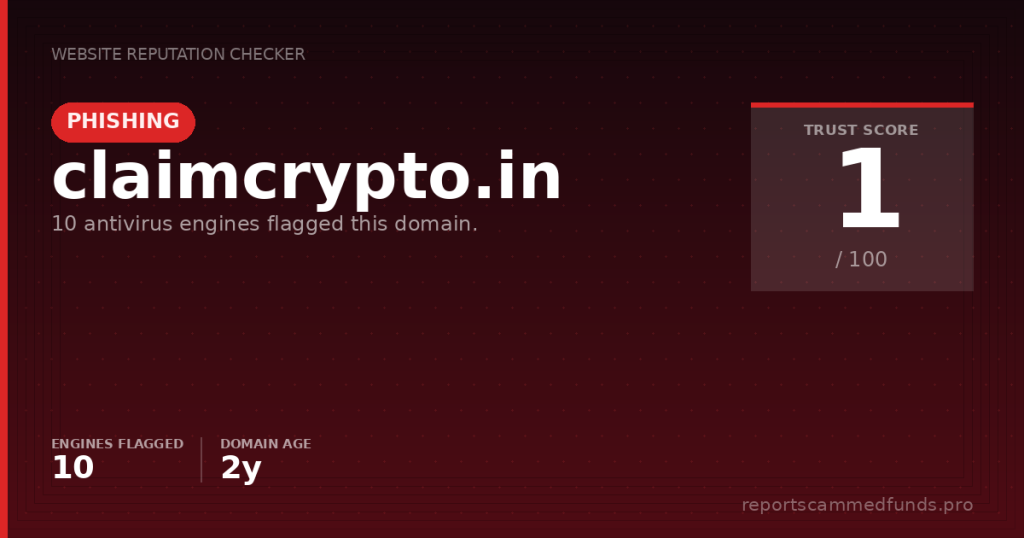
Everything that matters here points in the wrong direction: third-party scans flag the domain as phishing, ownership is opaque, the product relies on vague “free crypto” and “instant payout” claims, and no licensing or corporate identity is offered. Those are not minor omissions; they are the core ingredients of disposable crypto funnels. We recommend you do not register, do not connect a wallet, and do not send any funds or personal data to claimcrypto.in. If you are already entangled, follow the remediation steps above and seek help early—speed, documentation, and skepticism are your allies.