
Trading platform & site functionality
At its core, blockchain.com operates as a consumer gateway to crypto: a wallet for sending and receiving digital assets, an in‑house brokerage and swap function for buying or selling, an exchange venue for more active traders, and a well‑known block explorer. The landing pages detected in the scan point to a coherent, modern web stack that serves a global audience, complete with localized interfaces and mobile apps listed on the Apple App Store and Google Play. The wallet experience has historically blended self‑custody capability on some flows with custodial conveniences on others, allowing newcomers to get started while giving more advanced users the option to manage their own keys. That hybrid approach suits different risk appetites but also means terms and protections change depending on which sub‑product you use. In practice, consumers should read each feature’s specific disclosures in the legal section before assuming who holds keys and what recourse applies.
Beyond the wallet, blockchain.com promotes an exchange and “Earn” or staking‑style products in eligible jurisdictions. The exchange includes typical market and limit orders, pairs focused on major assets, and fiat on‑ramps offered through partners depending on location. The site layout segmented these flows clearly in our browsing, with distinct navigation for retail, institutional services, and a learning portal covering core topics like wallets and decentralized exchanges. The content is supported by a frequently updated blog and a podcast to maintain brand visibility. While the scan cannot validate order execution quality or liquidity, nothing on the public web front suggested abnormal slippage or fee anomalies beyond common crypto brokerage spreads.
The explorer at blockchain.com/explorer remains a draw for users who want to view recent blocks, market pricing, and transaction details. This tool appears to continue operating as an open data surface independent of the account‑based products, which is useful for verification and education. It is also a magnet for impersonators who copy its look and feel — a theme worth remembering when you see a familiar dark‑blue layout elsewhere. The legitimate explorer reflects data for major networks (BTC, ETH, SOL among others), and links out to asset information the brand curates on GitHub repositories. If you rely on the explorer for payment verification, always cross‑check the URL bar and bookmark the domain directly to avoid lookalikes.
From a technical perspective, the site uses Cloudflare’s edge network, TLS 1.3, HSTS, and a standard cookie consent system (Cookiebot) to manage analytics tags legally. We also observed third‑party marketing pixels (e.g., Distillery/dstillery, AppNexus/Adnxs) and Google Tag Manager for measurement and acquisition. That is expected for a large consumer brand but it does mean your usage metadata can be shared for analytics and advertising, as the cookie banner explains. The frontend is a modern app (Next.js‑style static chunks) with lazy‑loaded resources and localized assets, indicating ongoing engineering investment. Performance‑wise, we did not see obvious breakage or mixed‑content warnings in the scan results — a good sign for operational maturity.
License & regulatory status
Regulatory posture in crypto is inherently jurisdiction‑specific, and blockchain.com describes its compliance footprint across various regional entities on its legal pages. In broad strokes, the group indicates it operates through registered or licensed companies where required (for example, money‑service registration in parts of the United States and cryptoasset firm oversight in parts of Europe or the UK). We did not independently verify the real‑time status of each registration, and these listings can evolve as regulators refresh registers and firms update permissions. Responsible users should cross‑check any claim on the site by searching the relevant regulator’s public register — FCA in the UK, BaFin in Germany, FINMA in Switzerland, MAS in Singapore, or state/federal registries in the US like FinCEN’s MSB listings and the NMLS consumer portal.
Notably, while many parts of the blockchain.com ecosystem appear to have a long operating history, different product lines may have different regulatory treatments — a common pattern in crypto. A self‑custody wallet, for instance, typically falls outside traditional prudential regulation, whereas a brokerage that takes custody or enables fiat ramps may require registrations and specific AML/CTF controls. Staking or “Earn”‑style yields may be unavailable or restricted in certain countries due to local rules or enforcement trends. This is why the same site may present different availability notices and disclosures depending on your IP geolocation and KYC/KYB profile.
We found no credible regulator warnings specifically denouncing blockchain.com’s primary domain at the time of writing, and the automated security scan shows no malware flags. However, dozens of phishing clones that misuse the brand name have been reported across the years. The presence of a strong security baseline on the real domain does not protect users who click a spoofed URL sent by SMS or social DMs. Practically, treat any unexpected login prompt, airdrop invitation, or support DM as suspect unless you navigated to the URL from your own trusted bookmark and verified the SSL certificate and hostname.
User feedback
Public commentary about blockchain.com follows the pattern you see with most high‑traffic crypto services: the majority of routine users experience few issues, while a vocal minority report frustrations when something edge‑case arises. Among the common themes we’ve seen historically are KYC escalations triggered at withdrawal time, limits or cooldowns during compliance reviews, and confusion over which network fees are controlled by the blockchain versus which are the platform’s own charges. Some users also describe account lockouts following failed 2FA resets or long periods of inactivity, which then require support tickets and identity proofs to restore access. These are not unique to this brand, but they are worth anticipating so you retain backups of recovery information and enable app‑based MFA early.
There are scattered anecdotes about delayed crypto withdrawals or pending bank transfers, usually tied to regional rails, bank holidays, or additional checks. When such events happen during market volatility, emotions can run high and posts on Reddit, Trustpilot, or social channels may amplify the worst cases. Conversely, we also note long‑standing users who praise the wallet’s longevity, the explorer’s data utility, and the company’s public presence across blog and podcast formats that help them keep pace with the industry. As always, anecdotal reports should be weighed against your own needs and a careful read of the platform’s status page and legal documentation.
One persistent risk vector is not the company itself but impostor outreach — fake support agents in Telegram or X replies, fake airdrop emails, and fabricated upgrade pop‑ups that harvest seed phrases. Victims who thought they were speaking with “Blockchain.com Support” sometimes handed over recovery words and lost funds instantly. The legitimate team does not ask for your private keys, and legitimate channels are listed on the site’s contact/support pages. If any helper asks for your seed phrase, stop immediately — that is a textbook recovery scam.
Deposits & withdrawals
Funding methods on blockchain.com depend on location and the specific sub‑product. In many countries, card purchases and bank transfers are available via on‑ramp partners, while crypto deposits and withdrawals are generally supported across the networks listed in the app. Fees vary between the blockchain network’s miner or validator costs and the platform’s own spread or processing fees, which are disclosed at checkout. Withdrawal times are typically blockchain‑native (seconds to minutes) for crypto and banking‑rail dependent (same day to several days) for fiat.
Some complaints arise when users expect instant fiat withdrawals or do not recognize that an additional KYC or source‑of‑funds check can pause a transfer. This is by design in regulated environments: platforms are obligated to review certain triggers, and they also have peak‑load constraints during high volatility. If your transfer is taking longer than expected, first confirm you used the correct network (e.g., TRC20 vs ERC‑20 for USDT), then verify the transaction hash on the explorer, and finally reference the platform’s status page before filing a support ticket. Clear screenshots and the exact address or TXID speed up resolutions.
As a best practice, do not commit large amounts until you have successfully completed a small end‑to‑end withdrawal on your chosen rail and you understand any daily/monthly limits that apply to your account tier. For self‑custody flows, test your backup and recovery steps with trivial amounts so you confirm the exact steps ahead of a stress moment. For custodial holdings, review whether features like Earn or staking lock assets and what unbonding or settlement time applies. Planning these details up front sharply reduces unpleasant surprises later.
Why unregulated brokers are risky
Even for reputable brands, crypto products carry non‑trivial risks that differ from a bank account or a regulated securities broker. Price volatility can be extreme; network congestion can inflate fees unexpectedly; and if you send a transaction to the wrong address or chain, it may be irrecoverable. When you use self‑custody, the responsibility to protect private keys is yours — a mistaken seed‑phrase disclosure or a lost recovery sheet can result in permanent loss without recourse.
Custodial features reduce some operational burden but replace it with counterparty risk and compliance trade‑offs. Assets parked in yield or staking products may be subject to protocol‑level slashing, smart‑contract bugs, or legal restrictions that change with new guidance from regulators like the SEC, ESMA, or ASIC. If a regional regulator later constrains a product, you may face forced redemptions or capped access depending on your country. Read the product‑specific risk statements closely and never assume past availability guarantees future access.
A final caution concerns clones and brand hijacking: attackers register lookalike domains, mint fake mobile apps, and spin up social accounts that copy logos to solicit deposits or seed phrases. These are a leading cause of losses reported to Action Fraud in the UK, the FBI’s IC3 in the US, and financial ombudsmen globally. Bookmark the real domain (blockchain.com), confirm certificates, and verify app publishers directly from the official website links. Treat unsolicited inbound messages as suspect until proven otherwise.
How to get help if you’ve been scammed
If you believe you have lost money due to a mistaken transfer, a suspected phishing site, or an impostor posing as support, act quickly. For card or bank payments to a fraudster, immediately contact your issuing bank to initiate a chargeback or recall if available, and ask that your account be monitored for further unauthorized transactions. File a report with your national cybercrime line (for example, IC3.gov in the United States or Action Fraud in the United Kingdom) and preserve all evidence, including transaction hashes, emails, chat logs, and screenshots.
When the issue involves a legitimate platform account review (e.g., compliance hold), use the official support portal linked from the company’s website and resist the urge to engage with unsolicited DMs. Provide precise details — timestamps, TXIDs, addresses, and bank reference numbers — to speed up case handling. If you sent a crypto transaction to the wrong network or address, prepare the exact TXID so support can confirm what, if anything, is technically possible. Do not share your recovery phrase; legitimate staff will not request it.
For individualized recovery and reporting assistance, our team at reportscammedfunds.pro can help you structure your case and liaise with counterparties where appropriate. Contact us after you’ve alerted your bank and filed an official report; we can help compile a chronology, map on‑chain flows, and advise on realistic next steps. We also maintain alerts about current clone domains and recovery‑scam patterns so you can avoid compounding the loss.
Conclusion
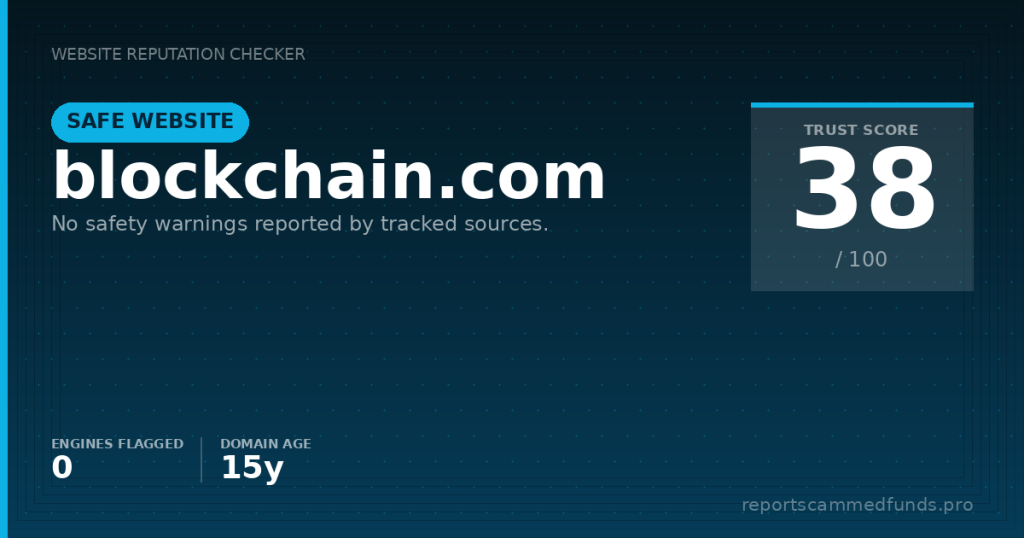
On balance, blockchain.com presents as a mature, technically competent, and widely recognized crypto platform whose primary domain and web stack show no signs of malware or obvious deception. Its long operating history, mainstream brand presence, and transparent legal pages are positive indicators. That said, crypto remains a high‑risk domain, and the nuances of self‑custody versus custodial features, plus jurisdiction‑specific compliance, require you to read the fine print.
We recommend that prospective users verify key facts directly: confirm the exact entity serving your country, check live regulator registers, and test small deposits and withdrawals on your intended rails before scaling up. Bookmark the correct URL, install the official app from links on the site, and treat any inbound support message as suspicious until validated through the official support portal. Keep MFA enabled, back up recovery materials securely, and never share your seed phrase with anyone.
Our bottom line: the site itself is legitimate, but your safety depends on disciplined operational habits and awareness of common scam patterns that target this and all major crypto brands. If something feels off — a too‑good‑to‑be‑true airdrop, an urgent DM asking for keys, a redirect to a misspelled domain — stop and re‑verify. When in doubt, seek a second opinion before you click send.