
Trading platform & site functionality
Hashly.site presents a single‑purpose proposition: deposit USDT (Tether) into what it calls a “cloud mining” program and watch balances grow. The front end is a lightweight web page that loads Tailwind CSS and AlpineJS from public CDNs, and Laravel Livewire scripts are present, indicating a PHP/Laravel stack beneath. The console emits a production warning about using cdn.tailwindcss.com, which suggests a minimal or hurried deployment approach rather than a hardened production build process. None of this is inherently malicious, but it does not instill confidence that the operator has invested in the controls or transparency expected of legitimate financial services.
Beyond the skin, the site signals a Telegram group for community contact, which can be useful for marketing yet offers little recourse compared to traceable ticketing, staffed email, or phone support. We observed a USDT logo asset and a CoinPayments image referenced, but there is no transparent, auditable payment flow presented on the landing page or documentation explaining custody, addresses, or withdrawal governance. Visitors encounter no public legal agreements, no risk disclosures, and no company registration or jurisdiction statements that could be independently confirmed. If an investment operation cannot point to its legal identity and regulatory status up front, the bar for trust remains unmet.
The site’s core promise—“Tether cloud mining”—is a functional misrepresentation. Unlike Bitcoin or other proof‑of‑work coins, USDT is issued by Tether Limited and does not require or support mining by network participants. Many fraudulent sites repurpose the cloud‑mining narrative to collect crypto deposits and display fictitious dashboards with auto‑accruing balances. While we cannot see behind the login wall here, the public‑facing proposition is conceptually flawed and aligns with known scam patterns, not with how stablecoins actually function.
License & regulatory status
A legitimate investment or crypto‑yield platform that targets a mass audience typically discloses its legal entity, jurisdiction of incorporation, and any licences or registrations that apply. We found none of these on hashly.site. There are no references to oversight by the FCA (UK), BaFin (Germany), ASIC (Australia), CONSOB (Italy), FINMA (Switzerland), or any American federal or state regulator (such as the CFTC, SEC, or New York’s DFS). The absence of corporate identities or regulatory references makes due diligence impossible and materially raises user risk.
Regulators across markets have repeatedly warned about unregistered crypto schemes promising high returns or ‘mining’ profits from assets that do not support mining at all. For example, FCA ScamSmart alerts often call out get‑rich‑quick crypto opportunities and the use of untraceable messaging channels as contact points. While we did not find a specific published warning naming this domain at the time of writing, the overall characteristics match the types of offerings that frequently earn regulatory action after victims report losses.
Hashly.site also does not publish risk disclosures, audited statements, or proof‑of‑reserves. No named directors, no corporate addresses, and no independent service providers are presented for vetting. Claims of CoinPayments involvement are not substantiated by merchant IDs, payment logs, or audited workflows. In the absence of independently verified information, any licence claim would be impossible to confirm; as things stand, we see no claim to a licence at all—only an unregulated solicitation of crypto deposits.
User feedback
At the time of our review, we did not find substantive, independent third‑party reviews from reputable consumer‑protection forums or recognized media evaluating hashly.site. This lack of credible footprint is typical for new or short‑lived operations and should not be misconstrued as a sign of quality. Bad actors often cycle through fresh domains to stay ahead of reputation checks and platform takedowns, which means early searches may turn up little until losses accumulate.
Patterns from analogous schemes are instructive. Users are commonly lured with daily percentage “mining” yields and social proofs in Telegram groups. Once deposits are made, profit counters in the dashboard rise automatically, but when users attempt to withdraw, they meet stalled payouts, “KYC” demands introduced after the fact, or surprise “tax” and “unlock fee” requests—classic advance‑fee tactics designed to extract more crypto. Because transactions in stablecoins like USDT are irreversible by design, these losses are difficult to recover once sent.
We caution that the signals here are consistent with the complaint themes we regularly document: withdrawal blockages after showing profits, sudden policy changes only after deposit, and support routes that lead back to unaccountable chats. If you encounter any of these friction points on hashly.site—especially requests to pay additional fees to release your own funds—treat them as serious red flags and stop sending money.
Deposits & withdrawals
The public page hints at USDT deposits and shows a CoinPayments image, but offers no transparent, verifiable workflows, addresses, or terms for deposits and withdrawals. Genuine services publish help centers explaining chains supported (e.g., TRON/TRC‑20 vs. Ethereum/ERC‑20), minimums, network fees, and exact timelines for settlement and cash‑out. Nothing of that caliber is shown here. Without documented procedures, users cannot assess delays, fee schedules, or reversal policies—if any exist.
In this segment of the market, we typically see one‑way flows into the platform, with no card or bank rails for reversible chargebacks. That design suits the operator, not the customer: when payouts stall, the absence of regulated payment processors leaves the depositor with no formal dispute channel. If CoinPayments or another processor is actually used behind the scenes, the site should disclose the merchant account details and terms, including who the legal counterparty is and what jurisdiction governs the agreement.
Before sending any funds, test claims with verifiable steps: ask for written terms, try a small withdrawal first, and confirm the company’s legal identity. If a site resists these basic protections, take it as your answer. Remember that crypto transfers settle final and are not aligned with the consumer remedies available on card networks; once funds leave your wallet to a third party, especially an unregulated one, your leverage to compel a refund is minimal.
Why unregulated brokers are risky
Unregulated platforms offering investment‑like returns expose depositors to a fundamental asymmetry: the operator holds your funds (or claims to) without being subject to prudential rules, client‑money segregation, periodic audits, or statutory complaints redress. If an operation ceases to respond or changes rules abruptly, users have virtually no enforceable rights and no recognized ombudsman to compel performance. The result is an environment where small design choices—like Telegram‑only contact—have outsized consequences when money goes missing.
Stablecoins add a layer of psychological comfort because they avoid volatile price swings, but that stability has no bearing on counterparty risk. Sending USDT to the wrong entity is precisely as final as sending bitcoin: there is no card issuer to call, no scheme rules to invoke, no reversal button to press. When an operator is anonymous or poorly documented, and when the proposition itself (like ‘mining’ USDT) is technically nonsensical, the counterparty risk overwhelms whatever superficial stability is implied by the asset.
Cloudflare and other CDNs are standard for performance and security, yet they also make it easy for opaque operators to stand up polished fronts quickly while hiding hosting origins and identities. Combined with fresh certificates and WHOIS gaps, this opacity leaves consumers with no practical route to verify ownership or trace accountability. In short: if you cannot verify who you are paying, on what licensed basis, and how withdrawals will be honored, you should not be paying them.
How to get help if you’ve been scammed
If you have already sent money to hashly.site and are facing withdrawal delays or fee demands, act quickly. First, collect all evidence: transaction hashes, on‑site messages, emails or Telegram chats, and screenshots of dashboard balances and error prompts. If any part of your deposit moved through a bank transfer or card payment (even indirectly), contact your bank or card issuer immediately to request a chargeback or recall and explain that you suspect fraud.
Report the incident to your national authority. In the UK, file with Action Fraud; in the EU, contact your local police and, where applicable, your national financial regulator; in the US, submit a report to the FBI’s IC3 and the FTC. These reports create a formal record and can support downstream investigations, takedown efforts, and, occasionally, fund tracing. If the site is targeting your jurisdiction without authorization, regulators such as the FCA, BaFin, ASIC, or CONSOB may seek to warn or block access.
For specialized assistance with case assessment, documentation, and next‑step strategy, you can reach our team at reportscammedfunds.pro. We prioritize consumer safety and can advise on evidence preservation, tracing options, and realistic recovery pathways. While crypto transactions are technically irreversible, early, well‑structured responses can improve your position—especially if any fiat legs or identifiable intermediaries can be engaged.
Conclusion
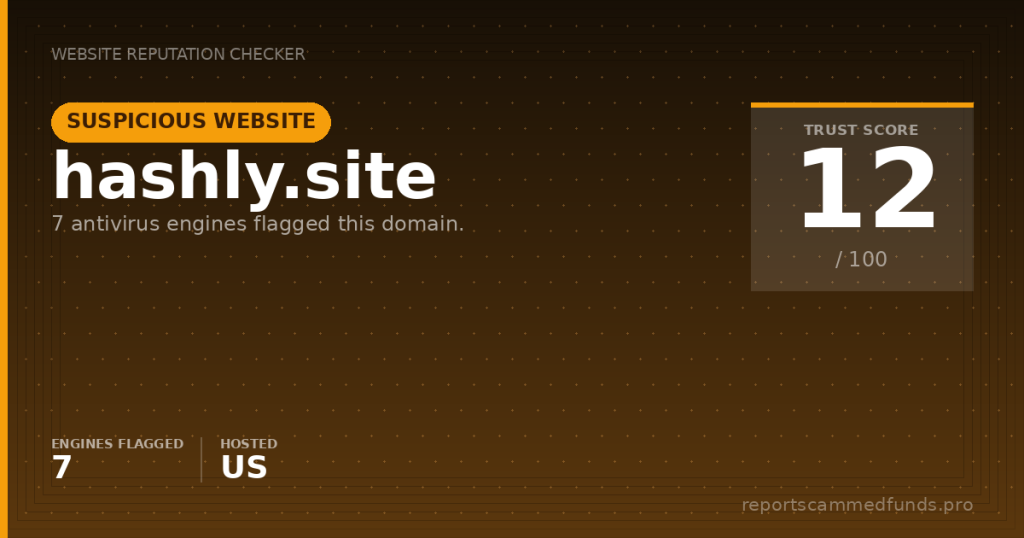
Hashly.site combines a technically impossible product pitch—‘mining’ a centrally issued stablecoin—with opaque ownership, no licensing, and several structural red flags. An automated scan found seven engines flagging the domain, the TLS certificate appears very recent, and corporate disclosures are absent. None of this meets a reasonable threshold for trust where real money is concerned.
If you are still considering engagement, pause and demand proofs the operator should be able to provide: a verifiable legal entity, registration or licence details in a reputable jurisdiction, detailed deposit and withdrawal terms, and successful small‑amount payout tests. Treat any pushback, fee‑release requests, or urgency pressure as warning sirens, not as inconveniences to be explained away. Genuine businesses respect due diligence because it protects both parties.
Our recommendation is to avoid sending funds to this site. There are no countervailing positives strong enough to offset the core inconsistencies and missing disclosures. Protect your capital, and if you have already interacted with the platform, follow the help steps above and contact reportscammedfunds.pro for assistance.